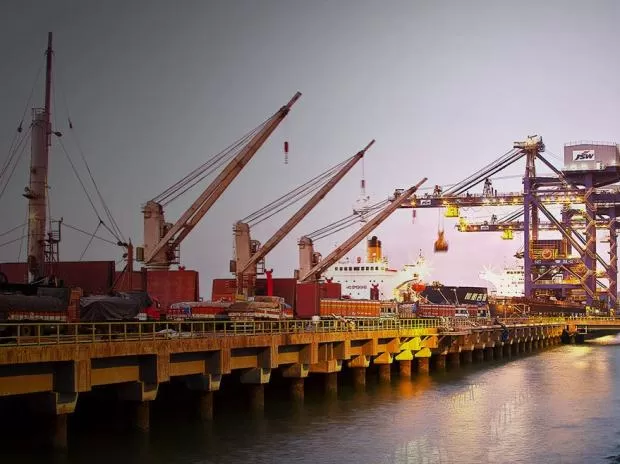
JSW Infra to invest Rs 70 billion to enhance cargo handling capacity
ECONOMY & POLICY

JSW Infra to invest Rs 70 billion to enhance cargo handling capacity

The company owned by Sajjan Jindal had emerged as the winning bidder for the development of a greenfield port at Keni in Karnataka last year. Following this, a concession agreement was signed with the Karnataka Maritime Board, as mentioned by Maheshwari. He stated that for the Keni port, the concession agreement was entered into in November last year, and construction will commence once the remaining approvals are obtained. The anticipated timeframe for completion is four years.

The estimated capital expenditure for the port is Rs 41.19 billion, and it is projected to have an initial cargo handling capacity of 30 million tonnes per annum (MTPA).

Additionally, Maheshwari mentioned the company's involvement in Jatadhar in Odisha, another greenfield port. He noted that JSW Steel plans to establish a steel plant there, with all necessary approvals already in place. The concession agreement is expected to be signed within the current month or the next four weeks. JSW Infra will then initiate the construction of the port, with a targeted capacity of 30 million tonnes in phase 1. This project is estimated to require a capital expenditure of about Rs 30 billion and is anticipated to be completed in 3-4 years.

Furthermore, JSW recently acquired a majority shareholding in PNP Maritime Services (PNP Port), an operating port in Raigad, Maharashtra, for Rs 2.7 billion. The port currently has a capacity of 5 MTPA, with the potential to expand to 19 MTPA.

Maheshwari expressed the company's goal to increase the capacity of the acquired port by 14-15% annually from the base, aiming to reach a total of at least 10 million in the next 3-4 years.

The company owned by Sajjan Jindal had emerged as the winning bidder for the development of a greenfield port at Keni in Karnataka last year. Following this, a concession agreement was signed with the Karnataka Maritime Board, as mentioned by Maheshwari. He stated that for the Keni port, the concession agreement was entered into in November last year, and construction will commence once the remaining approvals are obtained. The anticipated timeframe for completion is four years. The estimated capital expenditure for the port is Rs 41.19 billion, and it is projected to have an initial cargo handling capacity of 30 million tonnes per annum (MTPA). Additionally, Maheshwari mentioned the company's involvement in Jatadhar in Odisha, another greenfield port. He noted that JSW Steel plans to establish a steel plant there, with all necessary approvals already in place. The concession agreement is expected to be signed within the current month or the next four weeks. JSW Infra will then initiate the construction of the port, with a targeted capacity of 30 million tonnes in phase 1. This project is estimated to require a capital expenditure of about Rs 30 billion and is anticipated to be completed in 3-4 years. Furthermore, JSW recently acquired a majority shareholding in PNP Maritime Services (PNP Port), an operating port in Raigad, Maharashtra, for Rs 2.7 billion. The port currently has a capacity of 5 MTPA, with the potential to expand to 19 MTPA. Maheshwari expressed the company's goal to increase the capacity of the acquired port by 14-15% annually from the base, aiming to reach a total of at least 10 million in the next 3-4 years.

Next Story
Real Estate

AI: The New Recruit

From getting ideas to evaluating designs, presenting concepts to clients and tracking projects, artificial intelligence (AI) is helping architects work better and faster.“AI allows architects to spend more time doing what only they can do: think critically, synthesise complexity and design with intent,” says Dikshu C Kukreja, Managing Principal, CP Kukreja Architects. “Every minute reclaimed from repetitive processes can be invested in creativity, contextual understanding, interdisciplinary collaboration and innovation – the qualities that define meaningful architecture.”To read the ..

Next Story
Real Estate

Redevelopment 2.0

In 2017, Mumbai identified 160,000 ageing buildings due for structural audit. Close to half of these were in the Western Suburbs. Redeveloping the oldest and structurally weakest of these would help unlock new housing, much needed given the city’s growing population density and constant developed area of 437.7 sq km. At 30,600 people per sq km in 2024, Mumbai’s density was almost thrice that of Gurugram, and 60 per cent higher than Bengaluru’s.Essentially, Mumbai’s realty market has demand. It has capital. It has realty development potential.Fast forward to 2026. Mumbai has 1,094 regis..

Next Story
Technology

Cost intelligence will become a strategic contributor to project success

As India's construction industry accelerates its digital transformation, integrated platforms, AI and connected data are becoming essential to improving cost certainty, project efficiency and sustainability. Ravi Kumar, Sales Director – India, RIB Software India, shares how digital workflows are reshaping project planning, commercial management and decision-making across the construction value chain.India's construction sector is embracing digital technologies at an unprecedented pace. From your perspective, what are the biggest shifts driving this transformation and how is RIB Software enab..

Advertisement

Subscribe to Our Newsletter

Get daily newsletters around different themes from Construction world.

STAY CONNECTED

Advertisement

Advertisement

Advertisement