



+
NHAI Tightens AI-MC Construction Norms
ECONOMY & POLICY

NHAI Tightens AI-MC Construction Norms

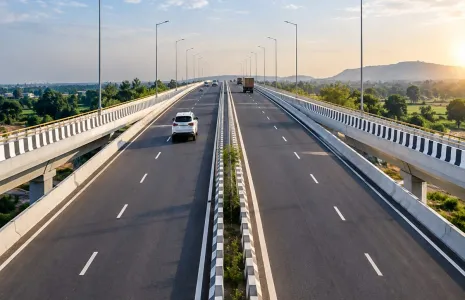
The National Highways Authority of India has tightened the framework for Automated and Intelligent Machine-Aided Construction (AI-MC) through Policy Circular No. 11.109/2026 dated 28 August 2026. Mandatory AI-MC is limited to highway projects with a continuous length over 20 km and Engineering, Procurement and Construction (EPC) or civil construction cost above Rs 5 billion (bn). Standalone bridges, road over bridges, tunnels, short bypasses below 10 km and overlay projects without base earthwork reconstruction are exempt and adoption below thresholds remains optional.

For embankment, subgrade and granular sub base construction the circular requires full AI-MC deployment across all grades. For water bound macadam and subsequent bituminous layers motor graders are barred and layers must be laid using UTS-guided three-dimensional (3D) smart pavers. Contractors must prepare a comprehensive 3D digital model covering the lowest embankment through every intermediate layer and lift, with selective deployment treated as non-compliant and liable to trigger change or reduction in scope under relevant EPC or Hybrid Annuity Model (HAM) provisions.

A digital payment gate will require contractors to provide secure cloud access to the Independent Engineer, Project Director and Regional Officer so daily telemetry can be cross-verified with Requests for Inspection. Manual override, signal loss or omission of telemetry during machine operation will be flagged as a critical non-conformity and unmapped stretches will not qualify for interim or milestone payments. The circular mandates a 200 m trial stretch before full earthwork, daily calibration of GNSS and UTS systems and immediate suspension where field verification shows deviations beyond permissible staking tolerances.

Contractors must provide independent survey hardware to NHAI engineers for spot checks and hand over raw data, 3D constructible models, detailed calculations, Design Basis Reports and native highway-design files within seven days of request without additional cost. A fully audited Digital As-Built Model of Record, including utilities and asset locations, must be submitted at completion. The amendments apply immediately to projects meeting the prescribed thresholds and will affect contractor payments, equipment deployment and ownership of digital project data, requiring adjustments in planning, procurement and contract management.

The National Highways Authority of India has tightened the framework for Automated and Intelligent Machine-Aided Construction (AI-MC) through Policy Circular No. 11.109/2026 dated 28 August 2026. Mandatory AI-MC is limited to highway projects with a continuous length over 20 km and Engineering, Procurement and Construction (EPC) or civil construction cost above Rs 5 billion (bn). Standalone bridges, road over bridges, tunnels, short bypasses below 10 km and overlay projects without base earthwork reconstruction are exempt and adoption below thresholds remains optional. For embankment, subgrade and granular sub base construction the circular requires full AI-MC deployment across all grades. For water bound macadam and subsequent bituminous layers motor graders are barred and layers must be laid using UTS-guided three-dimensional (3D) smart pavers. Contractors must prepare a comprehensive 3D digital model covering the lowest embankment through every intermediate layer and lift, with selective deployment treated as non-compliant and liable to trigger change or reduction in scope under relevant EPC or Hybrid Annuity Model (HAM) provisions. A digital payment gate will require contractors to provide secure cloud access to the Independent Engineer, Project Director and Regional Officer so daily telemetry can be cross-verified with Requests for Inspection. Manual override, signal loss or omission of telemetry during machine operation will be flagged as a critical non-conformity and unmapped stretches will not qualify for interim or milestone payments. The circular mandates a 200 m trial stretch before full earthwork, daily calibration of GNSS and UTS systems and immediate suspension where field verification shows deviations beyond permissible staking tolerances. Contractors must provide independent survey hardware to NHAI engineers for spot checks and hand over raw data, 3D constructible models, detailed calculations, Design Basis Reports and native highway-design files within seven days of request without additional cost. A fully audited Digital As-Built Model of Record, including utilities and asset locations, must be submitted at completion. The amendments apply immediately to projects meeting the prescribed thresholds and will affect contractor payments, equipment deployment and ownership of digital project data, requiring adjustments in planning, procurement and contract management.

Related Stories

Gold Stories

Next Story
Infrastructure Urban

TransIndia Launches World View Collection at Meridian

TransIndia Group has recently launched ‘The World View Collection’ at TransIndia Meridian, its residential development in Mumbai’s Sion-Matunga Corridor. The campaign introduces residences located on the 22nd floor and above, offering expansive views of the cityscape, Eastern Bay and the sea.The collection positions elevation as an integral part of the living experience, with the higher-floor homes designed around openness, changing skylines and wider city views. Rather than focusing only on floor height, the campaign highlights how elevated residences can offer a different perspective o..

Next Story
Real Estate

Villaro Design Studio Opens on MG Road in Delhi

Furniture designer Yuvraj Vohra has recently launched the new Villaro Design Studio on MG Road, Delhi, introducing a furniture brand built around an architectural approach to design, materiality and craftsmanship.Trained as an architect, Vohra approaches furniture as an integral part of the spatial experience rather than as standalone objects. Villaro's design philosophy focuses on proportion, material expression and the relationship between furniture and its surrounding architecture.The collection explores combinations of stone, marble, wood, metal and upholstery, with materials treated as st..

Next Story
Infrastructure Urban

India-Belgium Trade Shows Signs of Recovery in FY2026

India-Belgium economic relations are gaining renewed momentum following Belgian Prime Minister Bart De Wever’s three-day official visit to India from September 2–4, 2026. The visit, the first by a Belgian Prime Minister to India in two decades, focused on strengthening cooperation across trade, investment, defence, technology, connectivity and logistics.Belgium is an important European investment and trading partner for India, with cumulative foreign direct investment inflows of around $4.25 billion between April 2000 and March 2026. The country is a major European manufacturing, trade and..

Advertisement

Subscribe to Our Newsletter

Get daily newsletters around different themes from Construction world.

STAY CONNECTED

Advertisement

SPECIAL OFFER
QR Code