+
Panel Says Future Nuclear Fleet Will Need 5,400 Tonnes Uranium Annually
ECONOMY & POLICY

Panel Says Future Nuclear Fleet Will Need 5,400 Tonnes Uranium Annually

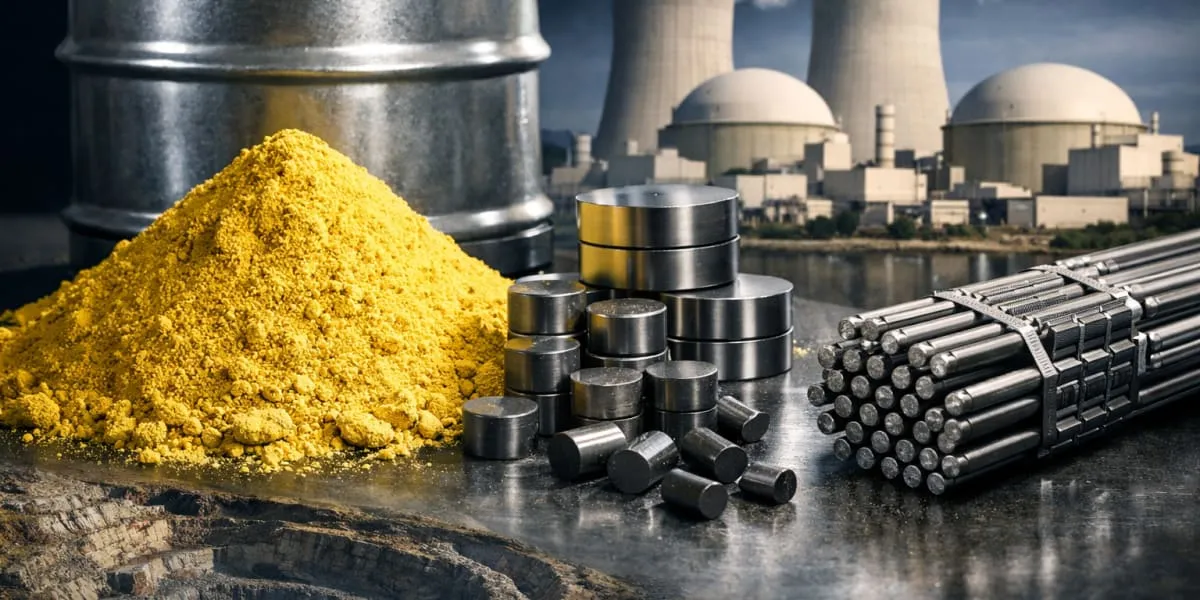
A Parliamentary Committee on Public Undertakings has found that planned expansion of India's nuclear fleet will raise uranium requirements, with pressurised heavy water reactors expected to need about 5,400 tonnes (t) of uranium oxide annually. The committee noted domestic production currently satisfies about 30 per cent of that baseline and urged faster expansion of mining and production to secure fuel supply. The Nuclear Fuel Complex assembles fuel for these reactors using uranium concentrate supplied by the Uranium Corporation of India Limited or through imports under government oversight.

Imports currently come from Kazakhstan, Russia, Uzbekistan and Canada, and a long-term supply contract with Uzbekistan runs until 2026. The committee said a proposed joint venture between the Uranium Corporation of India Limited and NTPC to acquire overseas uranium stakes could help stabilise fuel costs but asked the Department of Atomic Energy for clearer timelines and a detailed plan. It also sought a framework to involve mine developer-cum-operators in domestic production.

The committee emphasised the need to establish strategic uranium stockpiles calibrated to refuelling cycles and outage risks to protect reactor operations against supply disruptions. The Atomic Minerals Directorate for Exploration and Research has established around 0.431 million (mn) tonnes (t) of uranium oxide, and the report noted that of 80,423 tonnes transferred to the Uranium Corporation of India Limited about 39.22 per cent has already been depleted. The document observed that at current production rates the remaining reserves could last around 40 years if no new resources are added.

In response the Department of Atomic Energy said the Uranium Corporation of India Limited plans to double production by expanding existing mine capacity and developing projects in Jharkhand, Rajasthan and Chhattisgarh. Nuclear Power Corporation of India Limited operates 25 reactors with an installed capacity of 8,780 megawatt (MW) and has 17 reactors totalling 13,100 MW under execution; the government aims for 100 gigawatt (GW) by 2047 with NPCIL expected to provide nearly half of that capacity. The committee urged that securing domestic and overseas supplies be aligned with capacity targets.

A Parliamentary Committee on Public Undertakings has found that planned expansion of India's nuclear fleet will raise uranium requirements, with pressurised heavy water reactors expected to need about 5,400 tonnes (t) of uranium oxide annually. The committee noted domestic production currently satisfies about 30 per cent of that baseline and urged faster expansion of mining and production to secure fuel supply. The Nuclear Fuel Complex assembles fuel for these reactors using uranium concentrate supplied by the Uranium Corporation of India Limited or through imports under government oversight. Imports currently come from Kazakhstan, Russia, Uzbekistan and Canada, and a long-term supply contract with Uzbekistan runs until 2026. The committee said a proposed joint venture between the Uranium Corporation of India Limited and NTPC to acquire overseas uranium stakes could help stabilise fuel costs but asked the Department of Atomic Energy for clearer timelines and a detailed plan. It also sought a framework to involve mine developer-cum-operators in domestic production. The committee emphasised the need to establish strategic uranium stockpiles calibrated to refuelling cycles and outage risks to protect reactor operations against supply disruptions. The Atomic Minerals Directorate for Exploration and Research has established around 0.431 million (mn) tonnes (t) of uranium oxide, and the report noted that of 80,423 tonnes transferred to the Uranium Corporation of India Limited about 39.22 per cent has already been depleted. The document observed that at current production rates the remaining reserves could last around 40 years if no new resources are added. In response the Department of Atomic Energy said the Uranium Corporation of India Limited plans to double production by expanding existing mine capacity and developing projects in Jharkhand, Rajasthan and Chhattisgarh. Nuclear Power Corporation of India Limited operates 25 reactors with an installed capacity of 8,780 megawatt (MW) and has 17 reactors totalling 13,100 MW under execution; the government aims for 100 gigawatt (GW) by 2047 with NPCIL expected to provide nearly half of that capacity. The committee urged that securing domestic and overseas supplies be aligned with capacity targets.

Related Stories

Gold Stories

Next Story
Infrastructure Transport

MMRDA Targets Completion of Projects by December 2028

The Mumbai Metropolitan Region Development Authority (MMRDA) is targeting the completion of all its ongoing infrastructure projects by December 2028, a year ahead of its December 2029 deadline, Metropolitan Commissioner Dr Sanjay Mukherjee has said.Speaking at the sixth edition of the Real Estate & Infrastructure Investors' Summit (REIIS) 2026 in Mumbai, Mukherjee said the authority was developing an integrated network of roads, tunnels, sea links and Metro corridors under its broader vision of “Mumbai in 59 Minutes”.The objective is to improve east-west and north-south connectivity an..

Next Story
Building Material

High-Performance Façades Gain Ground in Indian Buildings

High-performance façades are gaining greater importance in Indian architecture as developers and architects increasingly focus on energy efficiency, thermal comfort and building performance, according to Shankar Fenestrations & Glasses.The company said modern façade systems are increasingly being considered as part of a building's overall performance strategy rather than being used primarily as aesthetic elements.High-performance glass, curtain wall systems and structural glazing can contribute to thermal regulation, solar control, daylight management and indoor comfort. Their growing ad..

Next Story
Technology

SPML Infra's 104.4 kWh BESS Battery Pack Clears Global Tests

SPML Infra has announced that its proprietary 104.4 kWh Battery Energy Storage System (BESS) battery pack has completed key international safety, performance and transportation testing and certification requirements, marking a step towards its commercial deployment.Developed under the company's own intellectual property, the battery pack has completed requirements under UL9540A, IEC 62619, IEC 63056, IEC 60730, IEC 61000-6-2, IEC 61000-6-4 and UN38.3 standards.The testing covers areas including thermal runaway safety, battery performance, system functional safety, electromagnetic compatibility..

Advertisement

Subscribe to Our Newsletter

Get daily newsletters around different themes from Construction world.

STAY CONNECTED

Advertisement

SPECIAL OFFER
QR Code