+
Regional Workshop Enhances District SDG Outcomes in Guwahati
ECONOMY & POLICY

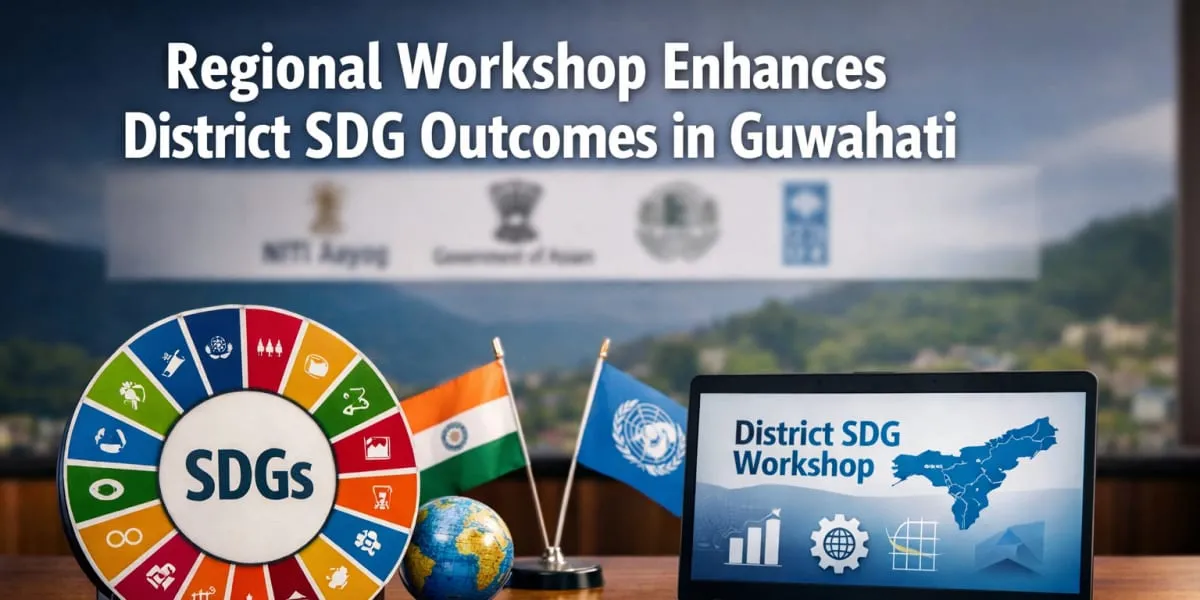
Regional Workshop Enhances District SDG Outcomes in Guwahati

The North-Eastern Region workshop on enhancing Sustainable Development Goals (SDGs) outcomes at the district level was organised by NITI Aayog under the State Support Mission (SSM) in collaboration with the Government of Assam and with technical support from the United Nations Development Programme (UNDP) India. The event was held in Guwahati on 12 February 2026 and brought together more than 120 participants from the eight North Eastern states, including planning secretaries, district collectors, senior state officials and representatives of the North Eastern Council (NEC) and UN agencies. The programme provided a platform to deliberate on district-led planning, convergence, financing and implementation of the SDGs with emphasis on translating evidence into actionable outcomes.

Participants underlined that success on the SDG agenda depends on effective district-level implementation where policies translate into tangible outcomes for citizens. The North-Eastern Region District SDG Index was presented as a critical decision-support tool for districts to identify strengths, diagnose development gaps and prioritise interventions to strengthen inter-sectoral convergence. Deliberations emphasised early SDG localisation by states to embed the goals within planning and governance processes and to shift from measurement to mission-mode implementation.

A presentation by the programme director of SDG work at NITI Aayog showcased district-level progress and gaps using the District SDG Index while an additional presentation introduced the Panchayat Advancement Index (PAI) as a complementary tool to reinforce granular local-level monitoring and last-mile delivery. The technical programme included sessions on translating evidence into action, sectoral deep dives based on district evidence, and a step-by-step guide for SDG budget tagging to align planning and budgeting with SDG priorities at the sub-national level. District administrations shared field-level experiences and discussed how granular evidence can inform targeted sectoral interventions.

The workshop sought to strengthen capacities for district-led planning and to foster systematic use of evidence in prioritisation and resource allocation. Organisers indicated that such initiatives are aimed at enabling districts to pursue integrated, outcome-oriented strategies that respond to local development needs. Follow-up engagement by central and state agencies was encouraged to sustain momentum and operationalise the recommendations.

The North-Eastern Region workshop on enhancing Sustainable Development Goals (SDGs) outcomes at the district level was organised by NITI Aayog under the State Support Mission (SSM) in collaboration with the Government of Assam and with technical support from the United Nations Development Programme (UNDP) India. The event was held in Guwahati on 12 February 2026 and brought together more than 120 participants from the eight North Eastern states, including planning secretaries, district collectors, senior state officials and representatives of the North Eastern Council (NEC) and UN agencies. The programme provided a platform to deliberate on district-led planning, convergence, financing and implementation of the SDGs with emphasis on translating evidence into actionable outcomes. Participants underlined that success on the SDG agenda depends on effective district-level implementation where policies translate into tangible outcomes for citizens. The North-Eastern Region District SDG Index was presented as a critical decision-support tool for districts to identify strengths, diagnose development gaps and prioritise interventions to strengthen inter-sectoral convergence. Deliberations emphasised early SDG localisation by states to embed the goals within planning and governance processes and to shift from measurement to mission-mode implementation. A presentation by the programme director of SDG work at NITI Aayog showcased district-level progress and gaps using the District SDG Index while an additional presentation introduced the Panchayat Advancement Index (PAI) as a complementary tool to reinforce granular local-level monitoring and last-mile delivery. The technical programme included sessions on translating evidence into action, sectoral deep dives based on district evidence, and a step-by-step guide for SDG budget tagging to align planning and budgeting with SDG priorities at the sub-national level. District administrations shared field-level experiences and discussed how granular evidence can inform targeted sectoral interventions. The workshop sought to strengthen capacities for district-led planning and to foster systematic use of evidence in prioritisation and resource allocation. Organisers indicated that such initiatives are aimed at enabling districts to pursue integrated, outcome-oriented strategies that respond to local development needs. Follow-up engagement by central and state agencies was encouraged to sustain momentum and operationalise the recommendations.

Next Story
Infrastructure Energy

Larsen & Toubro To Divest Nabha Power To Torrent Power

Larsen & Toubro Limited, hereafter L&T, has agreed to divest its entire stake in Nabha Power Limited to Torrent Power Limited, with the companies announcing the transaction. The deal will transfer ownership of the thermal power project and associated assets to Torrent Power as part of L&T's portfolio rationalisation. L&T is a US dollar 30 bn Indian multinational engaged in engineering, procurement and construction projects, hi-tech manufacturing and services across multiple geographies. The company attributes its market position to a strong customer-focused approach and sustained quality over ..

Next Story
Infrastructure Transport

Centre Approves Road Projects Worth Over Rs110 bn

The central government has approved road projects worth over Rs110 bn across Maharashtra, Gujarat and Telangana, according to the Ministry of Road Transport and Highways. The approvals follow a cabinet committee decision and are intended to improve connectivity and reduce travel times on key corridors. The package covers multiple stretches of national highways and involves both construction and widening works. In Gujarat, the ministry approved construction of four-lane sections on the Dhamasiya-Bitada/Movi and Nasarpore-Malotha stretches at a combined capital cost of about Rs45.84 bn. The prin..

Next Story
Infrastructure Urban

Prime Minister Inaugurates India AI Impact Expo 2026

Prime Minister Narendra Modi inaugurated the India AI Impact Expo 2026 at Bharat Mandapam in New Delhi, opening a national platform for Artificial Intelligence (AI) demonstration and dialogue. The event brought together innovators, researchers and technology enthusiasts from across the country and abroad to showcase applications and research. The inauguration underscored the government’s intent to position India as a significant contributor to global AI development. The prime minister noted in a post on X that being among innovators, researchers and tech enthusiasts offered a clear view of t..

Advertisement

Subscribe to Our Newsletter

Get daily newsletters around different themes from Construction world.

STAY CONNECTED

Advertisement

Advertisement

Advertisement

Open In App