SCLR Extension Nears Completion Linking BKC With Signal-Free Route
ECONOMY & POLICY

SCLR Extension Nears Completion Linking BKC With Signal-Free Route

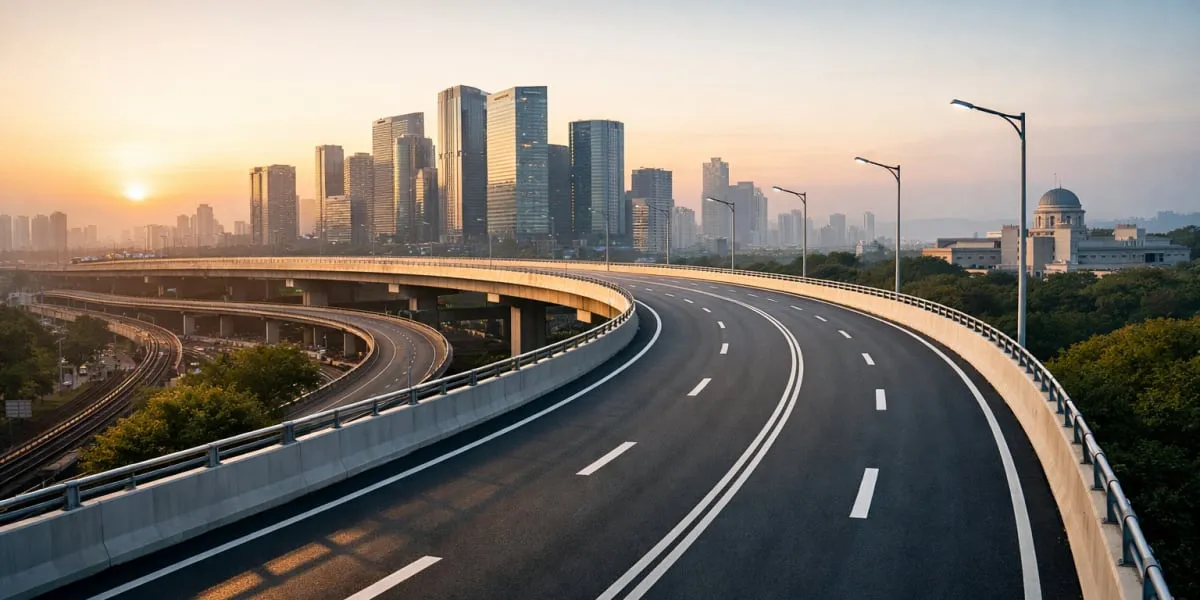
The Santacruz-Chembur Link Road (SCLR) extension towards Bandra-Kurla Complex (BKC) via the Mumbai University campus has entered its final stage, bringing motorists closer to a direct, signal-free connection between the Western Express Highway and the city’s commercial district. The elevated connector is being built as an arm from the SCLR alignment and will link the western suburbs with BKC without surface signals.

The link is designed to reduce journey times for commuters travelling from the western suburbs to BKC and to improve access to eastern Mumbai. By carrying through traffic above surface roads, it will relieve pressure on several arterial routes. Road users and commercial vehicles will gain more predictable travel times during peak hours.

The project has progressed through successive construction phases and is now in the final stage, with finishing works on the elevated deck and connecting ramps under way. Engineers are completing structural elements and integrating interchange points to ensure smooth transitions between the SCLR alignment and the Western Express Highway. The design incorporates measures to minimise disruption to the university campus and adjacent residential areas during remaining work.

Once open, the arm will support a mix of private vehicles, commercial traffic and public transport services, enhancing last mile connectivity to BKC. Traffic management plans will be implemented to regulate entry and exit points and to coordinate with existing junctions. The route will become an important corridor for east-west movement across the city.

Authorities will carry out testing and safety audits before opening the link to general traffic, followed by phased commissioning of ramps and interchanges. Work on landscaping and pedestrian arrangements near the campus is being finished to restore public areas. Coordination with local transport services is being planned to integrate bus routes and feeder services.

The nearing completion of the SCLR extension marks a significant step in the city’s efforts to improve urban mobility and to provide commuters with faster east-west links. Motorists are now a step closer to a continuous, signal-free route to BKC, which will help sustain commercial movement across Mumbai.

The Santacruz-Chembur Link Road (SCLR) extension towards Bandra-Kurla Complex (BKC) via the Mumbai University campus has entered its final stage, bringing motorists closer to a direct, signal-free connection between the Western Express Highway and the city’s commercial district. The elevated connector is being built as an arm from the SCLR alignment and will link the western suburbs with BKC without surface signals. The link is designed to reduce journey times for commuters travelling from the western suburbs to BKC and to improve access to eastern Mumbai. By carrying through traffic above surface roads, it will relieve pressure on several arterial routes. Road users and commercial vehicles will gain more predictable travel times during peak hours. The project has progressed through successive construction phases and is now in the final stage, with finishing works on the elevated deck and connecting ramps under way. Engineers are completing structural elements and integrating interchange points to ensure smooth transitions between the SCLR alignment and the Western Express Highway. The design incorporates measures to minimise disruption to the university campus and adjacent residential areas during remaining work. Once open, the arm will support a mix of private vehicles, commercial traffic and public transport services, enhancing last mile connectivity to BKC. Traffic management plans will be implemented to regulate entry and exit points and to coordinate with existing junctions. The route will become an important corridor for east-west movement across the city. Authorities will carry out testing and safety audits before opening the link to general traffic, followed by phased commissioning of ramps and interchanges. Work on landscaping and pedestrian arrangements near the campus is being finished to restore public areas. Coordination with local transport services is being planned to integrate bus routes and feeder services. The nearing completion of the SCLR extension marks a significant step in the city’s efforts to improve urban mobility and to provide commuters with faster east-west links. Motorists are now a step closer to a continuous, signal-free route to BKC, which will help sustain commercial movement across Mumbai.

Next Story
Infrastructure Transport

Raiganj MP Seeks Bengal Only Highway Link To Siliguri

Raiganj Member of Parliament Kartik Chandra Paul met Union Minister for Road Transport and Highways Nitin Gadkari in New Delhi to press for a new stretch of national highway in North Dinajpur district. He urged approval for a Bengal-to-Bengal link that would connect National Highways 12 and 27 to allow vehicles bound for Siliguri to avoid the current route through Kishanganj in neighbouring Bihar. He also submitted a proposed alignment of the new road to the ministry for consideration. At present vehicles from Raiganj travel along NH-12 and join NH-27 at Purnia More in Dalkhola, a route that p..

Next Story
Infrastructure Transport

Airport Kilambakkam Metro Line To Be Extended To Chengalpattu

Chennai Metro Rail (CMRL) has invited tenders for two detailed project reports that would extend its rail network to Chengalpattu in the south and extend Corridor-5 to Wimco Nagar in the north as part of a second wave of expansion beyond the operator's corridors under construction. The move signals an acceleration of planning for suburban links and interchange nodes. The larger of the two studies covers a roughly 27km extension from the planned Kilambakkam metro station to Chengalpattu under Corridor-1, Phase I. CMRL floated the tender at an estimated cost of Rs 21.6 mn. The proposed line woul..

Next Story
Infrastructure Urban

Seven New Bullet Train Corridors Planned After Mumbai-Ahmedabad

The central government is planning seven new high-speed rail corridors following the Mumbai-Ahmedabad project with the Delhi-Varanasi line among priority routes. The Delhi-Varanasi corridor is planned to link the national capital with Uttar Pradesh cities including Sarai Kale Khan, Noida International Airport, Mathura, Agra, Kanpur, Lucknow, Ayodhya, Prayagraj and Varanasi and is expected to cut the journey to around three and a half hours. The proposal has reached the detailed project report (DPR) stage and will require approvals, funding decisions and land acquisition. Officials have propose..

Advertisement

Subscribe to Our Newsletter

Get daily newsletters around different themes from Construction world.

STAY CONNECTED

Advertisement

Advertisement

Advertisement