Table Space Adds 0.5 Million (mn) Sq Ft In Hyderabad GCC Market
ECONOMY & POLICY

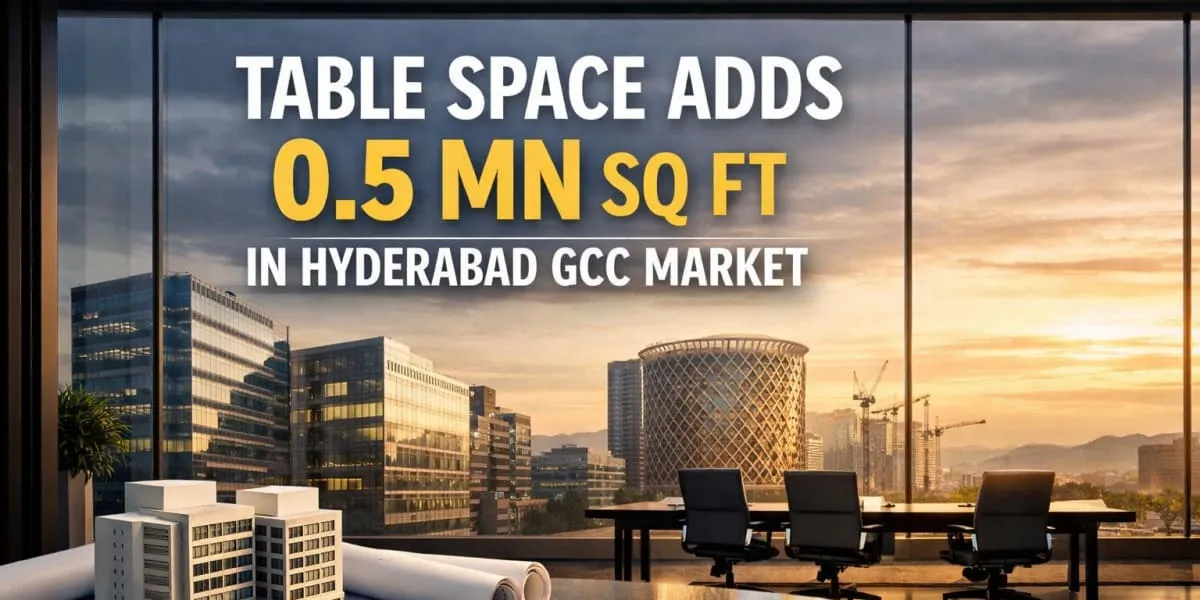
Table Space Adds 0.5 Million (mn) Sq Ft In Hyderabad GCC Market

Table Space has added 0.5 million (mn) sq ft of office space to the Hyderabad GCC market, the company announced. The addition increases the developer's presence in a market that has drawn sustained corporate interest and contributes to the available stock of modern office accommodation. The space is positioned to serve a range of occupiers seeking contemporary floor plates and flexible leasing arrangements.

Hyderabad has expanded as an employment and commercial hub over the past decade, attracting technology, financial and business services firms. Demand for high quality workspace has underpinned new development and investment in core clusters within the city. The GCC market has benefited from strategic location and infrastructure investment that support occupier requirements.

The newly added space will broaden options for tenants and enable more tailored workspace solutions across multiple sectors. Facilities are being marketed to institutional and corporate occupiers looking for scalable footprints and modern specifications. The increase in supply complements ongoing demand for efficient, technologically enabled office environments.

Market observers note that enhanced provision of modern office inventory supports corporate expansion and can influence leasing dynamics in Hyderabad. The developer expects the enlarged portfolio to strengthen its competitive positioning and to foster further leasing activity in the GCC market. Stakeholders will monitor absorption and rental trends as the new space integrates with existing stock.

Industry participants highlight that an expanded grade A inventory can attract ancillary services and stimulate local supply chains, supporting broader economic activity in surrounding neighbourhoods. Landlords and investors can use the additional capacity to assemble larger contiguous lettable areas that suit multi?national occupiers seeking consolidated operations. The development aligns with broader urban trends that favour well connected, amenity rich office precincts and with corporate strategies that prioritise operational efficiency and employee experience.

Table Space has added 0.5 million (mn) sq ft of office space to the Hyderabad GCC market, the company announced. The addition increases the developer's presence in a market that has drawn sustained corporate interest and contributes to the available stock of modern office accommodation. The space is positioned to serve a range of occupiers seeking contemporary floor plates and flexible leasing arrangements. Hyderabad has expanded as an employment and commercial hub over the past decade, attracting technology, financial and business services firms. Demand for high quality workspace has underpinned new development and investment in core clusters within the city. The GCC market has benefited from strategic location and infrastructure investment that support occupier requirements. The newly added space will broaden options for tenants and enable more tailored workspace solutions across multiple sectors. Facilities are being marketed to institutional and corporate occupiers looking for scalable footprints and modern specifications. The increase in supply complements ongoing demand for efficient, technologically enabled office environments. Market observers note that enhanced provision of modern office inventory supports corporate expansion and can influence leasing dynamics in Hyderabad. The developer expects the enlarged portfolio to strengthen its competitive positioning and to foster further leasing activity in the GCC market. Stakeholders will monitor absorption and rental trends as the new space integrates with existing stock. Industry participants highlight that an expanded grade A inventory can attract ancillary services and stimulate local supply chains, supporting broader economic activity in surrounding neighbourhoods. Landlords and investors can use the additional capacity to assemble larger contiguous lettable areas that suit multi?national occupiers seeking consolidated operations. The development aligns with broader urban trends that favour well connected, amenity rich office precincts and with corporate strategies that prioritise operational efficiency and employee experience.

Next Story
Infrastructure Urban

Centre Clears Power Distribution Upgrade for Uttar Pradesh

The Central Government has approved power distribution projects worth Rs 407.39 billion for Uttar Pradesh under the Revamped Distribution Sector Scheme (RDSS). The investment will be used to modernise the state's electricity distribution infrastructure and strengthen network capacity across urban and rural areas. The package targets one of the country's largest distribution networks as the state experiences rapid urbanisation and rising electricity consumption. Planned interventions include the strengthening of distribution lines, modernisation of substations, replacement of ageing electrical ..

Next Story
Infrastructure Energy

India Data Centres To Consume 191 TWh By 2040 Driving Renewables

A Wood Mackenzie report says India's operational data centre capacity is projected to increase more than fivefold to 12 gigawatt (GW) by 2030 from 2.2 GW in 2025 as artificial intelligence (AI) and cloud computing drive demand. It projects electricity consumption to rise from 10 terawatt-hour (TWh) in 2025 to 191 TWh by 2040. The study forecasts a compound annual growth rate of around 40 per cent and notes AI-dedicated capacity will surge nearly 24-fold from 275 megawatt (MW) in 2025 to 6,546 MW by 2030. The report places India's digital economy at Rs 32 trillion (tn) in 2025 and says it contr..

Next Story
Infrastructure Transport

Hydrogen Train Completes 1,200 Kilometres Of Trials

India's first hydrogen train was flagged off between Jind and Sonipat on July 17 and has travelled over 1,200 kilometres in trials, saving diesel consumption of more than 3,200 litres, a Railway Ministry press release said. The deployment marks the introduction of a zero-emission fuel cell train into route testing and represents a milestone in domestic rail innovation. The train generates electricity onboard through a chemical reaction between hydrogen and oxygen, producing electricity to propel the vehicle while emitting only water vapour as a by-product. There is no smoke and no tailpipe car..

Advertisement

Subscribe to Our Newsletter

Get daily newsletters around different themes from Construction world.

STAY CONNECTED

Advertisement

Advertisement

Advertisement