


+
Flying Wedge Launches Autonomous Defence R&D Hub
Company News

Flying Wedge Launches Autonomous Defence R&D Hub

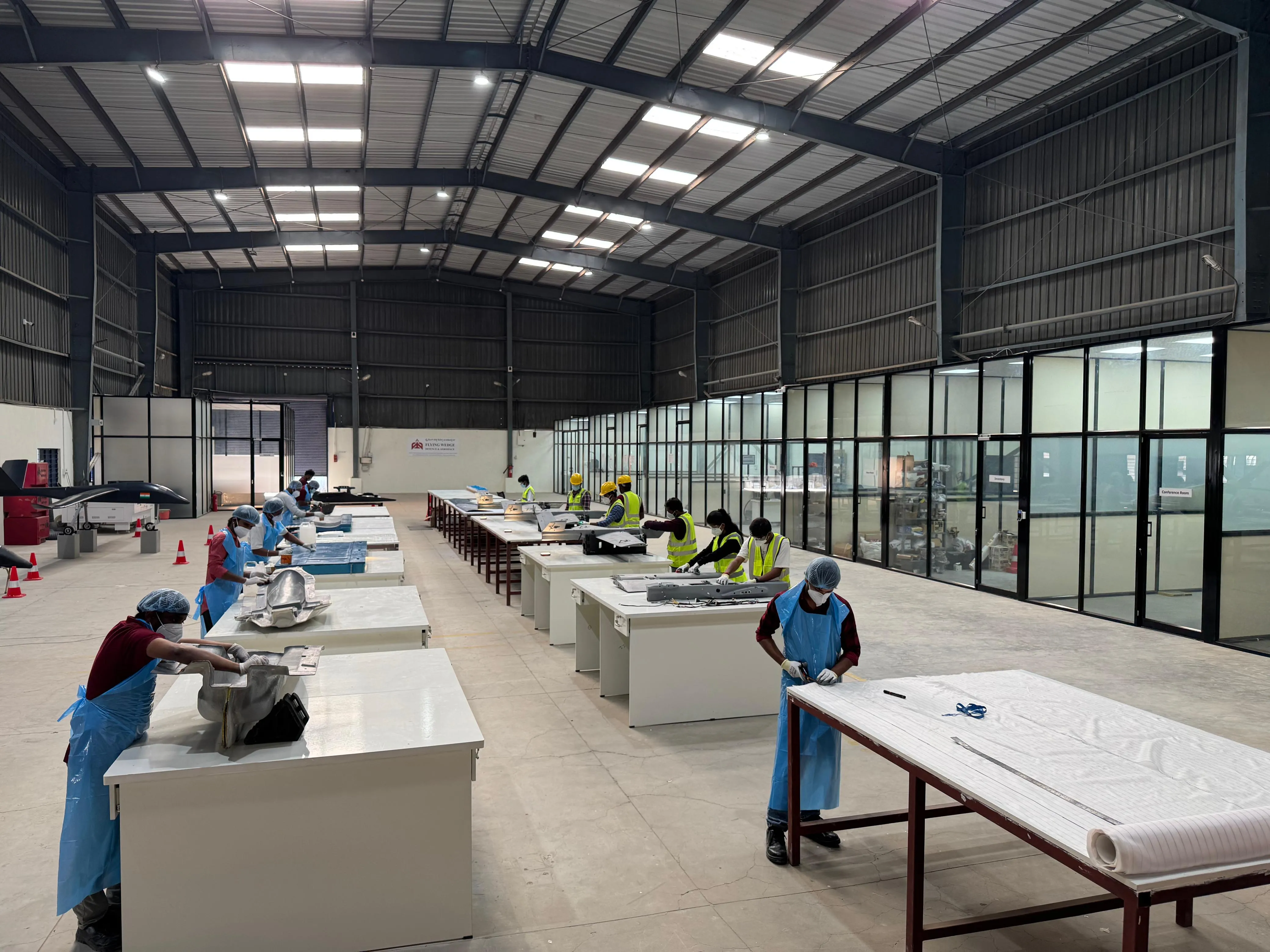
Flying Wedge Defence & Aerospace has launched its Centre for Autonomous Defence Research in Bengaluru, strengthening India’s capabilities in autonomous and unmanned defence technologies.
Spread across 25,000 sq ft, the facility is positioned as a dedicated R&D and rapid prototyping hub focused on research, design, system integration and technology validation of next-generation autonomous defence systems. The centre will support advanced programmes including the Kaalabhairav UCAV, AI-enabled fighter-jet technologies, and autonomous air-defence and interceptor systems.
By integrating expertise in aerostructures, composites, propulsion integration, autonomy and AI software, the facility aims to compress design-to-demonstrator timelines and accelerate technology maturation.
Suhas Tejaskanda, Founder and CEO, Flying Wedge Defence, said the initiative is intended to build deep indigenous expertise in autonomous combat aviation and networked air-defence systems, contributing to India’s transition from a manufacturing-led defence ecosystem to a source nation for high-end defence technologies.
The centre is expected to enable collaboration with the Indian Armed Forces and strategic partners while supporting sovereign, scalable technologies for domestic and export markets.

Flying Wedge Defence & Aerospace has launched its Centre for Autonomous Defence Research in Bengaluru, strengthening India’s capabilities in autonomous and unmanned defence technologies.Spread across 25,000 sq ft, the facility is positioned as a dedicated R&D and rapid prototyping hub focused on research, design, system integration and technology validation of next-generation autonomous defence systems. The centre will support advanced programmes including the Kaalabhairav UCAV, AI-enabled fighter-jet technologies, and autonomous air-defence and interceptor systems.By integrating expertise in aerostructures, composites, propulsion integration, autonomy and AI software, the facility aims to compress design-to-demonstrator timelines and accelerate technology maturation.Suhas Tejaskanda, Founder and CEO, Flying Wedge Defence, said the initiative is intended to build deep indigenous expertise in autonomous combat aviation and networked air-defence systems, contributing to India’s transition from a manufacturing-led defence ecosystem to a source nation for high-end defence technologies.The centre is expected to enable collaboration with the Indian Armed Forces and strategic partners while supporting sovereign, scalable technologies for domestic and export markets.

Next Story
Building Material

NITI Aayog Unveils Cement Decarbonisation Roadmap

NITI Aayog has released a sector-specific decarbonisation roadmap for cement as part of three green transition reports covering cement, aluminium and MSMEs. The report projects cement production rising to around 2,100 million tonnes by 2070 from 391 million tonnes in 2023, while targeting a reduction in carbon intensity to 0.09–0.13 tCO₂e per tonne. It recommends clinker substitution, refuse-derived fuels, CCUS adoption and carbon trading mechanisms to enable deep decarbonisation. ..

Next Story
Technology

Genesys Launches Advanced GeoRadar System

Genesys International Corporation has launched an advanced Ground Penetrating Radar (GPR) solution from IDS GeoRadar for underground utility mapping in India. The system uses patented Equalised Scrambling Technology (EST) and Wide/Multi-Array Antenna Technology to deliver high-resolution three-dimensional imaging of subsurface infrastructure. The technology enables the detection and mapping of buried assets such as water pipelines, sewer networks, telecom cables and power lines. By providing detailed subsurface insights, the system aims to help urban authorities and infrastructure developers ..

Next Story
Infrastructure Urban

Hindustan Zinc Partners Virginia Tech to Boost Silver Recovery

Hindustan Zinc Limited recently signed a Memorandum of Understanding (MoU) with Virginia Tech to advance research aimed at improving silver recovery across its lead–zinc (Pb–Zn) concentrators. The collaboration will focus on refining flotation techniques and optimising reagent usage to improve concentrate quality and operational efficiency at processing plants.Virginia Tech, based in Blacksburg, Virginia, is globally recognised for its expertise in mining engineering, mineral processing and applied metallurgical research. Through this partnership, Hindustan Zinc will leverage global resear..

Advertisement

Subscribe to Our Newsletter

Get daily newsletters around different themes from Construction world.

STAY CONNECTED

Advertisement

Advertisement

Advertisement

Open In App