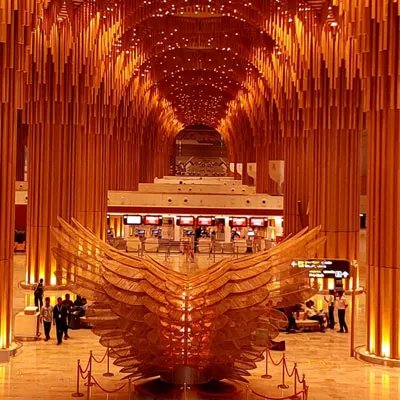
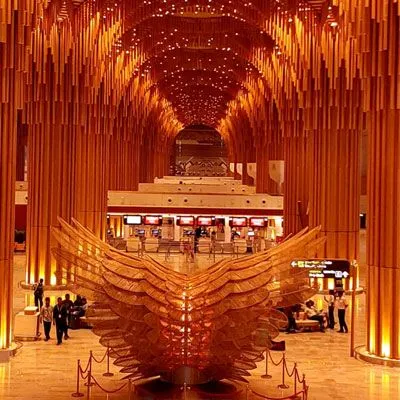
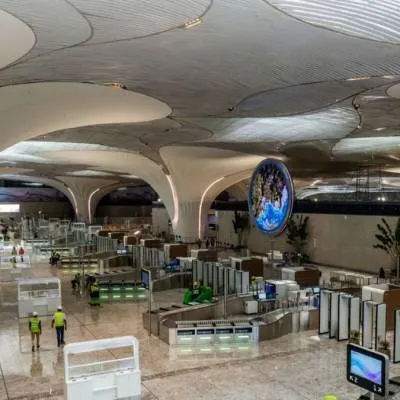
An airport terminal is designed to move people. But the new terminal at Lokpriya Gopinath Bordoloi International Airport (LGBIA), Guwahati, attempts something larger – it seeks to make people experience a place even before they step outside.Spread across nearly 1.4 lakh sq m and designed to handle over 13 million passengers annually, the new terminal represents a major expansion of Assam’s aviation infrastructure. For construction leaders, its significance goes beyond scale and aesthetics. The real achievement lies in bringing together architectural elements, structural systems, MEP networks, digital models, safety requirements and execution timelines into one integrated asset within a live aviation environment.This was not simply a building project. It was an exercise in precision.Creating a sense of AssamAirports are increasingly becoming expressions of the regions they serve. At Guwahati Airport, this intent was reflected in select interiors, including the Adani Lounge, where Panache Design Studio contributed to the design.Komal Behrani, Cofounder & Creative Director, Panache Design Studio, explains that the focus was on creating a contemporary interpretation of Assam’s identity. “Our aim was to interpret the region’s cultural richness in a way that felt contemporary, subtle and authentic,” she says.The design incorporated regional influences through bamboo-inspired ceiling features, partitions, lighting and Gamusa-inspired artworks. However, translating these ideas into a high-footfall airport environment required careful material selection. Marble was replaced with quartz in certain areas for better durability and maintenance, while a bamboo-inspired lighting feature was redesigned in metal to meet fire safety requirements. “Balance between creativity and performance is particularly important in large public infrastructure projects,” Behrani adds.The digital framework behind constructionThe complexity of a modern airport lies not only in its physical scale but in the coordination of multiple systems that must function together. At Guwahati Airport, architectural, structural, MEP and interior packages required a digital approach to minimise conflicts before execution.Aniruddha Roy, Cofounder & Chairman, TechnoStruct Academy, explains that façade and drywall coordination involved multiple intersections with structural grids, MEP routing, ceiling systems and fire safety requirements. To manage these interfaces, the team developed federated BIM models using Autodesk Revit and carried out clash detection through Autodesk Navisworks, enabling potential conflicts to be identified before reaching the execution stage. “The key value of BIM here was not only conflict detection but also conflict anticipation, resolving issues digitally before they translated into physical delays on site,” he explains.The use of LOD 450 execution models helped teams move from design intent to construction-ready information, enabling stakeholders to validate dimensions, interfaces and installation requirements before execution. The LOD 500 as-built model further created long-term operational value by supporting asset information management and lifecycle planning.Engineering the systems behind the terminalWhile architecture defines the passenger experience, an airport’s performance depends on systems that remain largely unseen. The terminal’s open spaces, extensive glazing and indoor landscaping created specialised requirements for MEP execution.Shabeer Rather, Senior Project Manager, Omtech Electricals Solutions, highlights that the terminal required engineering solutions beyond conventional airport systems. The indoor landscaping demanded specialised environmental controls, including microclimate HVAC engineering and automated irrigation and drainage networks. He explains that the architectural openness of the terminal influenced service planning. “The terminal’s expansive open volumes, extensive glazing and substantial indoor landscaping dictated a paradigm shift toward localised engineering.”One of the critical tasks was integrating high-capacity MEP infrastructure within a distinctive architectural environment. This required a combination of digital coordination and real-time engineering decisions on site.Design vision: Balancing identity with performanceTranslating Guwahati Airport’s design vision into a fully operational terminal required close integration between architecture, engineering and technology. Ashish Kumar, Head of Design, Adani Airport Holdings, explains that the project moved beyond parallel execution, with passenger flows, baggage systems, security infrastructure, lighting, indoor landscaping and experience zones developed as interconnected elements. The key challenge was ensuring that the biophilic and regionally inspired design could perform within a high-volume airport environment. This was addressed through multilevel passenger planning, automated baggage handling systems, self-service technologies, advanced security screening and scalable terminal planning. Kumar highlights that even elements such as engineered and natural bamboo required detailed coordination to meet durability, maintenance and airport compliance requirements. “By combining innovative materials with robust technical solutions, the project successfully preserved its architectural identity while meeting demanding operational and regulatory requirements,” he says.Execution: Turning coordination into realityLarge infrastructure projects are ultimately tested during execution, where design intent, engineering models and construction strategies must converge within strict timelines.For Biswajit Sarma, Project Head, Shapoorji Pallonji - Engineering & Construction (SP E&C), detailed planning across manpower, materials, logistics, equipment and finances was critical to maintaining project momentum. “There should not be any challenges if projects are planned and implemented well,” he says. The focus, he explains, was on anticipating requirements and aligning resources with the project’s critical path.However, airport construction operates within a highly controlled environment, where security protocols, airside restrictions and interface management add another layer of complexity. Logistics, material handling and security requirements at the airside-terminal interface required careful planning. “In airport construction, there is a need to follow security protocols very rigorously in accordance with Bureau of Civil Aviation Security (BCAS) regulations,” says Sarma. “However, through manpower and equipment planning in collaboration with the security agencies, we have been able to come out in time.”Maintaining material availability and uninterrupted execution also required close financial and vendor planning. Sarma highlights that timely resource allocation was essential to keeping critical activities moving. Beyond processes, collaboration remained central to delivery. Managing contractors, consultants and authorities required collective problem-solving. “The only way out is to have a positive approach of working, to hear their issues and grievances for an effective solution,” he says.A blueprint for future infrastructureGuwahati Airport reflects the changing face of Indian infrastructure – where landmark projects are no longer defined only by scale but by the intelligence behind their creation.The terminal demonstrates how design thinking, digital engineering, advanced building systems and execution expertise can come together to deliver assets that are efficient, future-ready and rooted in their context.For India’s construction ecosystem, the way forward lies in creating infrastructure that is not only faster to build, but smarter to operate, easier to maintain and more meaningful for the communities it serves. Because the future of infrastructure will not be measured only by the structures we create, but by the precision, collaboration and vision that bring them to life.FACT FILEProject: New Integrated Terminal Building, Lokpriya Gopinath Bordoloi International Airport (LGBIA), GuwahatiTerminal area: Approx. 1.4 lakh sq m Project Cost: 4,000 CroreInauguration:December 2025Commercial operations commenced: 22 February 2026 Passenger handling capacity: 13.1 million passengers annually Design theme: Bamboo Orchids, inspired by Assam’s biodiversity, bamboo craftsmanship and the region’s cultural identityAirport operator/developer: Adani Airport Holdings (AAHL) through Guwahati International Airport (GIAL) Architect: NUDES | Nuru Karim Principal engineering consultant: AECOM General contractor: Shapoorji Pallonji & Company Green consultancy & energy management: Godrej & Boyce - PRANJAL PATIL