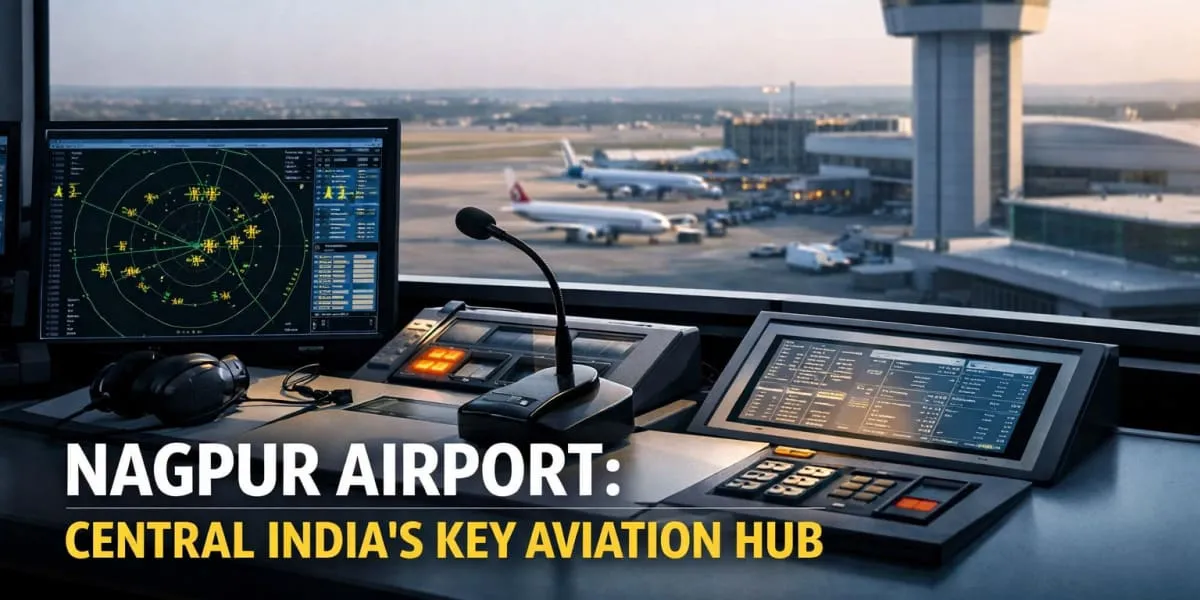
Nagpur Airport Emerges As Central India's Key Aviation Hub
AVIATION & AIRPORTS

Nagpur Airport Emerges As Central India's Key Aviation Hub

Nagpur Airport has emerged as a key aviation hub for Central India as sustained growth in aircraft movements has increased the facility's strategic importance and connectivity. ATC figures for early 2025 show robust activity with 51,160 movements in January, 50,952 in February and 51,100 in March, and a total of 13,375 takeoffs in the same period. Officials attribute the rise to the airport's location and improvements in traffic coordination that have enhanced throughput and resilience.

ATC managed a cumulative 52,253 terminal movements between one January 2024 and 31 December 2025, reflecting expanded scheduled and non scheduled handling capacities across peak and off peak periods. En route control handled 707,158 movements from one January 2024 to 31 March 2025, underscoring the airport's role on regional air routes. The Airports Authority of India (AAI) reported no separate records of aircraft denied landing permission because of congestion, indicating effective slot and flow management and operational continuity.

Coordination, technical vigilance and systematic air traffic management have been credited with smoothing operations as volumes rose, according to the authority. The combination of infrastructure readiness and procedural discipline has supported increased movements without reported operational denial for landing. Stakeholders say the capacity to absorb traffic growth solidifies Nagpur's position as a redistribution node for central routes and a reliever for neighbouring hubs and regional operators.

Continued monitoring of peak month flows and capacity planning will be needed to sustain punctuality and safety as the airport's catchment grows. Planners are encouraged to align runway and terminal development with rising demand while preserving regulatory oversight and airspace efficiency and long term investment planning. The airport's trajectory suggests it will remain an increasingly important centre for passenger and cargo movements across Central India in the coming years ahead.

Nagpur Airport has emerged as a key aviation hub for Central India as sustained growth in aircraft movements has increased the facility's strategic importance and connectivity. ATC figures for early 2025 show robust activity with 51,160 movements in January, 50,952 in February and 51,100 in March, and a total of 13,375 takeoffs in the same period. Officials attribute the rise to the airport's location and improvements in traffic coordination that have enhanced throughput and resilience. ATC managed a cumulative 52,253 terminal movements between one January 2024 and 31 December 2025, reflecting expanded scheduled and non scheduled handling capacities across peak and off peak periods. En route control handled 707,158 movements from one January 2024 to 31 March 2025, underscoring the airport's role on regional air routes. The Airports Authority of India (AAI) reported no separate records of aircraft denied landing permission because of congestion, indicating effective slot and flow management and operational continuity. Coordination, technical vigilance and systematic air traffic management have been credited with smoothing operations as volumes rose, according to the authority. The combination of infrastructure readiness and procedural discipline has supported increased movements without reported operational denial for landing. Stakeholders say the capacity to absorb traffic growth solidifies Nagpur's position as a redistribution node for central routes and a reliever for neighbouring hubs and regional operators. Continued monitoring of peak month flows and capacity planning will be needed to sustain punctuality and safety as the airport's catchment grows. Planners are encouraged to align runway and terminal development with rising demand while preserving regulatory oversight and airspace efficiency and long term investment planning. The airport's trajectory suggests it will remain an increasingly important centre for passenger and cargo movements across Central India in the coming years ahead.

Next Story
Infrastructure Urban

MIDC and Ramky Unit Sign Concession for Life Sciences Park

Maharashtra Industrial Development Corporation has signed a concession agreement with Maha Integrated Life Sciences City Limited (MILeS City), a wholly owned subsidiary of Ramky Infrastructure Limited (RIL), to develop a high-tech pharmaceutical park at Dighi Port Industrial Area in Raigad. The project will follow a public-private partnership under a DBFOT model and has an estimated cost of Rs 30 billion (Rs 30 bn). The concession will run for 95 years, including a five-year construction phase, with MILeS City responsible for development and management. The development will occupy approximatel..

Next Story
Real Estate

BuzzWorks Leases Hyderabad Office to MyComplianceOffice

Brigade Group’s managed workspace provider BuzzWorks has leased 550 seats at Mindspace Business Park in Hyderabad to Dublin based MyComplianceOffice, in what is the company’s largest office in India. With this signing, BuzzWorks' total leased office space in Hyderabad stands at zero point one one million (mn) square feet. The new premises will house core functions including product engineering, product management, customer success and global operations. Artificial intelligence enabled compliance technology initiatives will also be part of the local delivery model. BuzzWorks will provide wo..

Next Story
Infrastructure Transport

Jindal Stainless Flags Operational Strain From Middle East Crisis

Jindal Stainless warned that the Middle East war crisis has affected its operations because of dependence on industrial gases such as propane and LPG and on natural gas. The scrap-based production route used by the stainless steel maker does not generate blast furnace or coke oven gases internally, unlike the conventional steel industry. Several plant processes have been adversely impacted and production is being run at rationalised capacity. Disruptions in global shipping routes have resulted in vessel diversions, longer transit times and cargo delays, adding pressure to supply chains and to ..

Advertisement

Subscribe to Our Newsletter

Get daily newsletters around different themes from Construction world.

STAY CONNECTED

Advertisement

Advertisement

Advertisement