ICRA: Time for a Hybrid Toll Model in road sector
ROADS & HIGHWAYS

ICRA: Time for a Hybrid Toll Model in road sector

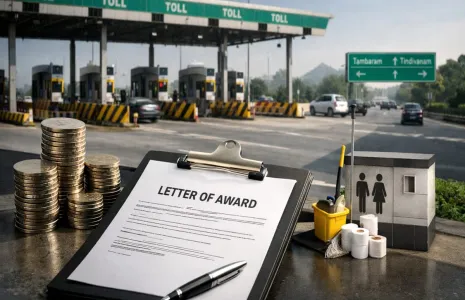
There has been a lot of debate in recent times about the need for the National Highways Authority of India (NHAI) to focus on asset monetisation and tap alternate funding avenues viz. toll-operate-transfer (TOT) and infrastructure investment trusts (InvITs) given the huge funding requirement for the ongoing Bharatmala Pariyojana programme. ICRA, in its earlier observation on this subject, has already highlighted the importance of speeding up the TOT awards and other fund-raising initiatives to meet the large funding requirements of the ambitious programme. However, the progress on both these fronts has been slow till date. To add to this, the share of the build-operate-transfer (BOT) (Toll) projects in the overall awards has declined sharply (being made primarily through the EPC/hybrid annuity mode); thereby increasing the financial burden on the NHAI. To overcome this, the NHAI may revert to the BOT (Toll) mode of project awarding. According to ICRA, the risk-sharing is not balanced enough, giving rise to the need to devise a new one.

Elaborating on why BOT (Toll) model may not have many takers in its current form, Mr. Rajeshwar Burla, VP & Associate Head, Corporate Ratings, ICRA said, “Risk averseness of road developers has increased over the last few years. Even today, many developers’ balance sheets cannot support huge equity investments towards BOT projects. Further, the transportation sector is undergoing transformational change with alternate modes viz. dedicated freight corridor and inland waterways which would result in a modal shift from road to these modes over the medium to long term. In addition, the road network itself is undergoing significant changes with some of the economic corridors under Bharatmala competing with few existing stretches. Overall, these factors would make the traffic forecasting extremely challenging. Therefore, BOT (Toll) model in its current form may not have many takers. Achieving financial closure also would be a challenge given these uncertainties.”

In the past, what made NHAI shift away from BOT (Toll) to BOT (HAM)? With stressed balance sheets many developers shied away from BOT (Toll) projects. Until FY2014, the mode of project award was determined based on the waterfall mechanism that explored BOT (Toll) first followed by BOT (HAM) and then EPC depending on the traffic density along the project stretch. This process slowed down the awards due to weak private sector participation. Thus, in the absence of private sector participation, shifting to EPC mode and restarting the award process was time consuming which was primary reason for low awards in FY2013 and FY2014. This process was subsequently scrapped, the committee headed by Secretary of Ministry of Road Transport and Highways (MoRTH) now decides on the mode (BOT/EPC) of project awards. One of the reasons why BOT (HAM) was successful in attracting private sector participation was due to low upfront equity requirements when compared to conventional BOT projects.

On increasing financial burden for NHAI, compliance to the Right to Fair Compensation and Transparency in Land Acquisition, Rehabilitation and Resettlement Act, 2013 (RFCTLARR) has led to increase in compensation by four times the market value in rural areas and twice the market value in urban areas. This in turn has led to a steep increase in land acquisition cost to upwards of Rs. 2.50 crore per hectare currently (as against Rs. 0.90 crore per hectare in FY2014). Land acquisition cost alone accounts for more than 30% of the total expenses of NHAI. Further, with around 90-92% of the awards over last few years through engineering procurement and construction (EPC, wherein NHAI has to fund 100% upfront) and BOT (HAM, wherein NHAI has to fund 40% upfront and remaining 60% over a period of 15 years) modes, the financial burden on NHAI has continued to remain high. The total debt for NHAI has increased by more than 2.4 times to Rs.1.79 lakh crore as on March 31, 2019 from Rs. 75,385 crore as on March 31, 2017.
In this context, NHAI is left with two options – a) to go slow on project awards or b) increase the mix of BOT (Toll) awards. Given the ambitious targets of Bharatmala programme, NHAI will be required to increase the mix of BOT (Toll) awards.

Mr. Burla added, “The risk sharing is not balanced in the current BOT (Toll) model. Therefore, it is time to devise a new model on the lines of BOT (HAM) to reduce the upfront equity contribution for private developers to an extent. Also, the new model should have provision to re-negotiate contracts to protect the returns of developers in case of lower-than-anticipated traffic performance especially given the challenges in traffic forecasting currently on account of likely shift to other competing modes.”

On NH awards and execution, awards were at a five-year low in FY2019 at 5,493 km (68% lower than 17,055 km awarded in FY2018) as against the target of 20,000 km for MoRTH. This was largely due to land acquisition related challenges and the general elections. However, execution remained healthy at 10,855 km in FY2019; around 10% higher than FY2018. The execution target for FY2020 has been set at 11,000 km.    

There has been a lot of debate in recent times about the need for the National Highways Authority of India (NHAI) to focus on asset monetisation and tap alternate funding avenues viz. toll-operate-transfer (TOT) and infrastructure investment trusts (InvITs) given the huge funding requirement for the ongoing Bharatmala Pariyojana programme. ICRA, in its earlier observation on this subject, has already highlighted the importance of speeding up the TOT awards and other fund-raising initiatives to meet the large funding requirements of the ambitious programme. However, the progress on both these fronts has been slow till date. To add to this, the share of the build-operate-transfer (BOT) (Toll) projects in the overall awards has declined sharply (being made primarily through the EPC/hybrid annuity mode); thereby increasing the financial burden on the NHAI. To overcome this, the NHAI may revert to the BOT (Toll) mode of project awarding. According to ICRA, the risk-sharing is not balanced enough, giving rise to the need to devise a new one.Elaborating on why BOT (Toll) model may not have many takers in its current form, Mr. Rajeshwar Burla, VP & Associate Head, Corporate Ratings, ICRA said, “Risk averseness of road developers has increased over the last few years. Even today, many developers’ balance sheets cannot support huge equity investments towards BOT projects. Further, the transportation sector is undergoing transformational change with alternate modes viz. dedicated freight corridor and inland waterways which would result in a modal shift from road to these modes over the medium to long term. In addition, the road network itself is undergoing significant changes with some of the economic corridors under Bharatmala competing with few existing stretches. Overall, these factors would make the traffic forecasting extremely challenging. Therefore, BOT (Toll) model in its current form may not have many takers. Achieving financial closure also would be a challenge given these uncertainties.”In the past, what made NHAI shift away from BOT (Toll) to BOT (HAM)? With stressed balance sheets many developers shied away from BOT (Toll) projects. Until FY2014, the mode of project award was determined based on the waterfall mechanism that explored BOT (Toll) first followed by BOT (HAM) and then EPC depending on the traffic density along the project stretch. This process slowed down the awards due to weak private sector participation. Thus, in the absence of private sector participation, shifting to EPC mode and restarting the award process was time consuming which was primary reason for low awards in FY2013 and FY2014. This process was subsequently scrapped, the committee headed by Secretary of Ministry of Road Transport and Highways (MoRTH) now decides on the mode (BOT/EPC) of project awards. One of the reasons why BOT (HAM) was successful in attracting private sector participation was due to low upfront equity requirements when compared to conventional BOT projects.On increasing financial burden for NHAI, compliance to the Right to Fair Compensation and Transparency in Land Acquisition, Rehabilitation and Resettlement Act, 2013 (RFCTLARR) has led to increase in compensation by four times the market value in rural areas and twice the market value in urban areas. This in turn has led to a steep increase in land acquisition cost to upwards of Rs. 2.50 crore per hectare currently (as against Rs. 0.90 crore per hectare in FY2014). Land acquisition cost alone accounts for more than 30% of the total expenses of NHAI. Further, with around 90-92% of the awards over last few years through engineering procurement and construction (EPC, wherein NHAI has to fund 100% upfront) and BOT (HAM, wherein NHAI has to fund 40% upfront and remaining 60% over a period of 15 years) modes, the financial burden on NHAI has continued to remain high. The total debt for NHAI has increased by more than 2.4 times to Rs.1.79 lakh crore as on March 31, 2019 from Rs. 75,385 crore as on March 31, 2017.In this context, NHAI is left with two options – a) to go slow on project awards or b) increase the mix of BOT (Toll) awards. Given the ambitious targets of Bharatmala programme, NHAI will be required to increase the mix of BOT (Toll) awards.Mr. Burla added, “The risk sharing is not balanced in the current BOT (Toll) model. Therefore, it is time to devise a new model on the lines of BOT (HAM) to reduce the upfront equity contribution for private developers to an extent. Also, the new model should have provision to re-negotiate contracts to protect the returns of developers in case of lower-than-anticipated traffic performance especially given the challenges in traffic forecasting currently on account of likely shift to other competing modes.”On NH awards and execution, awards were at a five-year low in FY2019 at 5,493 km (68% lower than 17,055 km awarded in FY2018) as against the target of 20,000 km for MoRTH. This was largely due to land acquisition related challenges and the general elections. However, execution remained healthy at 10,855 km in FY2019; around 10% higher than FY2018. The execution target for FY2020 has been set at 11,000 km.    

Next Story
Infrastructure Urban

VECV Sales Rise 7.8 Per Cent In May 2026

VE Commercial Vehicles recorded sales of 7,978 units in May 2026, compared to 7,401 units in May 2025, registering growth of 7.8 per cent. This included 7,789 units from the Eicher brand and 189 units from the Volvo brand.Eicher branded trucks and buses reported sales of 7,789 units during the month, up 7.3 per cent from 7,258 units a year earlier. In the domestic commercial vehicle market, Eicher sales rose 9.1 per cent to 7,375 units from 6,758 units in May 2025.Exports declined 17.2 per cent to 414 units from 500 units in the corresponding month last year. Volvo Trucks and Volvo Buses recor..

Next Story
Infrastructure Urban

Table Space Strengthens DESYN Leadership Team

Table Space has announced strategic leadership appointments within DESYN, its integrated Design and Build business, as it looks to strengthen operations across key enterprise and GCC markets in India. DESYN was launched as a strategic extension of Table Space’s workspace solutions portfolio to meet rising demand for agile, high-quality and rapidly deployable enterprise workspaces.Shruti Ookabhoy has joined DESYN as Executive Director and will lead the Design vertical, focusing on design capability, operational excellence and team development across markets. She brings over 22 years of experi..

Next Story
Infrastructure Transport

Concord Associate Bags Rs 2.79 Bn Kavach Order

Concord Control Systems said its associate company, Progota India, has received a Rs 2.79 bn domestic order from Indian Railways for the supply, installation, testing and commissioning of on-board Kavach 4.0 loco equipment.The order is scheduled for execution within 12 months and strengthens Concord’s role in India’s railway safety and signalling ecosystem. Kavach is India’s indigenous automatic train protection system, designed to improve operational safety by helping prevent signal passing at danger and reducing collision risks.Gaurav Lath, Joint Managing Director, Concord Control Syst..

Advertisement

Subscribe to Our Newsletter

Get daily newsletters around different themes from Construction world.

STAY CONNECTED

Advertisement

Advertisement

Advertisement

-->