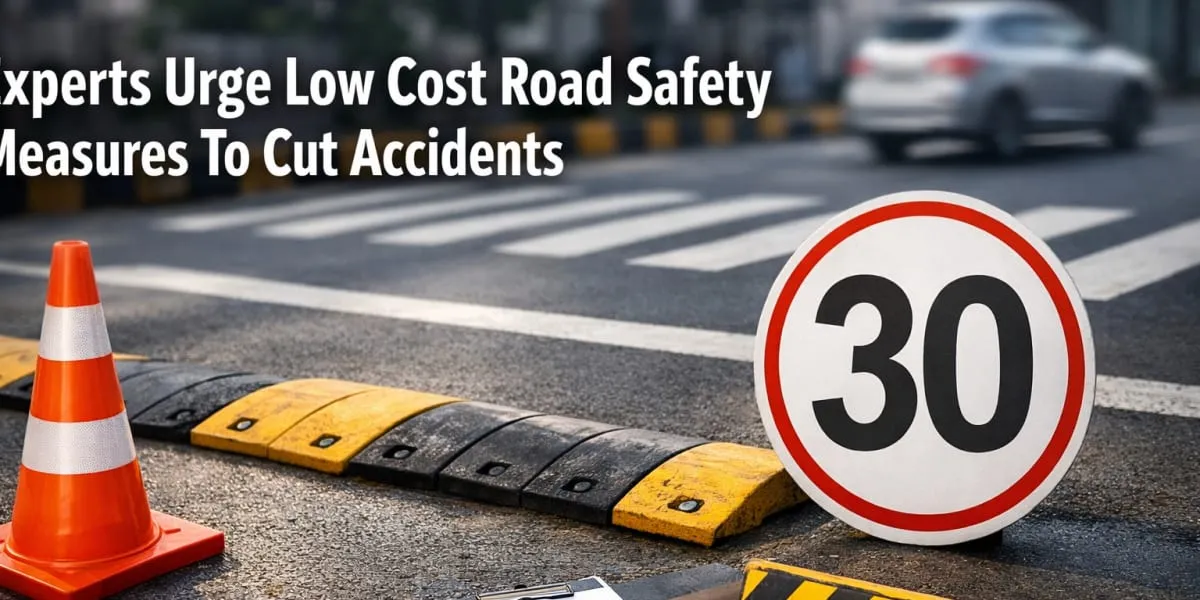
Experts Urge Low Cost Road Safety Measures To Cut Accidents
ROADS & HIGHWAYS

Experts Urge Low Cost Road Safety Measures To Cut Accidents

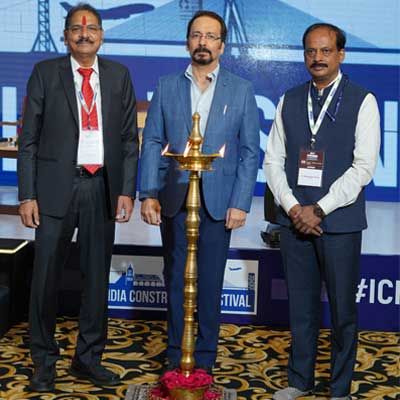
On 24 July in New Delhi, road safety experts described the state of road safety in the country as alarming and stressed the urgent need for practical, scalable and cost-effective measures to prevent accidents. They said a focus on affordable, evidence-based interventions in urban areas can substantially reduce road fatalities. The assessment emerged at a conference organised by the India chapter of the International Road Federation (IRF). The experts said the approach should be evidence-driven and tailored to local conditions across different city contexts.

At the meeting, IIT Delhi professor emeritus Geetam Tiwari highlighted road markings that improve night-time visibility as a high-impact, low-cost measure for urban streets. Delegates discussed the use of reflective paint, improved signage, raised pedestrian crossings and simple speed-calming measures as interventions that can be rolled out rapidly. The emphasis was on solutions that require modest investment but deliver measurable safety gains. Participants noted that many of these measures can be maintained within routine budgets and by local workforce.

Speakers argued that systematic data collection and targeted monitoring are essential to prioritise interventions where the risk is greatest. Local authorities were urged to integrate road safety into routine urban planning, maintenance and lighting programmes rather than treating it as an occasional project. Experts also recommended training for traffic personnel and public education to change behaviour on streets. Integration with transport planning and land use decisions was described as important to prevent new hazards.

The conference discussion concluded with a call for collaboration among government agencies, urban planners and civil society to scale effective practices across cities. Delegates said pilot programmes should be accompanied by clear metrics and independent evaluation so that lessons can be replicated. They emphasised that affordable measures, if implemented at scale, would save lives and reduce economic losses associated with road trauma. Speakers called for central support to disseminate technical guidance and to fund initial rollouts where local resources are limited.

On 24 July in New Delhi, road safety experts described the state of road safety in the country as alarming and stressed the urgent need for practical, scalable and cost-effective measures to prevent accidents. They said a focus on affordable, evidence-based interventions in urban areas can substantially reduce road fatalities. The assessment emerged at a conference organised by the India chapter of the International Road Federation (IRF). The experts said the approach should be evidence-driven and tailored to local conditions across different city contexts. At the meeting, IIT Delhi professor emeritus Geetam Tiwari highlighted road markings that improve night-time visibility as a high-impact, low-cost measure for urban streets. Delegates discussed the use of reflective paint, improved signage, raised pedestrian crossings and simple speed-calming measures as interventions that can be rolled out rapidly. The emphasis was on solutions that require modest investment but deliver measurable safety gains. Participants noted that many of these measures can be maintained within routine budgets and by local workforce. Speakers argued that systematic data collection and targeted monitoring are essential to prioritise interventions where the risk is greatest. Local authorities were urged to integrate road safety into routine urban planning, maintenance and lighting programmes rather than treating it as an occasional project. Experts also recommended training for traffic personnel and public education to change behaviour on streets. Integration with transport planning and land use decisions was described as important to prevent new hazards. The conference discussion concluded with a call for collaboration among government agencies, urban planners and civil society to scale effective practices across cities. Delegates said pilot programmes should be accompanied by clear metrics and independent evaluation so that lessons can be replicated. They emphasised that affordable measures, if implemented at scale, would save lives and reduce economic losses associated with road trauma. Speakers called for central support to disseminate technical guidance and to fund initial rollouts where local resources are limited.

Next Story
Infrastructure Urban

Centre Clears Power Distribution Upgrade for Uttar Pradesh

The Central Government has approved power distribution projects worth Rs 407.39 billion for Uttar Pradesh under the Revamped Distribution Sector Scheme (RDSS). The investment will be used to modernise the state's electricity distribution infrastructure and strengthen network capacity across urban and rural areas. The package targets one of the country's largest distribution networks as the state experiences rapid urbanisation and rising electricity consumption. Planned interventions include the strengthening of distribution lines, modernisation of substations, replacement of ageing electrical ..

Next Story
Infrastructure Energy

India Data Centres To Consume 191 TWh By 2040 Driving Renewables

A Wood Mackenzie report says India's operational data centre capacity is projected to increase more than fivefold to 12 gigawatt (GW) by 2030 from 2.2 GW in 2025 as artificial intelligence (AI) and cloud computing drive demand. It projects electricity consumption to rise from 10 terawatt-hour (TWh) in 2025 to 191 TWh by 2040. The study forecasts a compound annual growth rate of around 40 per cent and notes AI-dedicated capacity will surge nearly 24-fold from 275 megawatt (MW) in 2025 to 6,546 MW by 2030. The report places India's digital economy at Rs 32 trillion (tn) in 2025 and says it contr..

Next Story
Infrastructure Transport

Hydrogen Train Completes 1,200 Kilometres Of Trials

India's first hydrogen train was flagged off between Jind and Sonipat on July 17 and has travelled over 1,200 kilometres in trials, saving diesel consumption of more than 3,200 litres, a Railway Ministry press release said. The deployment marks the introduction of a zero-emission fuel cell train into route testing and represents a milestone in domestic rail innovation. The train generates electricity onboard through a chemical reaction between hydrogen and oxygen, producing electricity to propel the vehicle while emitting only water vapour as a by-product. There is no smoke and no tailpipe car..

Advertisement

Subscribe to Our Newsletter

Get daily newsletters around different themes from Construction world.

STAY CONNECTED

Advertisement

Advertisement

Advertisement