Gujarat To Build Cement Concrete Roads In Cities And Towns
ROADS & HIGHWAYS

Gujarat To Build Cement Concrete Roads In Cities And Towns

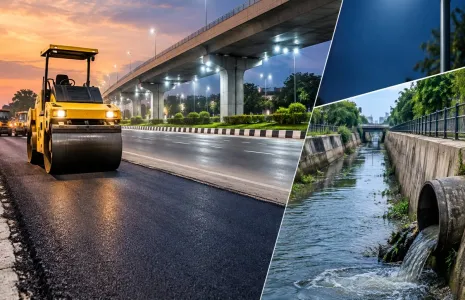
The Gujarat cabinet, chaired by Chief Minister Bhupendra Patel, has decided that internal roads in all Municipal Corporations and Municipalities will be constructed using cement concrete (CC) rather than asphalt. The move is intended to address the recurring problem of road damage during the monsoon and to provide surfaces that withstand heavy rainfall and waterlogging. The government spokesperson and minister Jitu Vaghani said the decision reflects a long-term infrastructure strategy to reduce disruption to citizens.

The cabinet also decided that asphalt roads in village settlements prone to waterlogging will be gradually converted to CC, and construction of such roads is already under way under the Suvidhapath Yojana. The use of CC will be expanded in industrial areas that experience heavy and extra-heavy vehicular traffic where required. A government release set out the operational focus and staged implementation across urban and rural local bodies.

Vaghani noted that construction costs for CC roads are generally 30 to 40 per cent higher than for asphalt, but the chief minister prioritised long-term public benefit over immediate expenditure. The administration has therefore accepted higher upfront costs to secure durable, high-quality infrastructure that is expected to serve for many years. Officials indicated that reduced frequency of repairs will lower recurring maintenance budgets over time.

Cement concrete roads are significantly stronger and have a longer service life than asphalt and are better suited to continuous movement by heavy, overloaded and multi-axle vehicles. They require minimal maintenance and repairs, which should reduce long-term expenditure on road upkeep and virtually eliminate recurring problems such as potholes and damaged surfaces. The material also performs effectively in areas receiving heavy rainfall and in locations prone to waterlogging. The decision is intended to strengthen road infrastructure across both urban and rural areas and to provide citizens with safer, more durable roads.

The Gujarat cabinet, chaired by Chief Minister Bhupendra Patel, has decided that internal roads in all Municipal Corporations and Municipalities will be constructed using cement concrete (CC) rather than asphalt. The move is intended to address the recurring problem of road damage during the monsoon and to provide surfaces that withstand heavy rainfall and waterlogging. The government spokesperson and minister Jitu Vaghani said the decision reflects a long-term infrastructure strategy to reduce disruption to citizens. The cabinet also decided that asphalt roads in village settlements prone to waterlogging will be gradually converted to CC, and construction of such roads is already under way under the Suvidhapath Yojana. The use of CC will be expanded in industrial areas that experience heavy and extra-heavy vehicular traffic where required. A government release set out the operational focus and staged implementation across urban and rural local bodies. Vaghani noted that construction costs for CC roads are generally 30 to 40 per cent higher than for asphalt, but the chief minister prioritised long-term public benefit over immediate expenditure. The administration has therefore accepted higher upfront costs to secure durable, high-quality infrastructure that is expected to serve for many years. Officials indicated that reduced frequency of repairs will lower recurring maintenance budgets over time. Cement concrete roads are significantly stronger and have a longer service life than asphalt and are better suited to continuous movement by heavy, overloaded and multi-axle vehicles. They require minimal maintenance and repairs, which should reduce long-term expenditure on road upkeep and virtually eliminate recurring problems such as potholes and damaged surfaces. The material also performs effectively in areas receiving heavy rainfall and in locations prone to waterlogging. The decision is intended to strengthen road infrastructure across both urban and rural areas and to provide citizens with safer, more durable roads.

Next Story
Infrastructure Urban

SCLR Extension Nears Completion Linking BKC With Signal-Free Route

The Santacruz-Chembur Link Road (SCLR) extension towards Bandra-Kurla Complex (BKC) via the Mumbai University campus has entered its final stage, bringing motorists closer to a direct, signal-free connection between the Western Express Highway and the city’s commercial district. The elevated connector is being built as an arm from the SCLR alignment and will link the western suburbs with BKC without surface signals. The link is designed to reduce journey times for commuters travelling from the western suburbs to BKC and to improve access to eastern Mumbai. By carrying through traffic above s..

Next Story
Infrastructure Transport

Raiganj MP Seeks Bengal Only Highway Link To Siliguri

Raiganj Member of Parliament Kartik Chandra Paul met Union Minister for Road Transport and Highways Nitin Gadkari in New Delhi to press for a new stretch of national highway in North Dinajpur district. He urged approval for a Bengal-to-Bengal link that would connect National Highways 12 and 27 to allow vehicles bound for Siliguri to avoid the current route through Kishanganj in neighbouring Bihar. He also submitted a proposed alignment of the new road to the ministry for consideration. At present vehicles from Raiganj travel along NH-12 and join NH-27 at Purnia More in Dalkhola, a route that p..

Next Story
Infrastructure Transport

Airport Kilambakkam Metro Line To Be Extended To Chengalpattu

Chennai Metro Rail (CMRL) has invited tenders for two detailed project reports that would extend its rail network to Chengalpattu in the south and extend Corridor-5 to Wimco Nagar in the north as part of a second wave of expansion beyond the operator's corridors under construction. The move signals an acceleration of planning for suburban links and interchange nodes. The larger of the two studies covers a roughly 27km extension from the planned Kilambakkam metro station to Chengalpattu under Corridor-1, Phase I. CMRL floated the tender at an estimated cost of Rs 21.6 mn. The proposed line woul..

Advertisement

Subscribe to Our Newsletter

Get daily newsletters around different themes from Construction world.

STAY CONNECTED

Advertisement

Advertisement

Advertisement