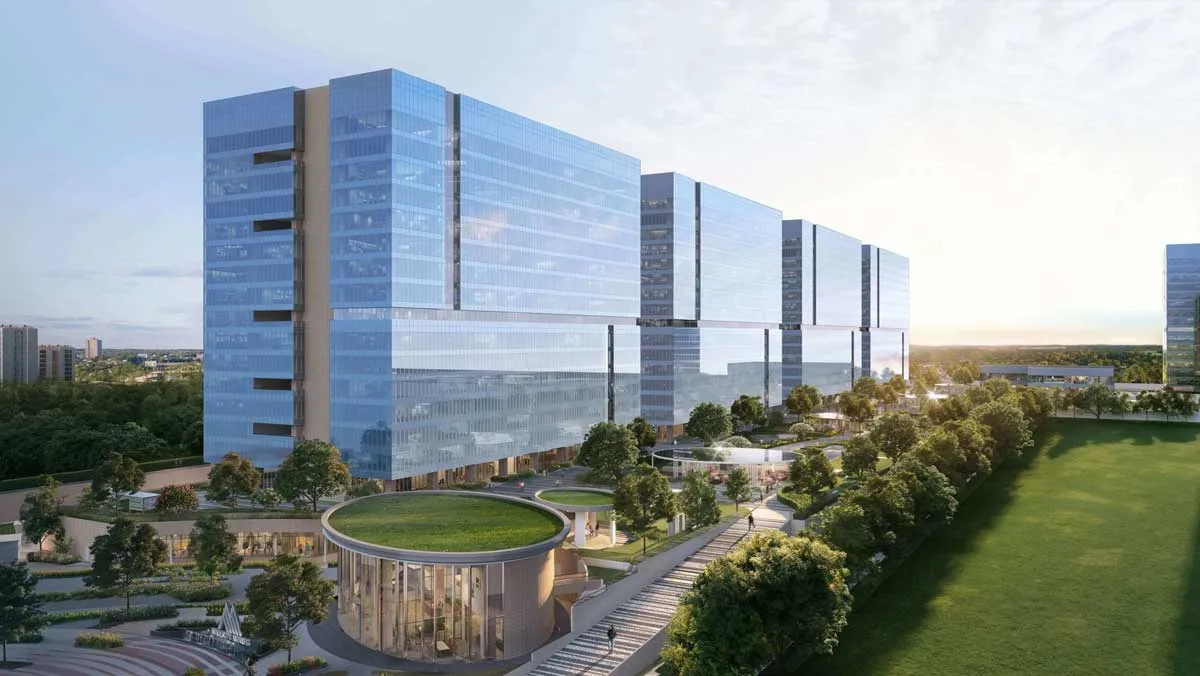
India’s commercial real estate landscape is undergoing a structural transition. While Bengaluru, Mumbai and Hyderabad continue to dominate office demand, increasing occupancy costs and infrastructure pressures are prompting enterprises to evaluate alternative markets capable of supporting long-term growth.Ahmedabad is increasingly positioning itself within this changing geography of investment.Million Minds Tech City aligns with Gujarat’s ambitions under the IT and ITES Policy 2022–2027 and the state’s broader strategy to attract technology-led investments and Global Capability Centres.For Ganesh Housing, the development was conceived not simply as office stock but as a future-ready ecosystem designed around enterprise needs.“At Million Minds Tech City, sustainability was not introduced as a design layer—it was embedded at the stage of land visioning itself,” says Anmol Patel, Director, Ganesh Housing. “This ensures that sustainability is not an added feature, but inherent to how the development functions at scale.”Patel sees Ahmedabad benefiting from a broader shift in enterprise location strategy.“There is a clear structural shift in how enterprises are expanding in India,” he says. “While cities such as Bangalore and Mumbai remain important, they are increasingly constrained by cost pressures and infrastructure saturation. Ahmedabad presents a differentiated value proposition with cost-efficient operations, prime commercial locations such as SG Highway, and a stable business environment.”This evolving market logic is increasingly favouring scalable, infrastructure-ready environments rather than purely policy-led destinations.Building beyond officesSpread across approximately 18 million sq ft, MMTC combines Grade A SEZ office infrastructure with residential, retail and hospitality components, positioning itself as an integrated walk-to-work district rather than a standalone office park.The development strategy reflects caution as much as ambition.Rather than introducing supply at scale upfront, Ganesh Housing is pursuing calibrated execution linked to demand visibility and leasing absorption.“Given the scale of approximately 18 million sq ft, the development is being executed through a phased, demand-aligned approach rather than a supply-led rollout,” Patel explains.Initial phases focus on ready-to-move Grade A office infrastructure targeted at IT, ITeS and GCC occupiers, while subsequent stages will introduce residential, retail and hospitality components.This phased deployment is intended to manage leasing exposure while preserving flexibility across market cycles. Large floor plates and scalable infrastructure form a central part of the proposition.Patel notes that the project has been planned to support enterprise expansion and occupier retention through ecosystem creation rather than isolated real estate delivery.Global standards, local executionInstitutional ambition alone, however, does not guarantee institutional delivery.Tishman Speyer, serving as Development Manager, brings international development and operational expertise to the project.“Our role at Million Minds Tech City is as Development Manager, partnering with Ganesh Housing Limited to deliver a project of institutional quality,” says Parvesh Sharma, EX MD and India Country Head, Tishman Speyer, who was instrumental in partnering and developing the project.For Sharma, Ahmedabad represents a market where infrastructure growth and enterprise demand are converging.“Ahmedabad represents a market with strong long-term fundamentals—driven by infrastructure growth, policy support, and increasing interest from technology-led enterprises,” he says. “It is a city at an inflection point, where the demand for Grade A office infrastructure is evolving faster than supply.”What differentiated MMTC was not merely location but development scale and planning ambition.“Million Minds Tech City offers a rare opportunity within this context,” Sharma says. “The scale of the development, its integrated master planning, and the commitment from Ganesh Housing Limited to create a globally benchmarked ecosystem make it a differentiated platform.”Tishman Speyer’s role extends beyond project oversight into operational positioning and occupier strategy.“From a leasing standpoint, the focus is on enabling a tenant mix that aligns with the long-term positioning of the development,” Sharma says. “This includes global capability centres, technology companies, and research-led organisations that require scale, operational efficiency, and long-term stability.”Execution governance, design reviews and coordination across consultants and contractors are intended to align global benchmarks with Indian regulatory realities.Designing the ecosystemThe architectural challenge lay in balancing density, mixed-use integration and climatic responsiveness without compromising operational efficiency.For Arunjot Singh Bhalla, Managing Director, RSP Design Consultants (India), planning began with functional clarity.“The master planning approach for Million Minds Tech City was driven by the need to create a high-performance mixed-use ecosystem that integrates commercial, residential, retail, and hospitality functions without operational conflict,” he says.RSP structured the development into clearly defined zones supported by dedicated circulation systems and access networks. Yet the project avoids fragmentation through pedestrian linkages and shared social infrastructure.“These connections are designed at a human scale and are deliberately segregated from vehicular and service movement systems,” Bhalla adds.Ahmedabad’s hot semi-arid climate further influenced design strategy.According to Mukesh C Bhogal, Senior Director – Design & Projects, RSP, passive design became central to achieving high environmental performance.“The design strategy prioritises reducing thermal loads at source through a combination of passive design interventions and high-performance building systems,” he says.High-performance façades, insulated glazing, daylight optimisation and advanced HVAC systems are intended to reduce energy demand while supporting user comfort.Density planning was approached through a usability lens rather than a FAR-maximisation exercise.“The approach to density optimisation was centred on delivering usable, high-performance built space rather than maximising FAR in isolation,” says Srinivas K, Director – Engineering & Sustainability, RSP.The resulting vertical planning model balances occupier flexibility with daylight access, environmental performance and SEZ compliance requirements.Performance by designFor MMTC, sustainability is positioned as operational infrastructure rather than certification alone.The project has secured IGBC Platinum status—an outcome that required extensive modelling and systems integration.“The most challenging and defining category was Energy Efficiency,” says Sameer Sinha, Founder & MD, Savvy Greens. “Achieving a 40.6% energy cost reduction over the ASHRAE 90.1-2010 baseline required extensive iterations in energy modelling.”The project targets a 59 per cent reduction in potable water consumption and incorporates 100 per cent wastewater recycling for flushing and irrigation alongside rooftop solar generation.Sinha notes that long-term performance monitoring was built into the sustainability strategy from the outset.“A key strength of Million Minds Tech City is that sustainability has been designed not just for certification, but for long-term operational performance,” he says.Integrated Building Management Systems, sub-metering infrastructure and third-party commissioning are expected to support performance validation post-handover.The larger propositionAs global tax structures evolve and enterprise location strategies mature, SEZ incentives alone are becoming less decisive.Patel acknowledges this changing framework.“SEZ benefits are positioned as a strategic enabler—not the core proposition,” he says.Instead, MMTC seeks relevance through a combination of infrastructure, ecosystem design, sustainability performance and scalability.Whether Ahmedabad can emerge as a significant GCC destination will ultimately depend on how successfully such integrated developments convert policy intent into long-term operational ecosystems. Million Minds Tech City represents one attempt to answer that question—through a model where sustainability, mixed-use planning and institutional delivery are treated not as parallel goals, but as interconnected foundations of future business districts. - KAVITA PARAB