+
Minister Narayana Reviews Arterial Road Works In Amaravati
ROADS & HIGHWAYS

Minister Narayana Reviews Arterial Road Works In Amaravati

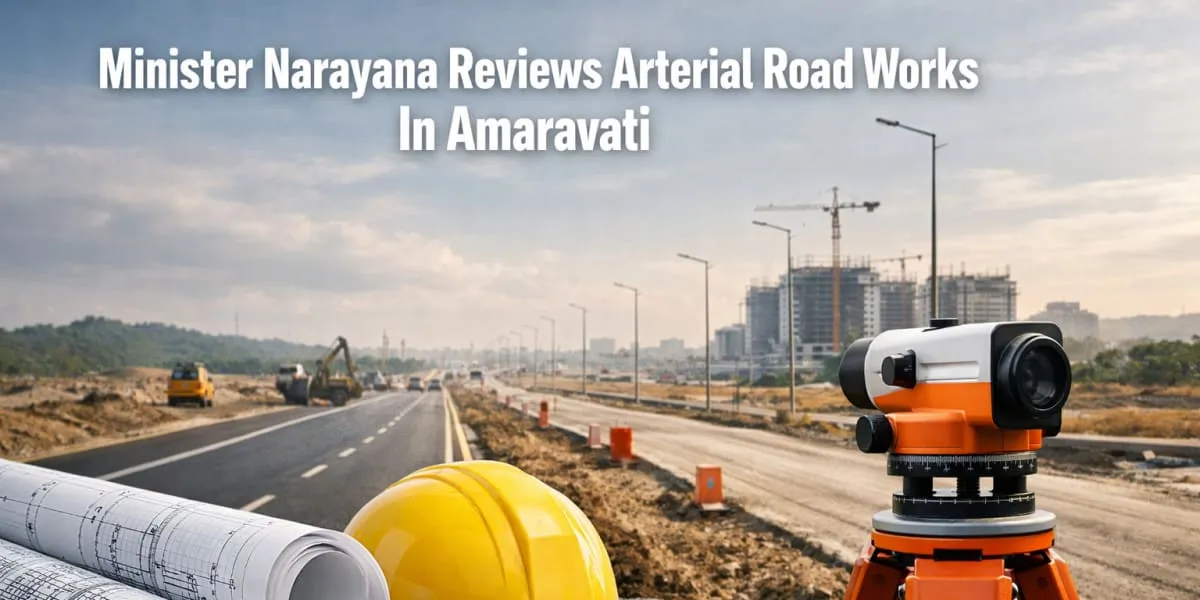
Municipal Administration and Urban Development (MA&UD) minister P Narayana reviewed progress of key arterial roads to fast-track regional connectivity into Amaravati. He held a high-level review meeting with AP Capital Region Development Authority (APCRDA) commissioner A Koteswara Rao, additional commissioner Y Karthik, Guntur district collector S Syaam Prasad and senior engineering officials, and instructed departments to coordinate to clear pending clearances and complete works within fixed timelines. Officials informed the minister that required railway permissions and land-related matters for proposed road corridors are near finalisation.

The review focused on accelerating construction across four primary access routes designed to provide multiple entry corridors into the capital, reducing reliance on any single transit route. Works on the Mangalagiri–Amaravati E15 Road are progressing rapidly to enable direct high-speed movement for vehicles entering Amaravati from the Mangalagiri side. The National Highway–AIIMS E13 Road has been planned as a major entry corridor connecting National Highway 16 to Amaravati via AIIMS Mangalagiri and was discussed for priority delivery.

Regarding the Seed Access Road E3 Elevated Corridor, the minister directed officials to expedite commencement of the Phase three elevated corridor stretching from the Steel Bridge to Manipal Hospital to streamline urban traffic flow. Progress was also evaluated on the Karakatta Parallel E1 Road, where construction is underway to widen the Karakatta embankment road up to Prakasam Barrage parallel to the Seed Access Road, creating a direct alternative from Vijayawada into Amaravati. Officials were asked to coordinate scheduling to avoid overlap and ensure efficient resource use.

The minister emphasised that strengthening multi-directional road connectivity is essential to meet the capital’s expanding traffic and logistics requirements as construction activity accelerates across Amaravati. He urged monitoring of timelines, speedy resolution of land and railway clearances and close collaboration among APCRDA, district administration and engineering departments. Work programmes were to be reviewed periodically to ensure access routes are delivered on schedule and support the broader urban development objectives.

Municipal Administration and Urban Development (MA&UD) minister P Narayana reviewed progress of key arterial roads to fast-track regional connectivity into Amaravati. He held a high-level review meeting with AP Capital Region Development Authority (APCRDA) commissioner A Koteswara Rao, additional commissioner Y Karthik, Guntur district collector S Syaam Prasad and senior engineering officials, and instructed departments to coordinate to clear pending clearances and complete works within fixed timelines. Officials informed the minister that required railway permissions and land-related matters for proposed road corridors are near finalisation. The review focused on accelerating construction across four primary access routes designed to provide multiple entry corridors into the capital, reducing reliance on any single transit route. Works on the Mangalagiri–Amaravati E15 Road are progressing rapidly to enable direct high-speed movement for vehicles entering Amaravati from the Mangalagiri side. The National Highway–AIIMS E13 Road has been planned as a major entry corridor connecting National Highway 16 to Amaravati via AIIMS Mangalagiri and was discussed for priority delivery. Regarding the Seed Access Road E3 Elevated Corridor, the minister directed officials to expedite commencement of the Phase three elevated corridor stretching from the Steel Bridge to Manipal Hospital to streamline urban traffic flow. Progress was also evaluated on the Karakatta Parallel E1 Road, where construction is underway to widen the Karakatta embankment road up to Prakasam Barrage parallel to the Seed Access Road, creating a direct alternative from Vijayawada into Amaravati. Officials were asked to coordinate scheduling to avoid overlap and ensure efficient resource use. The minister emphasised that strengthening multi-directional road connectivity is essential to meet the capital’s expanding traffic and logistics requirements as construction activity accelerates across Amaravati. He urged monitoring of timelines, speedy resolution of land and railway clearances and close collaboration among APCRDA, district administration and engineering departments. Work programmes were to be reviewed periodically to ensure access routes are delivered on schedule and support the broader urban development objectives.

Related Stories

Gold Stories
Next Story
Real Estate

BMC OC Amnesty Scheme Requires Key Approvals from Mumbai Societies

The Brihanmumbai Municipal Corporation (BMC) has clarified that housing societies applying under its Occupation Certificate (OC) amnesty scheme must possess key approvals linked to the original construction. The requirements include a valid Intimation of Disapproval (IOD), an approved building plan and a Commencement Certificate (CC), along with a No Objection Certificate (NOC) from the developer or original construction applicant. The Standard Operating Procedure (SOP) makes clear that the absence of an OC alone will not qualify a building for relief. Societies must establish that their build..

Next Story
Real Estate

Gurugram Emerges as Luxury Senior Living Hub

Gurugram is emerging as a potential hub for luxury senior living, supported by available land, healthcare infrastructure, connectivity and a concentration of affluent professionals, high-net-worth individuals and non-resident Indians. These factors could give the city an advantage over land-constrained metros such as Mumbai. A report by the Association of Senior Living India (ASLI) and JLL estimates that India’s organised senior living market could represent a $10.1 bn opportunity by 2030. The sector had about 25,050 organised units as of June 2026, while penetration stood at only 1.5 per ce..

Next Story
Real Estate

Corrosion Costs India’s Infrastructure Rs. 142 bn Annually

Corrosion costs India an estimated Rs. 1.42 tn annually, equivalent to 4.3 per cent of gross domestic product, according to a report by the Confederation of Indian Industry and the National Research Institute. Infrastructure accounts for Rs. 142 bn of the annual burden, making it the sector with the largest absolute cost among those examined. The report, presented at the CII Annual Infrastructure Summit 2026, said the infrastructure-sector cost equals about 2.9 per cent of the sector’s gross domestic product. It estimated that effective measures could generate maximum savings of Rs. 495.8 bn..

Advertisement

Subscribe to Our Newsletter

Get daily newsletters around different themes from Construction world.

STAY CONNECTED

Advertisement

SPECIAL OFFER
QR Code