



Modi Sets May Deadline To Improve Highway Quality
ROADS & HIGHWAYS

Modi Sets May Deadline To Improve Highway Quality

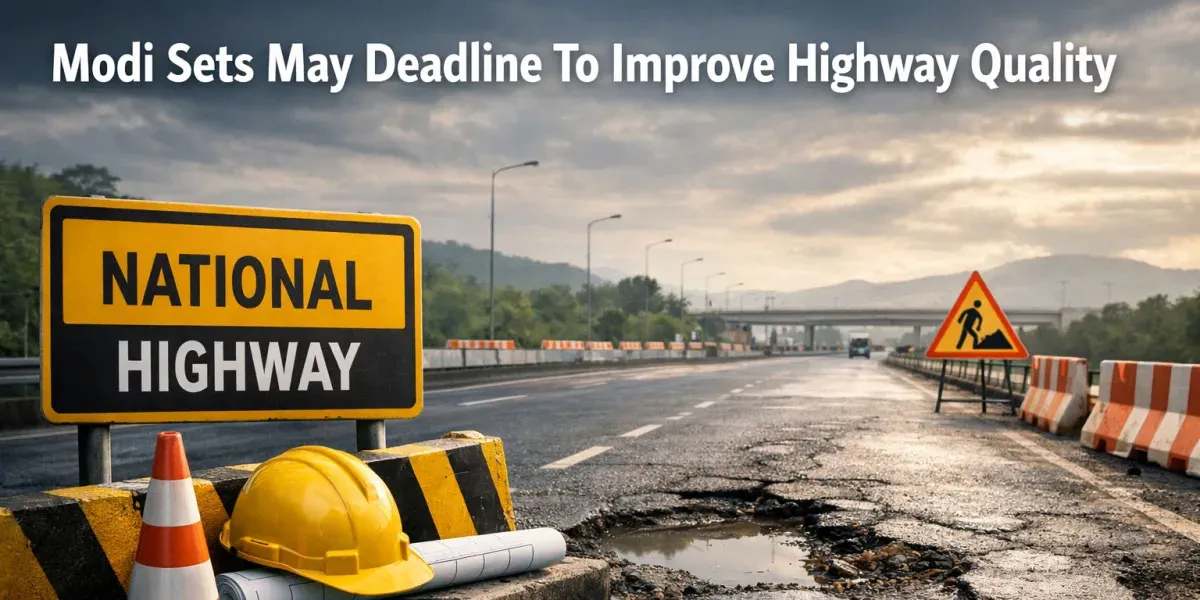
Prime Minister Narendra Modi has given the Ministry of Road Transport and Highways (the ministry) a deadline of May to improve the quality of national highways across India. The directive follows mounting complaints about deteriorating road conditions during and after the monsoon season and seeks to establish stringent standard operating procedures to improve accountability and consistency in construction and maintenance. The prime minister asked for urgent measures to ensure safer and more reliable road infrastructure.

In a review of sector progress the prime minister instructed the ministry to take decisive action against underperforming contractors and those engaged in ongoing litigation to reinforce construction standards. The review identified inadequate supervision by government engineers and consulting firms as a factor aggravating project quality and stressed the need for stronger oversight. The ministry was directed to tighten evaluation criteria and apply penalties where necessary to deter substandard work.

The prime minister asked for mechanisms to prevent blacklisted contractors from participating, directly or indirectly, in future bidding and for lower ratings for firms that frequently resort to arbitration. The ministry was also tasked with conducting a comprehensive study into delays in land acquisition amid concerns about potential collusion between contractors and landowners. The findings are expected to guide corrective actions and streamline procedures to reduce avoidable hold ups. These measures aim to improve project delivery timelines and public confidence.

Ministry officials were asked to analyse obstacles preventing high speed corridors from achieving an operational speed of 70 kilometres per hour and to identify regulatory constraints that limit efficiency. Revisions to subcontracting norms were ordered to require prior approvals from relevant authorities before subcontractor involvement in new projects. The prime minister also urged a halt to routine conversion of state highways into national highways, noting that the national highway network has expanded from approximately 91,300 kilometres to 146,000 kilometres, representing growth of 60 per cent.

Prime Minister Narendra Modi has given the Ministry of Road Transport and Highways (the ministry) a deadline of May to improve the quality of national highways across India. The directive follows mounting complaints about deteriorating road conditions during and after the monsoon season and seeks to establish stringent standard operating procedures to improve accountability and consistency in construction and maintenance. The prime minister asked for urgent measures to ensure safer and more reliable road infrastructure. In a review of sector progress the prime minister instructed the ministry to take decisive action against underperforming contractors and those engaged in ongoing litigation to reinforce construction standards. The review identified inadequate supervision by government engineers and consulting firms as a factor aggravating project quality and stressed the need for stronger oversight. The ministry was directed to tighten evaluation criteria and apply penalties where necessary to deter substandard work. The prime minister asked for mechanisms to prevent blacklisted contractors from participating, directly or indirectly, in future bidding and for lower ratings for firms that frequently resort to arbitration. The ministry was also tasked with conducting a comprehensive study into delays in land acquisition amid concerns about potential collusion between contractors and landowners. The findings are expected to guide corrective actions and streamline procedures to reduce avoidable hold ups. These measures aim to improve project delivery timelines and public confidence. Ministry officials were asked to analyse obstacles preventing high speed corridors from achieving an operational speed of 70 kilometres per hour and to identify regulatory constraints that limit efficiency. Revisions to subcontracting norms were ordered to require prior approvals from relevant authorities before subcontractor involvement in new projects. The prime minister also urged a halt to routine conversion of state highways into national highways, noting that the national highway network has expanded from approximately 91,300 kilometres to 146,000 kilometres, representing growth of 60 per cent.

Next Story
Infrastructure Urban

Premier Energies Secures Rs 25,770 mn Orders In Q4

Premier Energies Limited has received orders aggregating to Rs 25,770 million (mn) in the fourth quarter of fiscal year 2026 for the supply of 1,600 megawatt (MW) solar cells and modules. Execution of these orders is scheduled across fiscal year 2027 and fiscal year 2028 and the contracts have been secured from a mix of domestic independent power producers, module manufacturers and engineering, procurement and construction contractors in India. Capacity increases support the order book, with cell capacity expected to reach 10.6 gigawatt (GW) by September 2026 and module manufacturing capacity ..

Next Story
Building Material

Steel Exchange India Reports Rs 280 mn Debt Repayment

Steel Exchange India Limited (SEIL), one of the leading integrated steel manufacturers in South India and the maker of SIMHADRI TMT, has reported the repayment of Rs 280 mn of debt over the last two quarters. The company informed exchanges under listing regulations that the repayment was part of scheduled deleveraging measures aimed at strengthening the balance sheet. The update followed credit facilities that were taken in September 2025 to support operations and growth initiatives. During the period October 2025 to March 2026 a partial redemption was executed with Rs 214.3 mn directed toward..

Next Story
Infrastructure Energy

Tata Power Adopts Databricks Platform To Accelerate Energy Transition

Tata Power has adopted the Databricks platform across its enterprise to accelerate data and AI transformation across its business clusters. The initiative is intended to drive enhanced operational efficiency, smarter decision making and scalable digital innovation as the company advances renewable integration, smart grids and an expanding business-to-consumer portfolio. Tata Power framed the move as a step towards building a future-ready data and AI platform to power its next phase of growth. The unified platform will support intelligent grid management, advanced power planning and optimisatio..

Advertisement

Subscribe to Our Newsletter

Get daily newsletters around different themes from Construction world.

STAY CONNECTED

Advertisement

Advertisement

Advertisement