NHAI To Remove Illegal Highway Eateries And Curb Unauthorised Parking
ROADS & HIGHWAYS

NHAI To Remove Illegal Highway Eateries And Curb Unauthorised Parking

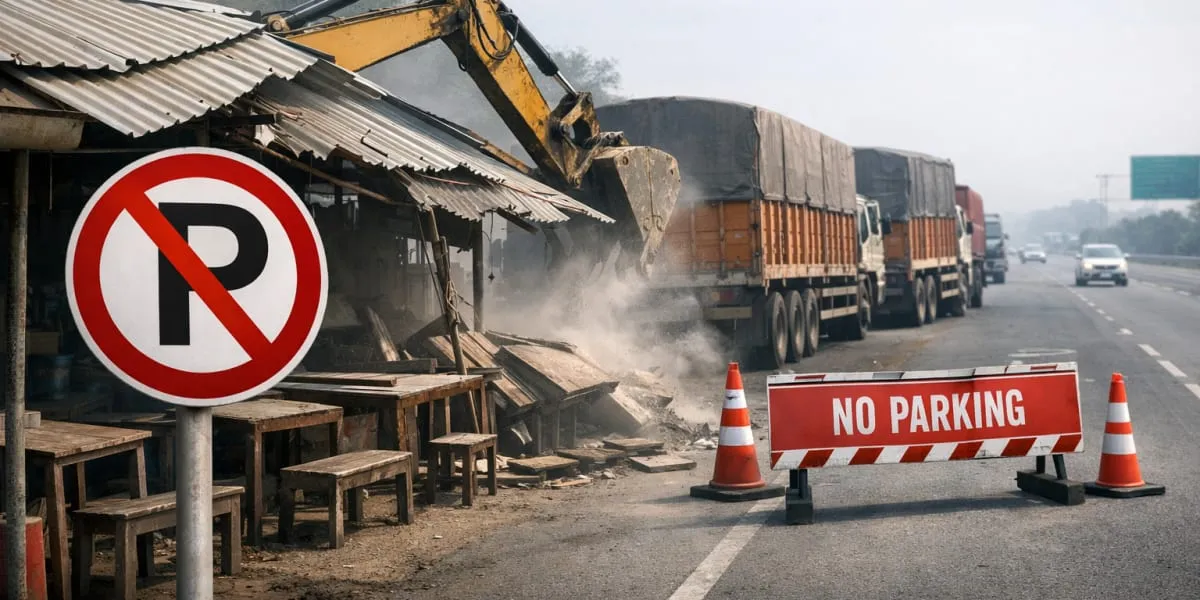
Illegal dhabas and roadside eateries along the National Highways will be removed to prevent the parking of heavy goods vehicles outside, the National Highways Authority of India (NHAI) said in a statement. The measure forms part of a major drive by the authority to curb unauthorised parking and encroachments and to enhance safety and ensure obstruction-free movement. The initiative follows a Supreme Court order restricting the parking of trucks along National Highway stretches except at designated bye-lays.

The authority has identified 595 critical locations of unauthorised parking, accompanied by longitude and latitude details, and is working closely with state governments, district administrations and enforcement agencies to remove unauthorised parking from National Highways. Removal of encroachments will be undertaken under the provisions of the Control of National Highways (Land and Traffic) Act, 2002. Coordination with local agencies is intended to support timely enforcement action and sustained compliance.

The authority is also supporting the establishment of District Highway Safety Task Forces and the appointment of nodal officers to monitor compliance and to facilitate inter-agency coordination. These mechanisms are intended to enable continuous monitoring of safety-related issues along the National Highway network and to provide a framework for rapid decision making. Field units have been urged to maintain active communication with enforcement partners to support removal operations.

Field offices have been directed to audit all Advanced Traffic Management System (ATMS) installations and to ensure that traffic monitoring cameras, video incident detection systems, variable speed detection systems, variable message signboards and emergency call boxes are fully operational. Deployment of ambulances and recovery vehicles, enhanced highway patrolling and integration of ATMS alerts with enforcement agencies have been prioritised to improve incident response and enforcement. Proactive maintenance of safety infrastructure is expected to contribute to safer travel for national highway users across the country.

Illegal dhabas and roadside eateries along the National Highways will be removed to prevent the parking of heavy goods vehicles outside, the National Highways Authority of India (NHAI) said in a statement. The measure forms part of a major drive by the authority to curb unauthorised parking and encroachments and to enhance safety and ensure obstruction-free movement. The initiative follows a Supreme Court order restricting the parking of trucks along National Highway stretches except at designated bye-lays. The authority has identified 595 critical locations of unauthorised parking, accompanied by longitude and latitude details, and is working closely with state governments, district administrations and enforcement agencies to remove unauthorised parking from National Highways. Removal of encroachments will be undertaken under the provisions of the Control of National Highways (Land and Traffic) Act, 2002. Coordination with local agencies is intended to support timely enforcement action and sustained compliance. The authority is also supporting the establishment of District Highway Safety Task Forces and the appointment of nodal officers to monitor compliance and to facilitate inter-agency coordination. These mechanisms are intended to enable continuous monitoring of safety-related issues along the National Highway network and to provide a framework for rapid decision making. Field units have been urged to maintain active communication with enforcement partners to support removal operations. Field offices have been directed to audit all Advanced Traffic Management System (ATMS) installations and to ensure that traffic monitoring cameras, video incident detection systems, variable speed detection systems, variable message signboards and emergency call boxes are fully operational. Deployment of ambulances and recovery vehicles, enhanced highway patrolling and integration of ATMS alerts with enforcement agencies have been prioritised to improve incident response and enforcement. Proactive maintenance of safety infrastructure is expected to contribute to safer travel for national highway users across the country.

Related Stories

Gold Stories

Next Story
Infrastructure Urban

KONE Opens India's First Digital Experience Centre in Pune

KONE, a global elevator and escalator manufacturer, has inaugurated its first Digital Experience Centre (DEC) in India, located in Pune. The facility aims to showcase how artificial intelligence (AI), connectivity and data-driven technologies can enhance customer experiences and improve building operations.The centre was inaugurated by Jussi Herlin, Executive Vice Chair, KONE Corporation; Philippe Delorme, President and CEO, KONE; and Nandan Nilekani, Co-founder and Chairman of the Board, Infosys.Designed as an interactive customer environment, the facility demonstrates digital solutions cover..

Next Story
Infrastructure Urban

CII GreenCo Launches Circularity Guidelines for Indian Industry

The Confederation of Indian Industry (CII) GreenCo Council has launched the CII GreenCo Circularity Guidelines – Pilot Version at the 17th CII GreenCo Waste & Resource Management Summit 2026 in Chennai. The initiative aims to strengthen resource efficiency, waste reduction and circular economy practices across Indian manufacturing and process industries.The guidelines introduce a structured framework with circularity indices covering raw materials, consumables, packaging and other resource inputs. These indicators will help industries assess existing practices, identify opportunities to ..

Next Story
Infrastructure Energy

Global Electronics Association Launches IPC-1783-CO2E Standard

The Global Electronics Association has introduced IPC-1783-CO2E, a new international standard aimed at improving consistency, transparency and comparability in product carbon footprint reporting across the electronics manufacturing industry.The standard, titled International Standard for Data Collection and Reporting of CO2 Equivalent (CO2e) Emissions for the Electronics Manufacturing Supply Chain, provides industry-specific guidance for collecting, estimating and reporting carbon emissions data.With increasing regulatory requirements and customer expectations, electronics manufacturers face c..

Advertisement

Subscribe to Our Newsletter

Get daily newsletters around different themes from Construction world.

STAY CONNECTED

Advertisement

SPECIAL OFFER
QR Code