+
OMR And Pallavaram Radial Road To Be Model Mobility Corridors
ROADS & HIGHWAYS

OMR And Pallavaram Radial Road To Be Model Mobility Corridors

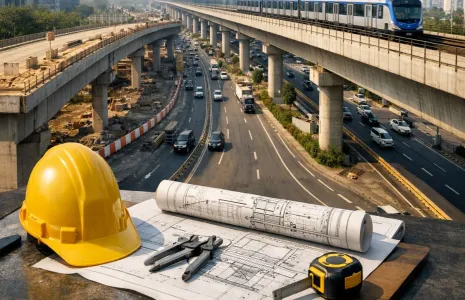
The Chennai Unified Metropolitan Transport Authority (Cumta) has decided to prepare a detailed project report to transform two major corridors into model urban mobility corridors. The Old Mahabalipuram Road (OMR) will be redeveloped along a stretch of 25 km from Madhya Kailash to Kelambakkam while the Pallavaram-Thoraipakkam Radial Road will be upgraded for seven point four km from Pallavaram Bridge to Thoraipakkam junction. The project is intended to create primary corridors linked with transport hubs to improve last-mile connectivity and multimodal integration.

The detailed project report (DPR) will outline upgrades to public spaces and infrastructure, including areas under flyovers, grade separators and above subways, and roads integrated with parks, together with improvements to the road network around public transportation hubs. The plan will prioritise walking and cycling and seek to de-incentivise private vehicle use to reduce congestion and vehicle idling at intersections, according to a Cumta document. The aim is to reduce or maintain the status quo of annual per capita greenhouse gas (GHG) emissions through promotion of low carbon modes.

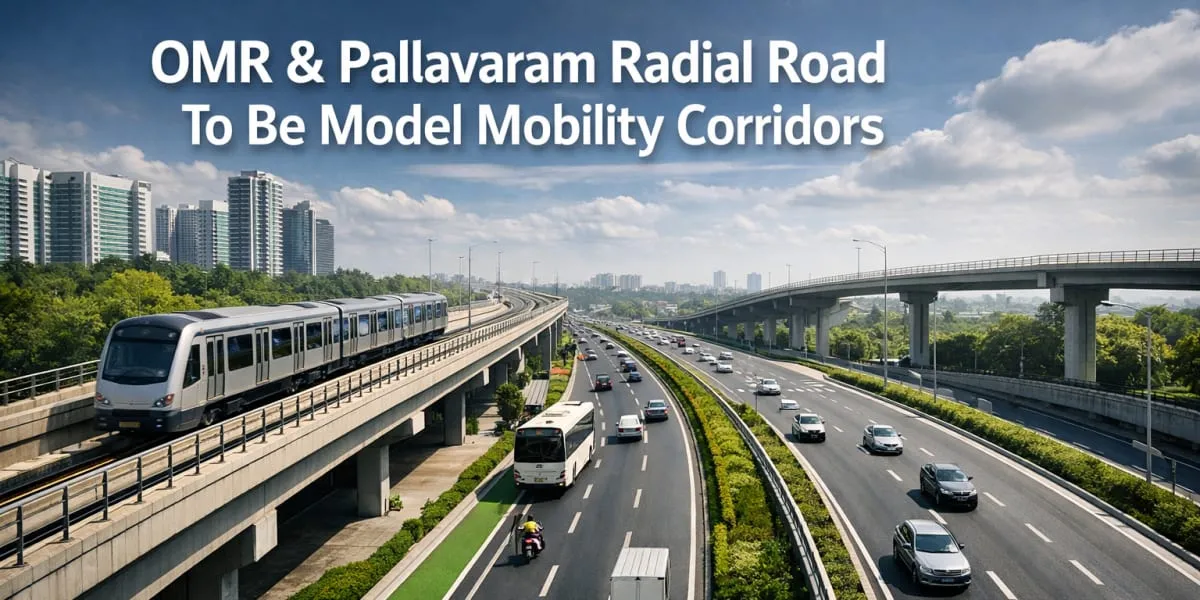
The corridor vision encompasses seamless traffic flow with clear priorities for non-motorised transportation (NMT) and public transportation, multimodal integration and measures for decongestion and comprehensive road safety. Proposals will include widening and strengthening of existing roads to achieve a uniform carriageway with a green median and dedicated service lanes, together with rehabilitation and widening of culverts and bridges and construction of grade separators. The report will also identify pedestrian facilities and safe intersections.

Design elements will provide designated bus bays and parking bays, improved access to railway stations, Mass Rapid Transit (MRT) stations and Metro stations, and measures to integrate bus terminals and stands with surrounding urban development. The DPR is expected to present a programme of phased interventions to enable implementation while minimising disruption to commuters and existing services. Cumta will use the DPR to guide subsequent detailed design and implementation planning.

The Chennai Unified Metropolitan Transport Authority (Cumta) has decided to prepare a detailed project report to transform two major corridors into model urban mobility corridors. The Old Mahabalipuram Road (OMR) will be redeveloped along a stretch of 25 km from Madhya Kailash to Kelambakkam while the Pallavaram-Thoraipakkam Radial Road will be upgraded for seven point four km from Pallavaram Bridge to Thoraipakkam junction. The project is intended to create primary corridors linked with transport hubs to improve last-mile connectivity and multimodal integration. The detailed project report (DPR) will outline upgrades to public spaces and infrastructure, including areas under flyovers, grade separators and above subways, and roads integrated with parks, together with improvements to the road network around public transportation hubs. The plan will prioritise walking and cycling and seek to de-incentivise private vehicle use to reduce congestion and vehicle idling at intersections, according to a Cumta document. The aim is to reduce or maintain the status quo of annual per capita greenhouse gas (GHG) emissions through promotion of low carbon modes. The corridor vision encompasses seamless traffic flow with clear priorities for non-motorised transportation (NMT) and public transportation, multimodal integration and measures for decongestion and comprehensive road safety. Proposals will include widening and strengthening of existing roads to achieve a uniform carriageway with a green median and dedicated service lanes, together with rehabilitation and widening of culverts and bridges and construction of grade separators. The report will also identify pedestrian facilities and safe intersections. Design elements will provide designated bus bays and parking bays, improved access to railway stations, Mass Rapid Transit (MRT) stations and Metro stations, and measures to integrate bus terminals and stands with surrounding urban development. The DPR is expected to present a programme of phased interventions to enable implementation while minimising disruption to commuters and existing services. Cumta will use the DPR to guide subsequent detailed design and implementation planning.

Related Stories

Gold Stories

Next Story
Infrastructure Transport

MMRDA Targets Completion of Projects by December 2028

The Mumbai Metropolitan Region Development Authority (MMRDA) is targeting the completion of all its ongoing infrastructure projects by December 2028, a year ahead of its December 2029 deadline, Metropolitan Commissioner Dr Sanjay Mukherjee has said.Speaking at the sixth edition of the Real Estate & Infrastructure Investors' Summit (REIIS) 2026 in Mumbai, Mukherjee said the authority was developing an integrated network of roads, tunnels, sea links and Metro corridors under its broader vision of “Mumbai in 59 Minutes”.The objective is to improve east-west and north-south connectivity an..

Next Story
Building Material

High-Performance Façades Gain Ground in Indian Buildings

High-performance façades are gaining greater importance in Indian architecture as developers and architects increasingly focus on energy efficiency, thermal comfort and building performance, according to Shankar Fenestrations & Glasses.The company said modern façade systems are increasingly being considered as part of a building's overall performance strategy rather than being used primarily as aesthetic elements.High-performance glass, curtain wall systems and structural glazing can contribute to thermal regulation, solar control, daylight management and indoor comfort. Their growing ad..

Next Story
Technology

SPML Infra's 104.4 kWh BESS Battery Pack Clears Global Tests

SPML Infra has announced that its proprietary 104.4 kWh Battery Energy Storage System (BESS) battery pack has completed key international safety, performance and transportation testing and certification requirements, marking a step towards its commercial deployment.Developed under the company's own intellectual property, the battery pack has completed requirements under UL9540A, IEC 62619, IEC 63056, IEC 60730, IEC 61000-6-2, IEC 61000-6-4 and UN38.3 standards.The testing covers areas including thermal runaway safety, battery performance, system functional safety, electromagnetic compatibility..

Advertisement

Subscribe to Our Newsletter

Get daily newsletters around different themes from Construction world.

STAY CONNECTED

Advertisement

SPECIAL OFFER
QR Code