+
Ahmedabad Metro Phase Three Secures PIB Clearance
RAILWAYS & METRO RAIL

Ahmedabad Metro Phase Three Secures PIB Clearance

The Public Investment Board (PIB) has approved the proposed Phase Three expansion of the Ahmedabad Metro, clearing a key administrative hurdle for the project. The expansion will create a 60 km network and include a planned connection to Dholera International Airport, and the Gujarat Metro Rail Corporation (GMRC) is overseeing development. Final approval from the Union Cabinet is required before civil construction may begin.

A principal element of Phase Three is a corridor from Thaltej Gam to Badrabad via Godhavi that will start at Shilaj Canal Road and follow the Sardar Patel Ring Road before reaching Badrabad near the Ahmedabad?Dholera Expressway. The Badrabad terminal has been proposed as a future interchange for extensions towards the Dholera Special Investment Region and the airport, intended to enhance connectivity in south west Ahmedabad. The plan will also integrate the new corridors with the existing East?West and North?South lines to provide additional interchange options.

The proposal foresees a circular corridor beginning and ending at Vadaj that will loop through western, eastern and southern parts of the city and call at key locations such as Akhbarnagar, Naranpura and Amraiwadi to offer alternatives to central city travel. Major interchanges are planned at Gujarat University, APMC, Amraiwadi and Vadaj to facilitate passenger movement without routing through the central business district. The expanded network is expected to include 41 elevated stations across the 60 km of new lines.

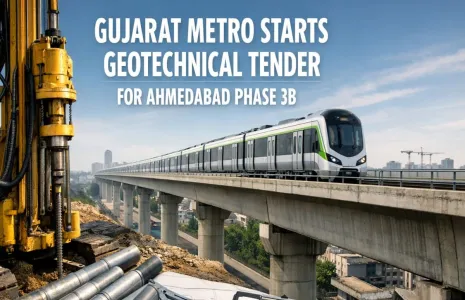
Preparatory work is under way as GMRC has engaged Detailed Design Consultants to finalise structural alignments and has begun geotechnical testing, utility diversion planning and tendering to reduce lead time before construction. A direct metro link to the South West Ahmedabad Sports Arena (SWASA) at Godhavi is included to improve access to the developing complex and support potential events related to Gujarat's bid for the 2030 Commonwealth Games. The PIB clearance marks a significant step while final cabinet approval will determine the course and timing of construction and future extensions towards Dholera.

The Public Investment Board (PIB) has approved the proposed Phase Three expansion of the Ahmedabad Metro, clearing a key administrative hurdle for the project. The expansion will create a 60 km network and include a planned connection to Dholera International Airport, and the Gujarat Metro Rail Corporation (GMRC) is overseeing development. Final approval from the Union Cabinet is required before civil construction may begin. A principal element of Phase Three is a corridor from Thaltej Gam to Badrabad via Godhavi that will start at Shilaj Canal Road and follow the Sardar Patel Ring Road before reaching Badrabad near the Ahmedabad?Dholera Expressway. The Badrabad terminal has been proposed as a future interchange for extensions towards the Dholera Special Investment Region and the airport, intended to enhance connectivity in south west Ahmedabad. The plan will also integrate the new corridors with the existing East?West and North?South lines to provide additional interchange options. The proposal foresees a circular corridor beginning and ending at Vadaj that will loop through western, eastern and southern parts of the city and call at key locations such as Akhbarnagar, Naranpura and Amraiwadi to offer alternatives to central city travel. Major interchanges are planned at Gujarat University, APMC, Amraiwadi and Vadaj to facilitate passenger movement without routing through the central business district. The expanded network is expected to include 41 elevated stations across the 60 km of new lines. Preparatory work is under way as GMRC has engaged Detailed Design Consultants to finalise structural alignments and has begun geotechnical testing, utility diversion planning and tendering to reduce lead time before construction. A direct metro link to the South West Ahmedabad Sports Arena (SWASA) at Godhavi is included to improve access to the developing complex and support potential events related to Gujarat's bid for the 2030 Commonwealth Games. The PIB clearance marks a significant step while final cabinet approval will determine the course and timing of construction and future extensions towards Dholera.

Related Stories

Gold Stories

Next Story
Infrastructure Urban

KONE Opens India's First Digital Experience Centre in Pune

KONE, a global elevator and escalator manufacturer, has inaugurated its first Digital Experience Centre (DEC) in India, located in Pune. The facility aims to showcase how artificial intelligence (AI), connectivity and data-driven technologies can enhance customer experiences and improve building operations.The centre was inaugurated by Jussi Herlin, Executive Vice Chair, KONE Corporation; Philippe Delorme, President and CEO, KONE; and Nandan Nilekani, Co-founder and Chairman of the Board, Infosys.Designed as an interactive customer environment, the facility demonstrates digital solutions cover..

Next Story
Infrastructure Urban

CII GreenCo Launches Circularity Guidelines for Indian Industry

The Confederation of Indian Industry (CII) GreenCo Council has launched the CII GreenCo Circularity Guidelines – Pilot Version at the 17th CII GreenCo Waste & Resource Management Summit 2026 in Chennai. The initiative aims to strengthen resource efficiency, waste reduction and circular economy practices across Indian manufacturing and process industries.The guidelines introduce a structured framework with circularity indices covering raw materials, consumables, packaging and other resource inputs. These indicators will help industries assess existing practices, identify opportunities to ..

Next Story
Infrastructure Energy

Global Electronics Association Launches IPC-1783-CO2E Standard

The Global Electronics Association has introduced IPC-1783-CO2E, a new international standard aimed at improving consistency, transparency and comparability in product carbon footprint reporting across the electronics manufacturing industry.The standard, titled International Standard for Data Collection and Reporting of CO2 Equivalent (CO2e) Emissions for the Electronics Manufacturing Supply Chain, provides industry-specific guidance for collecting, estimating and reporting carbon emissions data.With increasing regulatory requirements and customer expectations, electronics manufacturers face c..

Advertisement

Subscribe to Our Newsletter

Get daily newsletters around different themes from Construction world.

STAY CONNECTED

Advertisement

SPECIAL OFFER
QR Code