Bengaluru Tunnel Road Cost Higher Than Metro Per Km
RAILWAYS & METRO RAIL

Bengaluru Tunnel Road Cost Higher Than Metro Per Km

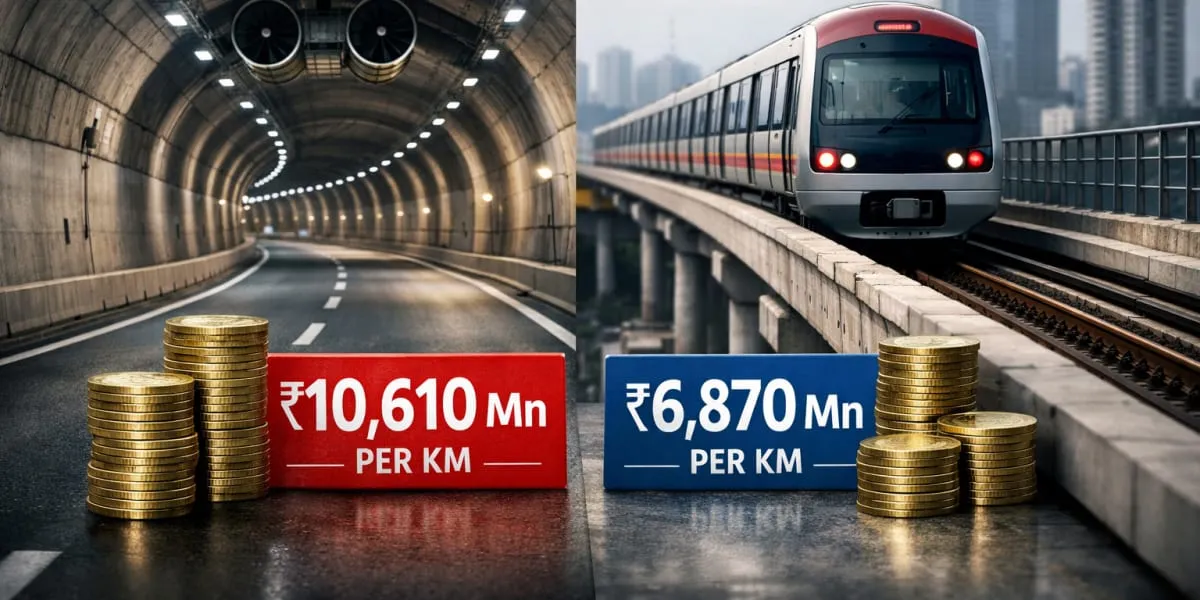
The proposed 16.75 kilometre (km) tunnel road from KR Puram to Hebbal will cost one point five times more per km than the Metro Red Line, according to detailed project reports. The tunnel road DPR pegs construction at Rs 1,061 crore per km, which equals Rs 10,610 million (mn) per km, while the Metro DPR estimates Rs 687 crore per km, equal to Rs 6,870 mn per km. The comparison uses DPR figures made publicly available and highlights a marked difference in per kilometre construction costs for broadly similar corridors.

The Namma Metro Phase three A Red Line is set out as a 37.80 km corridor connecting Sarjapur to Hebbal, with an estimated cost of Rs 25,999 crore or Rs 259,990 mn. The corridor comprises 23.524 km of elevated viaduct with 17 stations and 14.28 km of underground sections with 10 stations, totalling 27 stations and indicating high passenger capacity. The Metro per kilometre figure derives from dividing the overall estimate by the corridor length.

The proposed tunnel road is currently estimated at Rs 17,780 crore, or Rs 177,800 mn, for the 16.75 km alignment and therefore works out to Rs 10,610 mn per km. Project documents note the possibility of cost escalation by up to 45 per cent before completion, which would lift the per kilometre estimate to about Rs 1,538 crore or Rs 15,380 mn per km. The DPR further indicates that the Metro would carry a maximum fare of Rs 90 while the tolled tunnel would levy a round trip charge above Rs 600 and would restrict certain vehicle types.

The Metro project itself has been subject to review after a December 2024 cabinet approval placed Phase three A at Rs 28,405 crore, or Rs 284,050 mn, but a later submission to the ministry led to revisions and the dropping of one station to lower costs. Both schemes broadly address travel between south east and north parts of Bengaluru, yet they differ fundamentally in function, capacity and user charges. Officials have inspected junctions along proposed routes as studies continue amid judicial and technical scrutiny.

The proposed 16.75 kilometre (km) tunnel road from KR Puram to Hebbal will cost one point five times more per km than the Metro Red Line, according to detailed project reports. The tunnel road DPR pegs construction at Rs 1,061 crore per km, which equals Rs 10,610 million (mn) per km, while the Metro DPR estimates Rs 687 crore per km, equal to Rs 6,870 mn per km. The comparison uses DPR figures made publicly available and highlights a marked difference in per kilometre construction costs for broadly similar corridors. The Namma Metro Phase three A Red Line is set out as a 37.80 km corridor connecting Sarjapur to Hebbal, with an estimated cost of Rs 25,999 crore or Rs 259,990 mn. The corridor comprises 23.524 km of elevated viaduct with 17 stations and 14.28 km of underground sections with 10 stations, totalling 27 stations and indicating high passenger capacity. The Metro per kilometre figure derives from dividing the overall estimate by the corridor length. The proposed tunnel road is currently estimated at Rs 17,780 crore, or Rs 177,800 mn, for the 16.75 km alignment and therefore works out to Rs 10,610 mn per km. Project documents note the possibility of cost escalation by up to 45 per cent before completion, which would lift the per kilometre estimate to about Rs 1,538 crore or Rs 15,380 mn per km. The DPR further indicates that the Metro would carry a maximum fare of Rs 90 while the tolled tunnel would levy a round trip charge above Rs 600 and would restrict certain vehicle types. The Metro project itself has been subject to review after a December 2024 cabinet approval placed Phase three A at Rs 28,405 crore, or Rs 284,050 mn, but a later submission to the ministry led to revisions and the dropping of one station to lower costs. Both schemes broadly address travel between south east and north parts of Bengaluru, yet they differ fundamentally in function, capacity and user charges. Officials have inspected junctions along proposed routes as studies continue amid judicial and technical scrutiny.

Related Stories

Gold Stories

Next Story
Infrastructure Urban

Vedanta Metal Bazaar Expands to Global Markets

Vedanta Aluminium has expanded its digital e-commerce platform, Vedanta Metal Bazaar, to international markets, enabling overseas customers to order and purchase aluminium products online.The platform will now be available to buyers across Asia, Europe, Africa and the Americas, providing a digital gateway for export transactions with 24x7 access.In FY26, Vedanta Metal Bazaar processed transactions worth nearly $4.1 billion, or over Rs 380 billion, and fulfilled more than 23,000 orders. The platform is also used regularly by more than 550 MSMEs in India alongside large OEM customers.The export ..

Next Story
Infrastructure Urban

Ramky Infrastructure Q1 FY27 Revenue Rises 24.3%

Ramky Infrastructure Limited reported a 24.3% year-on-year increase in consolidated revenue from operations to Rs 471.2 crore for Q1 FY27, compared with Rs 3.79 billion in the corresponding quarter of FY26.Standalone revenue from operations rose 27.5% YoY to Rs 4.51 billion from Rs 3.54 billion, while total standalone income increased 35% to Rs 5.32 billion.Consolidated profit before tax stood at Rs 540.9 million during the quarter. The company highlighted a sharp sequential improvement compared with a pre-exceptional loss of Rs 190.1 million in Q4 FY26.Two of the three projects awarded during..

Next Story
Technology

LTTS Launches AgenticIQ AI Platform for Engineering

L&T Technology Services (LTTS) has launched AgenticIQ, an end-to-end agentic AI platform designed for engineering and manufacturing organisations.The platform is aimed at helping enterprises move beyond isolated AI pilots by enabling autonomous, multi-agent workflows across engineering, product development, manufacturing, industrial operations and customer experience.AgenticIQ is built on LTTS’ Engineering Intelligence portfolio and converts existing engineering capabilities into specialised, reusable AI agents. Its planning-first architecture is embedded into engineering and production ..

Advertisement

Subscribe to Our Newsletter

Get daily newsletters around different themes from Construction world.

STAY CONNECTED

Advertisement

Advertisement

Advertisement