MPD 2047 Unveiled With Housing And Metro Expansion
RAILWAYS & METRO RAIL

MPD 2047 Unveiled With Housing And Metro Expansion

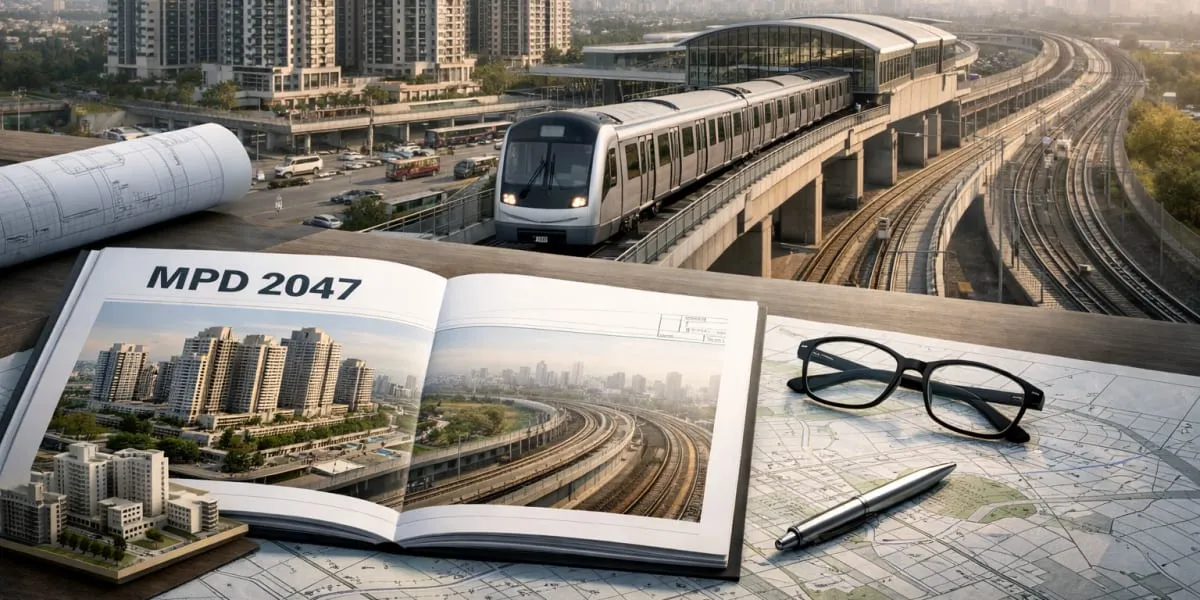
The Union government unveiled the Master Plan for Delhi (MPD 2047), outlining long-term changes for the capital. The 535-page plan proposes construction of four million (4 mn) homes and expansion of the metro rail network to 695 km by 2047 to meet demand. It includes multimodal transit hubs and a unified parking management system to improve connectivity. The roadmap is presented as aligned with the vision of Viksit Bharat 2047 and as a strategic framework for growth.

The plan designates hubs at Anand Vihar, Sarai Kale Khan and Kashmiri Gate and proposes integration of buses and six new Regional Rapid Transit System corridors. A Transit Oriented Development policy is intended to facilitate affordable housing near transit nodes and to encourage compact growth. Commercial activity will be permitted on ground floors along roads 30 metres wide in residential areas. Data centres, co-working spaces and cloud kitchens are listed under a new economies category.

The master plan removes general building height norms for most of the city while protecting special zones such as the Lutyens' Bungalow Zone, certain bungalow areas, Connaught Place and the Yamuna floodplain and Ridge. For plotted residential housing outside these zones the plan prescribes a maximum height of 15 metres for plots without stilt parking and 17.5 metres for plots with stilt parking. Regeneration schemes with public spaces, schools, healthcare and childcare will be allowed a maximum floor area ratio of 350 to enable integrated redevelopment.

The plan commits to preserving 180 sq km of Yamuna floodplains and the Ridge while promoting development elsewhere. It projects support for investment, innovation and job creation for an estimated 32 million (32 mn) residents and seeks to shift urban planning from a regulatory approach to a development-oriented model. Officials expect closer coordination among the Centre, the Delhi government and civic bodies to aid implementation. The plan also states that no farmhouses will be permitted in low-density areas and recommends area-based redevelopment of unauthorised colonies.

The Union government unveiled the Master Plan for Delhi (MPD 2047), outlining long-term changes for the capital. The 535-page plan proposes construction of four million (4 mn) homes and expansion of the metro rail network to 695 km by 2047 to meet demand. It includes multimodal transit hubs and a unified parking management system to improve connectivity. The roadmap is presented as aligned with the vision of Viksit Bharat 2047 and as a strategic framework for growth. The plan designates hubs at Anand Vihar, Sarai Kale Khan and Kashmiri Gate and proposes integration of buses and six new Regional Rapid Transit System corridors. A Transit Oriented Development policy is intended to facilitate affordable housing near transit nodes and to encourage compact growth. Commercial activity will be permitted on ground floors along roads 30 metres wide in residential areas. Data centres, co-working spaces and cloud kitchens are listed under a new economies category. The master plan removes general building height norms for most of the city while protecting special zones such as the Lutyens' Bungalow Zone, certain bungalow areas, Connaught Place and the Yamuna floodplain and Ridge. For plotted residential housing outside these zones the plan prescribes a maximum height of 15 metres for plots without stilt parking and 17.5 metres for plots with stilt parking. Regeneration schemes with public spaces, schools, healthcare and childcare will be allowed a maximum floor area ratio of 350 to enable integrated redevelopment. The plan commits to preserving 180 sq km of Yamuna floodplains and the Ridge while promoting development elsewhere. It projects support for investment, innovation and job creation for an estimated 32 million (32 mn) residents and seeks to shift urban planning from a regulatory approach to a development-oriented model. Officials expect closer coordination among the Centre, the Delhi government and civic bodies to aid implementation. The plan also states that no farmhouses will be permitted in low-density areas and recommends area-based redevelopment of unauthorised colonies.

Related Stories

Gold Stories

Next Story
Real Estate

Gradiant expands Coimbatore engineering centre

Gradiant has expanded its Global Engineering Center (GEC) in Coimbatore, more than doubling its engineering workforce from approximately 100 to over 200 professionals as it strengthens its global project execution capabilities.The expanded centre will bring together multidisciplinary expertise across process engineering, detailed design and project engineering, enabling the India team to take on greater responsibility for the engineering and design of Gradiant’s international projects.According to Govind Alagappan, COO, Gradiant, Coimbatore’s engineering talent and industrial heritage make..

Next Story
Infrastructure Urban

Domestic Firms Choose Locally Designed Reactors to Cut Delays

Domestic companies in the nuclear sector are choosing locally designed reactors to avoid time consuming approvals and supply chain bottlenecks that can delay project execution. The shift reflects an emphasis on reducing dependence on foreign designs and accelerating construction schedules by aligning design, manufacturing and regulatory processes within national frameworks. Industry participants expect that locally designed systems will allow closer coordination with regulators and vendors, shortening lead times for certification and component delivery. Localisation is projected to stimulate t..

Next Story
Infrastructure Urban

Kadiyam Kavya Seeks Separate Railway Division For Kazipet

Warangal Member of Parliament Kadiyam Kavya has urged the establishment of a separate railway division based at Kazipet and submitted a representation to the South Central Railway (SCR) general manager at the headquarters in Secunderabad. She highlighted Kazipet's role as a major railway hub and argued that the junction has not seen development commensurate with its strategic importance. The representative action aimed to press for administrative reorganisation to address local operational and developmental needs. She noted that creation of an independent Kazipet division has been a long stand..

Advertisement

Subscribe to Our Newsletter

Get daily newsletters around different themes from Construction world.

STAY CONNECTED

Advertisement