Mumbai Metro Records Highest Single Day Ridership
RAILWAYS & METRO RAIL

Mumbai Metro Records Highest Single Day Ridership

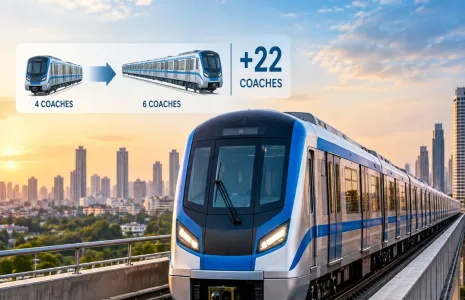
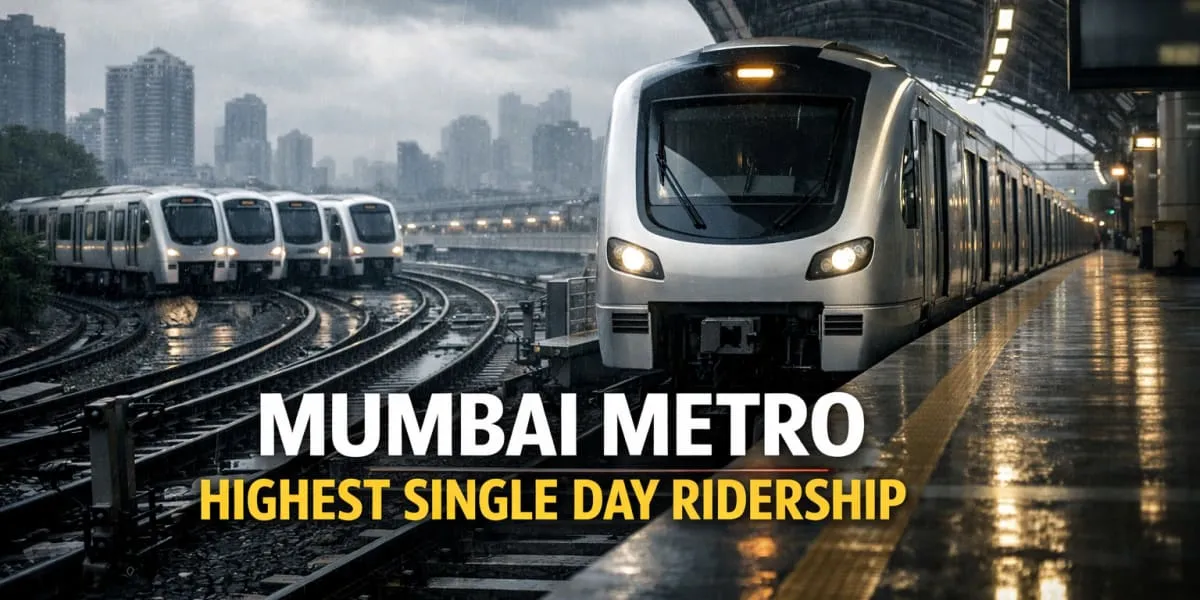
The Maha Mumbai Metro Operation Corporation Limited (MMMOCL) recorded its highest-ever single day ridership of 358,115 passenger journeys on 23 June 2026 as the southwest monsoon intensified across the Mumbai Metropolitan Region. To accommodate increased passenger demand MMMOCL positioned additional metro rakes on standby across all corridors that can be deployed according to ridership and crowd levels and these will be operational beyond peak hours to ensure safe and reliable travel during the monsoon. Previously, on 19 June the metro recorded a peak of 357,895 passenger journeys. Service adjustments were implemented to manage crowding and maintain punctuality.

Mumbai Metro is the second largest metro network in India and the foundation for the project was laid in June 2006 by the then Prime Minister Manmohan Singh. The first line began passenger operations on eight June 2014 and the system has since become an integral part of the city transport network, contributing to economic growth and reduced road congestion. The metro has shortened travel times and enhanced connectivity across multiple suburbs and business districts.

The first phase of Mumbai Metro Line five from Thane to Dhamankar Naka in Bhiwandi is closer to commencement and the Commissioner of Metro Rail Safety inspection will be conducted before passenger operations begin; the corridor spans 34.21 km, making it the longest line in the Mumbai Metropolitan Region. Mumbai Metro Line nine Phase one was inaugurated on seven April 2026 and both phases commenced passenger services from eight April, increasing the number of active metro lines to five, including Line one, Line two A, Line seven and Line three, known as the Aqua Line.

MMMOCL will continue to monitor ridership patterns during the monsoon and adjust deployments to maintain service frequency and safety. The ongoing expansion of the network and phased commissioning of new corridors is intended to further relieve traffic, improve travel efficiency and extend connectivity across the city. Regular inspections and staged launches will remain part of operational planning as new sections approach readiness.

"Join industry leaders at RAHSTA Expo, India's premier platform for roads, highways and traffic infrastructure. Register now to explore innovations, network with experts and shape the future of mobility."

The Maha Mumbai Metro Operation Corporation Limited (MMMOCL) recorded its highest-ever single day ridership of 358,115 passenger journeys on 23 June 2026 as the southwest monsoon intensified across the Mumbai Metropolitan Region. To accommodate increased passenger demand MMMOCL positioned additional metro rakes on standby across all corridors that can be deployed according to ridership and crowd levels and these will be operational beyond peak hours to ensure safe and reliable travel during the monsoon. Previously, on 19 June the metro recorded a peak of 357,895 passenger journeys. Service adjustments were implemented to manage crowding and maintain punctuality. Mumbai Metro is the second largest metro network in India and the foundation for the project was laid in June 2006 by the then Prime Minister Manmohan Singh. The first line began passenger operations on eight June 2014 and the system has since become an integral part of the city transport network, contributing to economic growth and reduced road congestion. The metro has shortened travel times and enhanced connectivity across multiple suburbs and business districts. The first phase of Mumbai Metro Line five from Thane to Dhamankar Naka in Bhiwandi is closer to commencement and the Commissioner of Metro Rail Safety inspection will be conducted before passenger operations begin; the corridor spans 34.21 km, making it the longest line in the Mumbai Metropolitan Region. Mumbai Metro Line nine Phase one was inaugurated on seven April 2026 and both phases commenced passenger services from eight April, increasing the number of active metro lines to five, including Line one, Line two A, Line seven and Line three, known as the Aqua Line. MMMOCL will continue to monitor ridership patterns during the monsoon and adjust deployments to maintain service frequency and safety. The ongoing expansion of the network and phased commissioning of new corridors is intended to further relieve traffic, improve travel efficiency and extend connectivity across the city. Regular inspections and staged launches will remain part of operational planning as new sections approach readiness.

Next Story
Infrastructure Transport

RITES Expands NUPPL Railway Siding Contract To Rs1,489.3 mn

RITES Limited has expanded the scope of its railway siding contract with Neyveli Uttar Pradesh Power Limited (NUPPL), increasing the contract value to Rs1,489.3 million (mn) from Rs1,201.3 million (mn). The revision covers comprehensive operation and maintenance of the NUPPL/GTPP railway siding and includes hiring of locomotives on a wet-lease basis. The locomotive hire is for a period of 48 months and forms part of the extended operational scope under the agreement. The overall execution period remains five years from the original Memorandum of Understanding dated 13 February 2025, with the e..

Next Story
Infrastructure Urban

India Office Leasing Rises Six Per Cent In H1 2026

A Colliers India report said India's Grade A office market recorded gross leasing of 35.7 million (mn) square feet in the first half of 2026, up six per cent year-on-year despite a softer second quarter amid global trade disruptions. Leasing in April–June totalled 17.4 mn square feet, down two per cent from a year earlier, while Grade A absorption exceeded 15 mn square feet for the ninth consecutive quarter across seven markets. Demand was supported by Global Capability Centres (GCCs), technology firms and flexible workspace operators. Bengaluru led leasing with 10.5 mn square feet in H1 and..

Next Story
Real Estate

PE Investments Fall 23 per cent To Rs 1.13 bn In H1 2026

Private equity investments in the Indian real estate sector fell 23 per cent year-on-year to Rs 1.13 billion (bn) in the first half of 2026, down from Rs 1.47 bn in H1 of 2025, as investors adopted a more selective approach amid elevated global interest rates, tighter financial conditions and heightened geopolitical uncertainty. The finding appears in Knight Frank's Trends in Private Equity Investment in India: H1 2026 report. Despite the overall decline, the office segment remained the preferred asset class, accounting for 89 per cent of private equity allocations in H1 2026, with the residen..

Advertisement

Subscribe to Our Newsletter

Get daily newsletters around different themes from Construction world.

STAY CONNECTED

Advertisement

Advertisement

Advertisement