Vande Bharat Freight Train Hits 145 kmph In Trials
RAILWAYS & METRO RAIL

Vande Bharat Freight Train Hits 145 kmph In Trials

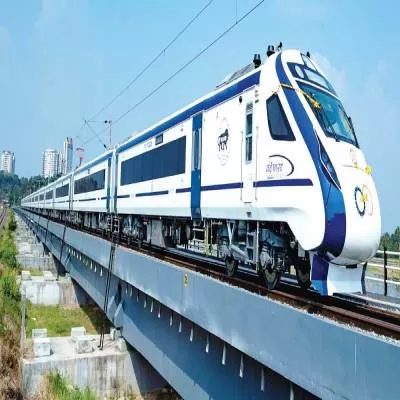
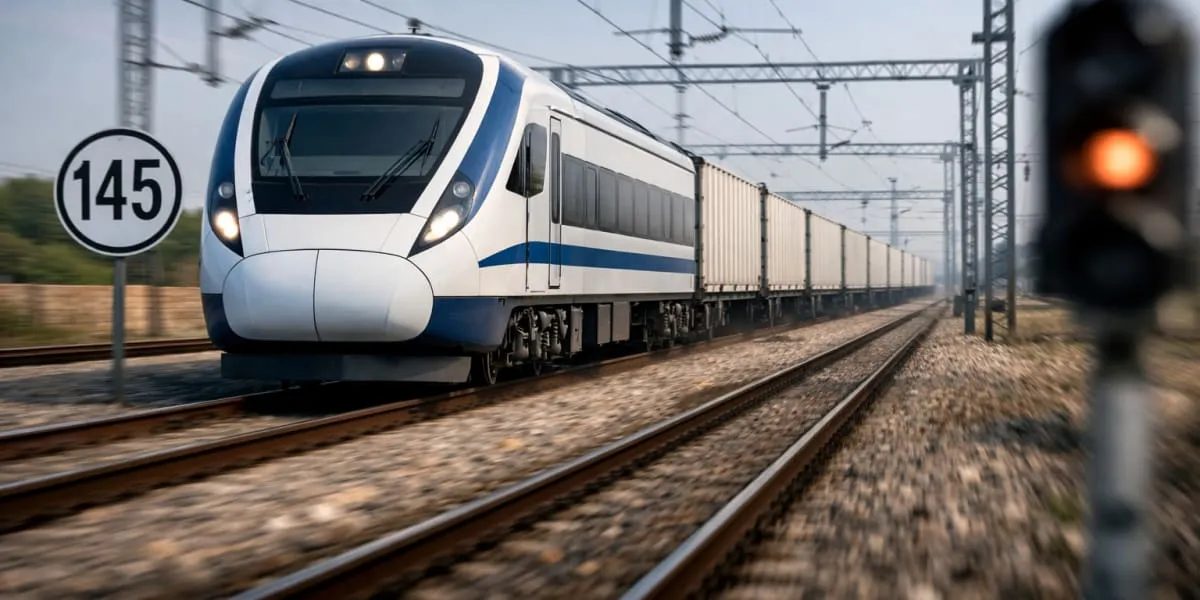
Indian Railways has begun technical trials of the country’s first Vande Bharat platform-based Freight EMU in Rajasthan’s Kota Division, with the prototype reaching a top speed of 145 kmph on its first day of testing. The trials are being carried out by the Research Designs and Standards Organisation (RDSO) on the Kota–Nagda–Sawai Madhopur high-speed corridor. The rake was developed by the Integral Coach Factory (ICF), Chennai, and will be assessed for suitability for regular operations.

The 16-coach prototype comprises 12 parcel coaches, two refrigerated vans for temperature-sensitive consignments and two non-driving trailer coaches. It carries a payload capacity of over 397 tonne (t) and an axle load exceeding 20 t, allowing the design to handle heavy cargo efficiently. The formation is fitted with advanced braking and propulsion systems to enable reliable movement of express parcels, e-commerce shipments and cold-chain freight.

Initial runs included tests at 120 kmph and 135 kmph on different sections before the unit reached 145 kmph during a return journey to Kota. The month-long programme will include at least two round trips each day on the route and will expose the rake to a range of operating and speed conditions. The trials are expected to improve the movement of parcels, e-commerce shipments and temperature-sensitive cargo across the country.

Engineers will evaluate oscillation at different speeds, braking performance, traction and ride quality along with signal and telecom interfaces and door operation. Onboard electrical equipment will be tested in both loaded and unloaded states to measure performance under varied scenarios. The comprehensive testing regime aims to validate safety and reliability parameters before clearance for scheduled service.

The introduction of a Vande Bharat Freight EMU is intended to shorten transit times for high-value and time-sensitive consignments and to strengthen cold-chain logistics. If cleared, the design could be deployed on key routes to offer faster and more dependable freight services.

Indian Railways has begun technical trials of the country’s first Vande Bharat platform-based Freight EMU in Rajasthan’s Kota Division, with the prototype reaching a top speed of 145 kmph on its first day of testing. The trials are being carried out by the Research Designs and Standards Organisation (RDSO) on the Kota–Nagda–Sawai Madhopur high-speed corridor. The rake was developed by the Integral Coach Factory (ICF), Chennai, and will be assessed for suitability for regular operations. The 16-coach prototype comprises 12 parcel coaches, two refrigerated vans for temperature-sensitive consignments and two non-driving trailer coaches. It carries a payload capacity of over 397 tonne (t) and an axle load exceeding 20 t, allowing the design to handle heavy cargo efficiently. The formation is fitted with advanced braking and propulsion systems to enable reliable movement of express parcels, e-commerce shipments and cold-chain freight. Initial runs included tests at 120 kmph and 135 kmph on different sections before the unit reached 145 kmph during a return journey to Kota. The month-long programme will include at least two round trips each day on the route and will expose the rake to a range of operating and speed conditions. The trials are expected to improve the movement of parcels, e-commerce shipments and temperature-sensitive cargo across the country. Engineers will evaluate oscillation at different speeds, braking performance, traction and ride quality along with signal and telecom interfaces and door operation. Onboard electrical equipment will be tested in both loaded and unloaded states to measure performance under varied scenarios. The comprehensive testing regime aims to validate safety and reliability parameters before clearance for scheduled service. The introduction of a Vande Bharat Freight EMU is intended to shorten transit times for high-value and time-sensitive consignments and to strengthen cold-chain logistics. If cleared, the design could be deployed on key routes to offer faster and more dependable freight services.

Next Story
Infrastructure Transport

Adani Eyes UK Port Operator Associated British Ports

Adani Ports and Special Economic Zone is evaluating a potential bid for Associated British Ports, the United Kingdom’s largest port operator, people aware of the discussions told Moneycontrol. A spokesperson said the company does not comment on market speculation and continuously evaluates opportunities that align with its long-term strategy. The spokesperson added that the approach aims to create sustainable value for stakeholders. The discussions remain at an early stage and may not result in a formal offer. Associated British Ports operates 21 ports across England, Scotland and Wales, inc..

Next Story
Infrastructure Urban

NPCIL Seeks Bids For Engineering And 3D Design Of Bharat Small Reactors

The Nuclear Power Corporation of India (NPCIL) has floated a tender for plant engineering and three-dimensional (3D) modelling of its 220 megawatt (MW) Bharat Small Reactors (BSRs). The reactors are based on proven 220 megawatt (MW) pressurised heavy water reactor (PHWR) technology and bids are to be submitted by August 10. The move marks a further step in India's plan to expand nuclear power capacity. The scope calls for generic design and engineering for civil, process, mechanical, piping, electrical and control and instrumentation systems, together with ventilation and air conditioning, pip..

Next Story
Infrastructure Urban

Supreme Court Quashes 2021 OM Allowing Retrospective Clearances

The Supreme Court quashed the 2021 Office Memorandum allowing retrospective environmental clearances for projects commenced without approval. A bench of Chief Justice Surya Kant and Justices Joymalya Bagchi and Vipul M Pancholi delivered a unanimous verdict applying prospectively to protect projects that had already received retrospective clearances from demolition and punitive measures. The court cited examples such as an AIIMS in Odisha, a greenfield airport in Vijayanagar in Karnataka and several common effluent treatment plants central to pollution control. The court held that post-facto c..

Advertisement

Subscribe to Our Newsletter

Get daily newsletters around different themes from Construction world.

STAY CONNECTED

Advertisement

Advertisement

Advertisement