Delhi Buses To Run On Hydrogen From Segregated Waste
WATER & WASTE

Delhi Buses To Run On Hydrogen From Segregated Waste

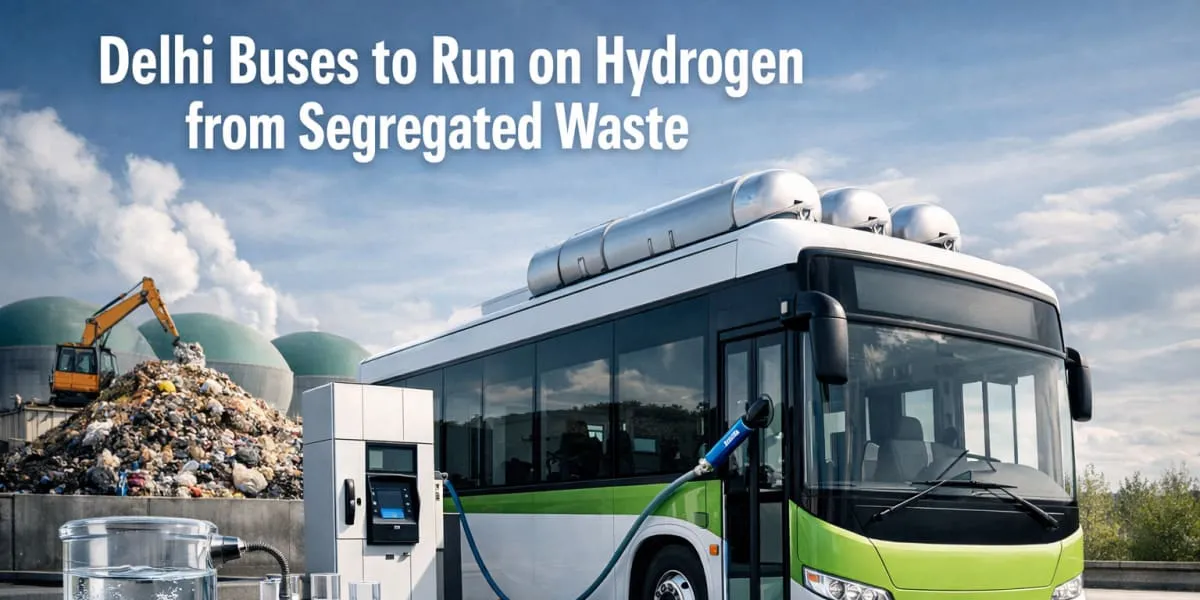
Union road transport and highways minister Nitin Gadkari addressed a youth conclave organised by the Delhi BJP and outlined a plan for public buses to run on hydrogen produced from segregated municipal waste. He described a process in which waste would be processed through biodigesters to generate hydrogen for public transport. He also set out a longer term vision of vehicles that use water to generate hydrogen for propulsion.

Gadkari said the technology would involve segregation of garbage and its conversion into hydrogen at local facilities, emphasising that such systems could be integrated into existing waste management. He acknowledged scepticism over the idea and referred to his record of forecasting developments over the past 50 years. The remarks were reported by news agencies and presented as a policy objective rather than a detailed timetable.

The minister noted that waste has already been reused in infrastructure projects, saying that around eight million (mn) tonnes (t) of garbage from Delhi landfill sites have been used in expressway construction. He used the term million (mn) and tonne (t) on first reference and indicated the government aims to eliminate garbage across the country by 2027. The comment linked waste reuse to both environmental and logistical benefits in road projects.

Gadkari pointed to economic returns from waste projects, saying the municipal corporation in his parliamentary constituency earns around Rs 3.25 billion (bn) annually by selling treated wastewater. He defined billion (bn) on first mention and suggested such revenue streams could help finance local services. He framed the approach as combining economic incentives with pollution reduction.

On fuel policy, he contested reports of damage from E20 petrol and urged critics to name any vehicle that suffered problems after the introduction of the fuel. He warned that dependence on fossil fuels imposes an economic burden of Rs 22 trillion (tn) in annual imports and underlined the importance of clean energy adoption. India has already achieved 20 per cent blending of ethanol with petrol as part of that effort.

Union road transport and highways minister Nitin Gadkari addressed a youth conclave organised by the Delhi BJP and outlined a plan for public buses to run on hydrogen produced from segregated municipal waste. He described a process in which waste would be processed through biodigesters to generate hydrogen for public transport. He also set out a longer term vision of vehicles that use water to generate hydrogen for propulsion. Gadkari said the technology would involve segregation of garbage and its conversion into hydrogen at local facilities, emphasising that such systems could be integrated into existing waste management. He acknowledged scepticism over the idea and referred to his record of forecasting developments over the past 50 years. The remarks were reported by news agencies and presented as a policy objective rather than a detailed timetable. The minister noted that waste has already been reused in infrastructure projects, saying that around eight million (mn) tonnes (t) of garbage from Delhi landfill sites have been used in expressway construction. He used the term million (mn) and tonne (t) on first reference and indicated the government aims to eliminate garbage across the country by 2027. The comment linked waste reuse to both environmental and logistical benefits in road projects. Gadkari pointed to economic returns from waste projects, saying the municipal corporation in his parliamentary constituency earns around Rs 3.25 billion (bn) annually by selling treated wastewater. He defined billion (bn) on first mention and suggested such revenue streams could help finance local services. He framed the approach as combining economic incentives with pollution reduction. On fuel policy, he contested reports of damage from E20 petrol and urged critics to name any vehicle that suffered problems after the introduction of the fuel. He warned that dependence on fossil fuels imposes an economic burden of Rs 22 trillion (tn) in annual imports and underlined the importance of clean energy adoption. India has already achieved 20 per cent blending of ethanol with petrol as part of that effort.

Next Story
Infrastructure Transport

Surya Roshni delivers customised lighting for NCRTC RRTS stations

Surya Roshni has supplied customised indoor lighting solutions for 18 elevated stations on the National Capital Region Transport Corporation's (NCRTC) Rapid Rail Transit System (RRTS), strengthening its presence in India's infrastructure lighting segment.The project involved the design and deployment of lighting systems for platforms, concourses, foot overbridges (FOBs) and back-of-house (BOH) areas. According to the company, the luminaires were developed specifically to meet NCRTC's design, operational and performance requirements rather than using standard products.Surya introduced two custo..

Next Story
Real Estate

Hilton debuts Tapestry Collection brand in Vietnam

Hilton has opened NHAAN Resort & Spa Hoi An, Tapestry Collection by Hilton, marking the debut of the Tapestry Collection brand in Vietnam and expanding its lifestyle hospitality portfolio in Southeast Asia.Located along the Co Co River in Cam Thanh village, the 174-key resort provides access to Hoi An Ancient Town, Cua Dai Beach and the Cam Thanh Nipa Forest. The property has been designed by Vietnamese architect Vo Trong Nghia, incorporating biophilic architecture, locally sourced materials and riverfront landscapes.The resort offers a mix of guest rooms and suites, including family-frien..

Next Story
Building Material

Electrent expands lithium energy storage system portfolio

Electrent Energy has expanded its lithium-based energy storage portfolio with the launch of the ESS 850 and ESS 1050, targeting compact and maintenance-free power backup solutions for Indian homes.The new systems integrate a Home UPS and a LiFePO4 lithium battery into a single unit, extending the company's product range following the launch of its ESS 1350 and ESS 2500 models.Designed for apartments and smaller homes, the ESS 850 provides up to 1 hour 15 minutes of backup, while the ESS 1050 offers up to 1 hour 45 minutes on a typical 400 W household load. The systems can power essential appli..

Advertisement

Subscribe to Our Newsletter

Get daily newsletters around different themes from Construction world.

STAY CONNECTED

Advertisement

Advertisement

Advertisement