+
Delhi Launches 917 Vehicles For Door-to-Door Waste Collection
WATER & WASTE

Delhi Launches 917 Vehicles For Door-to-Door Waste Collection

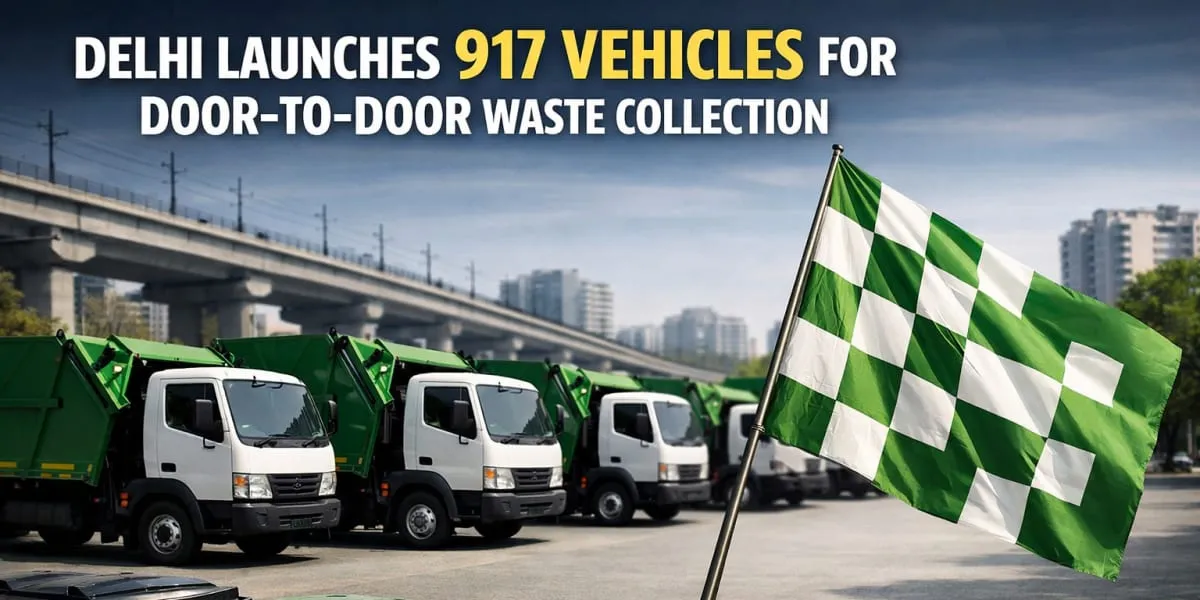
Rekha Gupta, the municipal official, flagged off 917 garbage vehicles to begin door-to-door waste collection across West Delhi. The fleet launch forms part of a municipal drive to bolster last-mile waste management and expand house-to-house collection services in the city. The vehicles will operate on designated routes to collect household refuse and organic waste and to facilitate more regular pick-up in residential areas that previously relied on communal collection points. The move seeks to improve collection frequency and reduce reliance on ad hoc pick-ups.

The drive is accompanied by logistical adjustments within municipal departments to streamline collection schedules and monitor performance. Supervisory teams will coordinate vehicle deployment and ensure adherence to operational protocols. The initiative is described as an effort to reduce littering and improve public hygiene through more systematic waste removal from neighbourhoods. Data collection systems will track service coverage and identify gaps for future planning.

Local authorities have outlined plans for integrating the new fleet with existing transfer stations and processing centres to smooth the flow of collected material. Emphasis will be placed on encouraging waste segregation at source and on routing biodegradable material to composting facilities. Officials expect the expanded collection network to ease burden on informal collectors and to strengthen overall municipal waste handling capacity. Coordination with recyclers will be strengthened to channel recoverable material into formal streams.

The project announcement highlights a broader municipal aim to raise cleanliness standards and to enhance citizen access to consistent services. Training modules for crew members are to be rolled out alongside the deployment to promote safe handling and efficient operations. Residents are being urged to follow revised collection schedules and to cooperate with segregation guidelines presented by local authorities. Public information campaigns will accompany the rollout to inform residents of revised timings and segregation norms.

Rekha Gupta, the municipal official, flagged off 917 garbage vehicles to begin door-to-door waste collection across West Delhi. The fleet launch forms part of a municipal drive to bolster last-mile waste management and expand house-to-house collection services in the city. The vehicles will operate on designated routes to collect household refuse and organic waste and to facilitate more regular pick-up in residential areas that previously relied on communal collection points. The move seeks to improve collection frequency and reduce reliance on ad hoc pick-ups. The drive is accompanied by logistical adjustments within municipal departments to streamline collection schedules and monitor performance. Supervisory teams will coordinate vehicle deployment and ensure adherence to operational protocols. The initiative is described as an effort to reduce littering and improve public hygiene through more systematic waste removal from neighbourhoods. Data collection systems will track service coverage and identify gaps for future planning. Local authorities have outlined plans for integrating the new fleet with existing transfer stations and processing centres to smooth the flow of collected material. Emphasis will be placed on encouraging waste segregation at source and on routing biodegradable material to composting facilities. Officials expect the expanded collection network to ease burden on informal collectors and to strengthen overall municipal waste handling capacity. Coordination with recyclers will be strengthened to channel recoverable material into formal streams. The project announcement highlights a broader municipal aim to raise cleanliness standards and to enhance citizen access to consistent services. Training modules for crew members are to be rolled out alongside the deployment to promote safe handling and efficient operations. Residents are being urged to follow revised collection schedules and to cooperate with segregation guidelines presented by local authorities. Public information campaigns will accompany the rollout to inform residents of revised timings and segregation norms.

Related Stories

Gold Stories

Next Story
Infrastructure Urban

KONE Opens India's First Digital Experience Centre in Pune

KONE, a global elevator and escalator manufacturer, has inaugurated its first Digital Experience Centre (DEC) in India, located in Pune. The facility aims to showcase how artificial intelligence (AI), connectivity and data-driven technologies can enhance customer experiences and improve building operations.The centre was inaugurated by Jussi Herlin, Executive Vice Chair, KONE Corporation; Philippe Delorme, President and CEO, KONE; and Nandan Nilekani, Co-founder and Chairman of the Board, Infosys.Designed as an interactive customer environment, the facility demonstrates digital solutions cover..

Next Story
Infrastructure Urban

CII GreenCo Launches Circularity Guidelines for Indian Industry

The Confederation of Indian Industry (CII) GreenCo Council has launched the CII GreenCo Circularity Guidelines – Pilot Version at the 17th CII GreenCo Waste & Resource Management Summit 2026 in Chennai. The initiative aims to strengthen resource efficiency, waste reduction and circular economy practices across Indian manufacturing and process industries.The guidelines introduce a structured framework with circularity indices covering raw materials, consumables, packaging and other resource inputs. These indicators will help industries assess existing practices, identify opportunities to ..

Next Story
Infrastructure Energy

Global Electronics Association Launches IPC-1783-CO2E Standard

The Global Electronics Association has introduced IPC-1783-CO2E, a new international standard aimed at improving consistency, transparency and comparability in product carbon footprint reporting across the electronics manufacturing industry.The standard, titled International Standard for Data Collection and Reporting of CO2 Equivalent (CO2e) Emissions for the Electronics Manufacturing Supply Chain, provides industry-specific guidance for collecting, estimating and reporting carbon emissions data.With increasing regulatory requirements and customer expectations, electronics manufacturers face c..

Advertisement

Subscribe to Our Newsletter

Get daily newsletters around different themes from Construction world.

STAY CONNECTED

Advertisement

SPECIAL OFFER
QR Code