



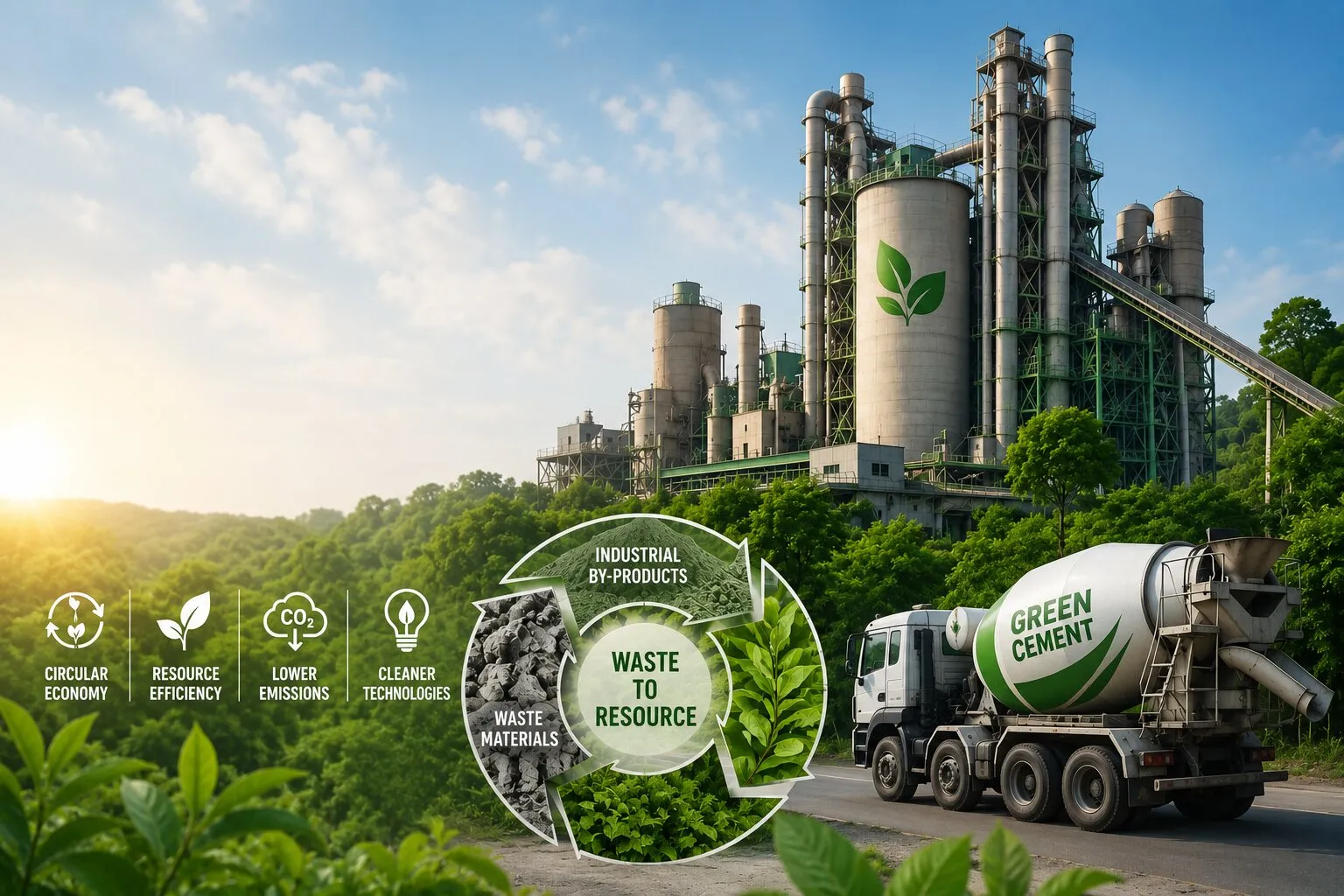
Cement Makers Reaffirm Commitment to Sustainable Growth
On World Environment Day, the Indian cement industry reiterated its commitment to supporting India's climate ambitions through sustainable manufacturing, resource efficiency and the adoption of cleaner technologies.
The Cement Manufacturers' Association (CMA) said the sector remains aligned with the Government of India's Net Zero commitments and is accelerating efforts to reduce its environmental footprint while supporting the country's infrastructure and development agenda.

Parth Jindal, President, CMA and Managing Director, JSW Cement, said the industry is increasingly adopting cleaner technologies, improving energy efficiency and expanding the use of alternative fuels and raw materials. He also highlighted the growing importance of circular economy practices, where industrial by-products and waste streams from one sector are utilised as resources in another.
"The Indian Cement Industry is aligned to the Government's commitments on carbon mitigation and is accelerating the adoption of cleaner technologies, resource efficiency and circular economy practices while actively exploring the potential of Carbon Capture, Utilisation and Storage (CCUS) as a critical pathway for deep decarbonisation," said Jindal.
He added that coprocessing industrial waste and by-products helps conserve natural resources, reduce disposal requirements and lower the environmental footprint across multiple sectors.
According to Jindal, sustainability is no longer limited to manufacturing processes but is increasingly influencing investment decisions, innovation strategies and long-term growth plans within the industry.
Echoing similar views, Dr Raghavpat Singhania, Vice President, CMA and Managing Director, JK Cement, said sustainable development extends beyond emissions reduction and must also focus on responsible resource utilisation and waste minimisation.

"Sustainability in the built environment cannot be measured by emissions alone. It is equally about how efficiently we use resources, how effectively we minimise waste and how responsibly we create the infrastructure that will serve future generations," said Singhania.
He noted that the cement industry is advancing its sustainability agenda through greater resource efficiency, increased circularity, technological innovation and continuous improvements in manufacturing practices. As a key contributor to India's infrastructure development, the sector has a critical role to play in balancing economic growth with environmental responsibility.
On the occasion of World Environment Day, industry leaders reaffirmed their commitment to supporting India's climate goals while delivering the materials required for resilient, durable and sustainable infrastructure.
Related Stories

Gold Stories




Interio by Godrej launches modular workplace solutions
Interio by Godrej has launched Workscapes, a modular workplace solutions category designed to help organisations configure and adapt workspaces to changing requirements. The portfolio combines mobile and compatible furniture and support elements that can be rearranged across different work modes without changes to fixed layouts.Workscapes includes Collaboration Tables, Privacy Solutions, Mobile Markerboards and Space Dividers, Power Solutions, Storage and Support Elements, Meeting and Presentation Tools, and Seating Elements. The range is designed for focused work, collaboration, informal disc..

CAFE-III Gives Auto Industry Investment Clarity
The government’s new Corporate Average Fuel Economy (CAFE-III) norms have provided the automobile industry with a clearer framework for technology investments, according to industry representatives. The framework seeks to balance environmental objectives with flexibility for manufacturers while encouraging the adoption of flex-fuel vehicles and biofuels. Society of Indian Automobile Manufacturers (SIAM) President Shenu Agarwal said the five-year framework would give automakers greater predictability to plan investments and accelerate innovation. He said the regulation established annual targ..

Mines Ministry to Auction Two Offshore Mineral Blocks in Andaman Sea
The Ministry of Mines will launch an auction of two offshore mineral blocks in the Andaman Sea on Thursday, seeking to unlock India’s offshore mineral potential and strengthen long-term mineral resource security. The blocks will be offered under a composite licence, which permits exploration and development activities in accordance with the applicable regulatory framework. The ministry said the auction was intended to encourage systematic exploration, attract investment and promote the use of advanced technologies for offshore mineral exploration and development. The initiative is also aimed..
Related Articles
Latest Updates













