
+
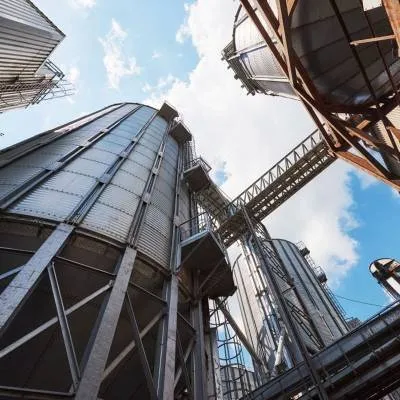
Steel: Shielded or Strengthened?
Cement

Steel: Shielded or Strengthened?

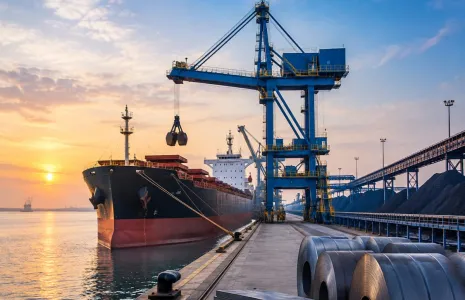
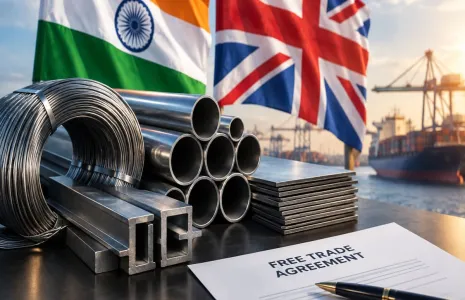
Going forward, domestic steel mills are targeting capacity expansion of nearly 40 per cent through till FY31, adding 80-85 mt, translating into an investment pipeline of $ 45-50 billion. So, Jhunjhunwala points out that continuing the safeguard duty will be vital to prevent a surge in imports and protect domestic prices from external shocks. While in FY26, the industry operating profit per tonne is expected to hold at around $ 108, similar to last year, the industry’s earnings must meaningfully improve from hereon to sustain large-scale investments. Else, domestic mills could experience a significant spike in industry leverage levels over the medium term, increasing their vulnerability to external macroeconomic shocks.(~$ 60/tonne) over the past one month, compressing the import parity discount to ~$ 23-25/tonne from previous highs of ~$ 70-90/tonne, adds Jhunjhunwala. With this, he says, “the industry can expect high resistance to further steel price increases.”

Domestic HRC prices have increased by ~Rs 5,000/tonne
“Aggressive capacity additions (~15 mt commissioned in FY25, with 5 mt more by FY26) have created a supply overhang, temporarily outpacing demand growth of ~11-12 mt,” he says...

To read the full article Click Here

Going forward, domestic steel mills are targeting capacity expansion of nearly 40 per cent through till FY31, adding 80-85 mt, translating into an investment pipeline of $ 45-50 billion. So, Jhunjhunwala points out that continuing the safeguard duty will be vital to prevent a surge in imports and protect domestic prices from external shocks. While in FY26, the industry operating profit per tonne is expected to hold at around $ 108, similar to last year, the industry’s earnings must meaningfully improve from hereon to sustain large-scale investments. Else, domestic mills could experience a significant spike in industry leverage levels over the medium term, increasing their vulnerability to external macroeconomic shocks.(~$ 60/tonne) over the past one month, compressing the import parity discount to ~$ 23-25/tonne from previous highs of ~$ 70-90/tonne, adds Jhunjhunwala. With this, he says, “the industry can expect high resistance to further steel price increases.”Domestic HRC prices have increased by ~Rs 5,000/tonne “Aggressive capacity additions (~15 mt commissioned in FY25, with 5 mt more by FY26) have created a supply overhang, temporarily outpacing demand growth of ~11-12 mt,” he says...To read the full article Click Here

Next Story
Infrastructure Urban

Manohar Lal Inaugurates Municipalika 2026

Union Minister for Housing and Urban Affairs and Power, Shri Manohar Lal, inaugurated Municipalika 2026 at Bharat Mandapam, New Delhi, outlining a comprehensive roadmap for India’s evolving urban landscape under the vision of Viksit Bharat @2047. The three-day exhibition and conference, recognised as India’s only 360-degree platform on safe, smart and sustainable city solutions, is being held from 25 to 27 February 2026. The 18th edition brings together ministers, mayors, municipal commissioners, Smart City CEOs, policymakers, planners and technology providers to deliberate on governance,..

Next Story
Infrastructure Urban

Enlight Metals Speeds Metal Deliveries by 35%

Enlight Metals has introduced its Agentic AI-enabled procurement platform aimed at addressing long-standing inefficiencies in India’s metal supply chain. The company reports 35 per cent faster procurement cycles and delivery timelines of up to 24 hours across major industrial regions. As infrastructure and manufacturing activity intensify, metal sourcing has remained constrained by fragmented supply networks, limited demand visibility and manual coordination. Enlight Metals’ platform integrates Agentic AI across sourcing, inventory management and logistics, replacing reactive workflows wi..

Next Story
Infrastructure Energy

Critical Minerals Key to India’s Clean Energy Push

A new report released by FICCI in collaboration with Deloitte underscores the strategic importance of critical minerals and rare earth elements (REEs) in supporting India’s clean energy transition, industrial competitiveness and long-term economic security. As India moves towards 500 GW of renewable capacity, 30 per cent EV penetration by 2030 and net-zero emissions by 2070, access to lithium, nickel, cobalt, graphite, copper and REEs will be central to achieving these targets. The study highlights that mineral security is emerging as a decisive factor in sustaining economic growth and tech..

Advertisement

Subscribe to Our Newsletter

Get daily newsletters around different themes from Construction world.

STAY CONNECTED

Advertisement

Advertisement

Advertisement

Open In App