+
When nature audits our infrastructure
ECONOMY & POLICY

When nature audits our infrastructure

The images emerging from Nepal are heart-wrenching. Hundreds have died and thousands remain missing after a catastrophic torrent of ice, rock, mud and water swept through the Himalayan valleys on August 26.But this was not another cloudburst.Cloudburs...

The images emerging from Nepal are heart-wrenching. Hundreds have died and thousands remain missing after a catastrophic torrent of ice, rock, mud and water swept through the Himalayan valleys on August 26.But this was not another cloudburst.Cloudbursts and extreme rainfall have repeatedly exposed the consequences of unplanned urban sprawl, indiscriminate hill-cutting and construction in fragile Himalayan terrain. The latest Nepal disaster presents an even more disturbing challenge: What happens when the mountain itself begins to move?Preliminary scientific assessments indicate that a massive section of glacier and rock collapsed high above the Lhende Khola river system. The collapse generated seismic signals of about magnitude 5.2 – initially mistaken for an earthquake. The ice-rock mass plunged into the valley and transformed into a high-velocity debris flow, travelling at speeds estimated at around 150-180 kmph. Downstream, water levels reportedly rose by as much as 9 m within 30 minutes.Scientists are still investigating precisely what destabilised the glacier. Warming at the glacier bed, meltwater penetration, accumulation of snow and increasingly unstable permafrost are among the possible mechanisms. What is clear is the extraordinary energy involved. Basanta Raj Adhikari of Tribhuvan University's Centre for Disaster Studies has estimated that the energy released exceeded that of the atomic bomb dropped on Hiroshima.The Himalayas have witnessed similar cascading disasters before. The 2021 Chamoli rock-and-ice avalanche in Uttarakhand killed more than 200 people and destroyed two hydropower projects. Nepal, too, has experienced repeated glacier and flood-related events. What makes the latest catastrophe especially sobering is its scale and speed.Even the warning system was overwhelmed. Hydrological monitoring stations were damaged by the debris-laden surge itself. Conventional systems designed to detect gradually rising river levels can prove inadequate when a wall of rock, ice, mud and water arrives almost instantaneously.Nepal now estimates that reconstruction could require $ 4-5 billion – nearly one-tenth of its economy.There is a lesson here for India.We cannot prevent earthquakes, glacier collapses or extreme rainfall. But we can determine where we build, how we build and what standards we enforce.Japan offers an instructive comparison. Its seismic regulations aim for buildings to suffer little damage during earthquakes around Shindo 5-upper intensity and, during the extremely severe shaking associated with Shindo 6-upper to 7, to avoid collapse that threatens human life. India's seismic philosophy similarly seeks limited structural damage in moderate earthquakes and prevention of total collapse during severe ones. The larger difference often lies not merely in the code, but in compliance, enforcement and accountability.This is India's vulnerability.The real-estate and infrastructure boom has created enormous economic opportunity. But it has also increased pressure on land, municipal systems and regulatory institutions. Too often, scrutiny is weakest while projects are being approved. Then, disaster strikes and the pendulum swings violently: construction is frozen, permissions withheld, licences cancelled and legitimate economic activity suffers.That is governance by reaction.India needs something better: an independent Infrastructure Safety and Resilience Audit Authority with a sovereign mandate to periodically assess critical infrastructure, vulnerable urban clusters and major projects against structural, geological, hydrological and climate risks – and place its findings in the public domain.Infrastructure should be audited before nature audits it for us.Because when nature conducts the audit, the price is no longer measured merely in rupees. It is measured in lives.Indian EPC contractors are warriors who fight government mandates, compliances, delays, manage factors of production, competition and then struggle to eke out a decent margin from the businesses. Despite EPC contractors taking all the risks, all their suppliers, like cement, steel, technologies and equipment who depend on the EPC contractors for their business, command better valuations of their businesses than EPC companies. What can the EPC companies and infrastructure companies do to build better valuations? These and other important wealth creation topics are being curated at the Infrastructure Today Leadership Conclave scheduled on October 15, 2026, in Mumbai. Look for details and book early. Delegates get to attend the 24th Construction World Global Awards and the 14th Equipment India Awards. Nominations for awards are open.

Related Stories

Gold Stories

Next Story
Real Estate

BMC OC Amnesty Scheme Requires Key Approvals from Mumbai Societies

The Brihanmumbai Municipal Corporation (BMC) has clarified that housing societies applying under its Occupation Certificate (OC) amnesty scheme must possess key approvals linked to the original construction. The requirements include a valid Intimation of Disapproval (IOD), an approved building plan and a Commencement Certificate (CC), along with a No Objection Certificate (NOC) from the developer or original construction applicant. The Standard Operating Procedure (SOP) makes clear that the absence of an OC alone will not qualify a building for relief. Societies must establish that their build..

Next Story
Real Estate

Gurugram Emerges as Luxury Senior Living Hub

Gurugram is emerging as a potential hub for luxury senior living, supported by available land, healthcare infrastructure, connectivity and a concentration of affluent professionals, high-net-worth individuals and non-resident Indians. These factors could give the city an advantage over land-constrained metros such as Mumbai. A report by the Association of Senior Living India (ASLI) and JLL estimates that India’s organised senior living market could represent a $10.1 bn opportunity by 2030. The sector had about 25,050 organised units as of June 2026, while penetration stood at only 1.5 per ce..
Next Story
Real Estate

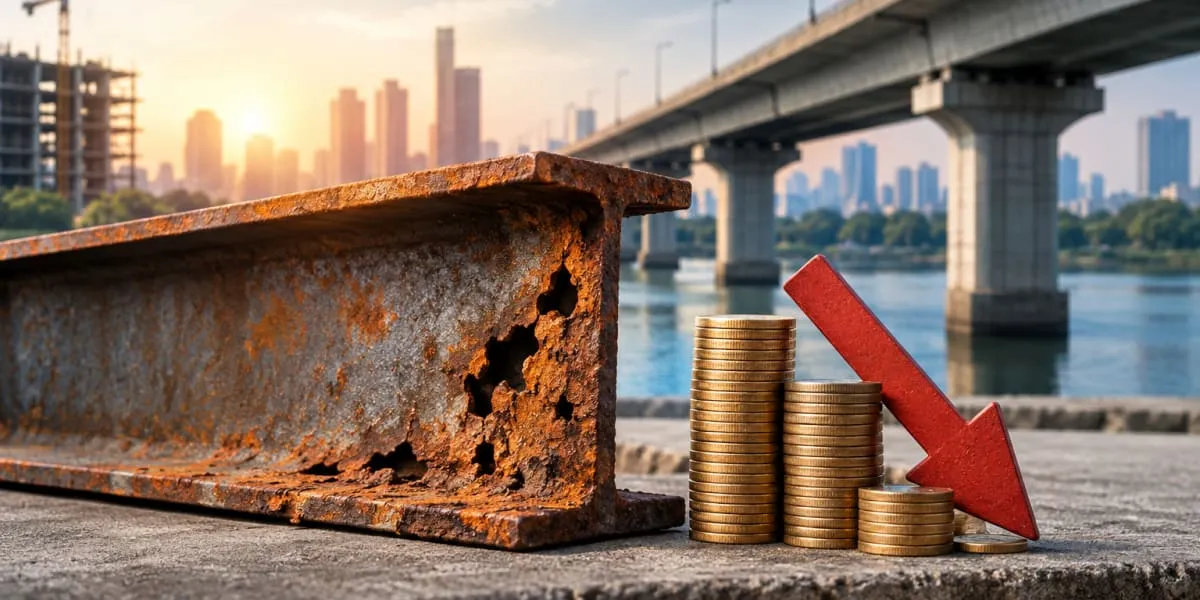
Corrosion Costs India’s Infrastructure Rs. 142 bn Annually

Corrosion costs India an estimated Rs. 1.42 tn annually, equivalent to 4.3 per cent of gross domestic product, according to a report by the Confederation of Indian Industry and the National Research Institute. Infrastructure accounts for Rs. 142 bn of the annual burden, making it the sector with the largest absolute cost among those examined. The report, presented at the CII Annual Infrastructure Summit 2026, said the infrastructure-sector cost equals about 2.9 per cent of the sector’s gross domestic product. It estimated that effective measures could generate maximum savings of Rs. 495.8 bn..

Advertisement

Subscribe to Our Newsletter

Get daily newsletters around different themes from Construction world.

STAY CONNECTED

Advertisement

SPECIAL OFFER
QR Code