
+
PMC to Replicate Aundh Road Model in Merged Villages
SMART CITIES

PMC to Replicate Aundh Road Model in Merged Villages

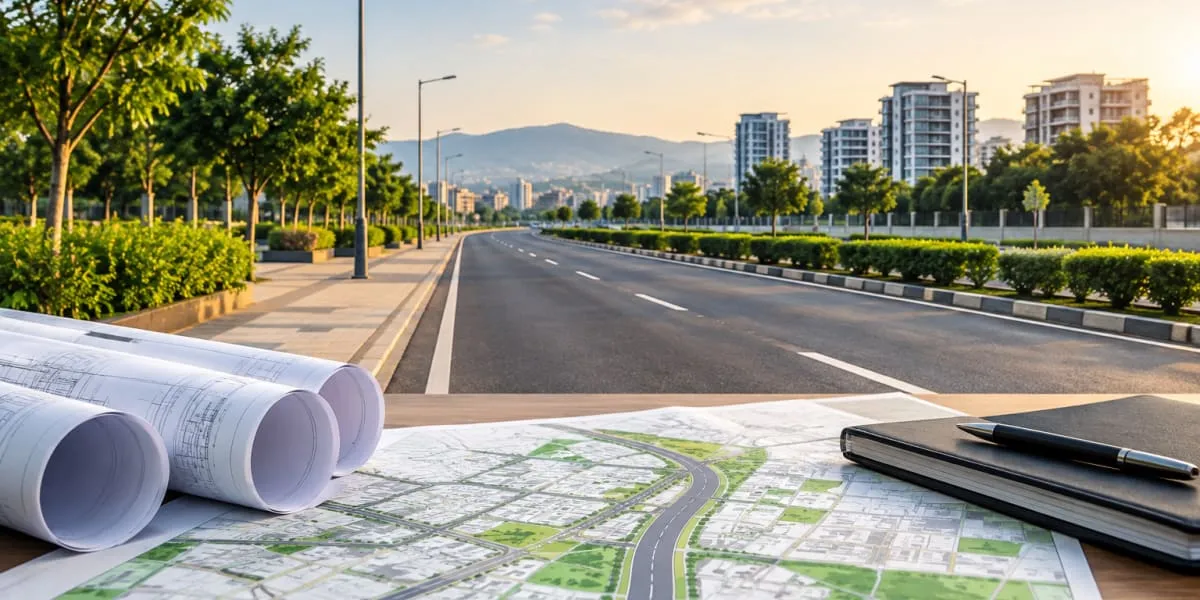
The Pune Municipal Corporation (PMC) plans to develop at least one smart-design road in each village merged with the civic body, drawing on the redevelopment of Aundh DP Road. The project received national recognition after a case study was published in the September 2026 issue of Indian Highways, the technical journal of the Indian Roads Congress (IRC).

The Aundh project was developed as a pilot under the Smart Cities Mission in 2017. Its case study was prepared by project consultant Vikas Thakar, project architect and urban designer Prasanna Desai, and PMC city engineer Aniruddha Pawaskar, and documents the transformation of a conventional urban road into an inclusive street.

Pawaskar said the civic body intended to replicate the model across the merged villages, with at least one such road planned in every village. He said the Aundh stretch had avoided major traffic and congestion problems, while its design followed consultations with stakeholders and addressed initial criticism from local residents and shopkeepers.

The project includes continuous footpaths, raised pedestrian crossings, universal accessibility, organised parking, cycling infrastructure and provisions for underground utilities. The design provides a more balanced distribution of road space among pedestrians, cyclists and motorists, while the redevelopment retained all 140 existing trees along the stretch.

The case study records negligible maintenance requirements and no major waterlogging incidents. It identifies better material specifications, rigorous supervision, quality control, contractor capacity building, utility coordination and improved workmanship as lessons for future projects. Local groups welcomed the proposed replication but also called for action against illegal vendors, completion of missing links and wider adherence to IRC standards. The IRC develops technical standards, specifications and guidelines used by road agencies, local bodies, consultants and the construction industry.

The Pune Municipal Corporation (PMC) plans to develop at least one smart-design road in each village merged with the civic body, drawing on the redevelopment of Aundh DP Road. The project received national recognition after a case study was published in the September 2026 issue of Indian Highways, the technical journal of the Indian Roads Congress (IRC). The Aundh project was developed as a pilot under the Smart Cities Mission in 2017. Its case study was prepared by project consultant Vikas Thakar, project architect and urban designer Prasanna Desai, and PMC city engineer Aniruddha Pawaskar, and documents the transformation of a conventional urban road into an inclusive street. Pawaskar said the civic body intended to replicate the model across the merged villages, with at least one such road planned in every village. He said the Aundh stretch had avoided major traffic and congestion problems, while its design followed consultations with stakeholders and addressed initial criticism from local residents and shopkeepers. The project includes continuous footpaths, raised pedestrian crossings, universal accessibility, organised parking, cycling infrastructure and provisions for underground utilities. The design provides a more balanced distribution of road space among pedestrians, cyclists and motorists, while the redevelopment retained all 140 existing trees along the stretch. The case study records negligible maintenance requirements and no major waterlogging incidents. It identifies better material specifications, rigorous supervision, quality control, contractor capacity building, utility coordination and improved workmanship as lessons for future projects. Local groups welcomed the proposed replication but also called for action against illegal vendors, completion of missing links and wider adherence to IRC standards. The IRC develops technical standards, specifications and guidelines used by road agencies, local bodies, consultants and the construction industry.

Related Stories

Gold Stories

Next Story
Real Estate

BMC OC Amnesty Scheme Requires Key Approvals from Mumbai Societies

The Brihanmumbai Municipal Corporation (BMC) has clarified that housing societies applying under its Occupation Certificate (OC) amnesty scheme must possess key approvals linked to the original construction. The requirements include a valid Intimation of Disapproval (IOD), an approved building plan and a Commencement Certificate (CC), along with a No Objection Certificate (NOC) from the developer or original construction applicant. The Standard Operating Procedure (SOP) makes clear that the absence of an OC alone will not qualify a building for relief. Societies must establish that their build..

Next Story
Real Estate

Gurugram Emerges as Luxury Senior Living Hub

Gurugram is emerging as a potential hub for luxury senior living, supported by available land, healthcare infrastructure, connectivity and a concentration of affluent professionals, high-net-worth individuals and non-resident Indians. These factors could give the city an advantage over land-constrained metros such as Mumbai. A report by the Association of Senior Living India (ASLI) and JLL estimates that India’s organised senior living market could represent a $10.1 bn opportunity by 2030. The sector had about 25,050 organised units as of June 2026, while penetration stood at only 1.5 per ce..

Next Story
Real Estate

Corrosion Costs India’s Infrastructure Rs. 142 bn Annually

Corrosion costs India an estimated Rs. 1.42 tn annually, equivalent to 4.3 per cent of gross domestic product, according to a report by the Confederation of Indian Industry and the National Research Institute. Infrastructure accounts for Rs. 142 bn of the annual burden, making it the sector with the largest absolute cost among those examined. The report, presented at the CII Annual Infrastructure Summit 2026, said the infrastructure-sector cost equals about 2.9 per cent of the sector’s gross domestic product. It estimated that effective measures could generate maximum savings of Rs. 495.8 bn..

Advertisement

Subscribe to Our Newsletter

Get daily newsletters around different themes from Construction world.

STAY CONNECTED

Advertisement

SPECIAL OFFER
QR Code