

+
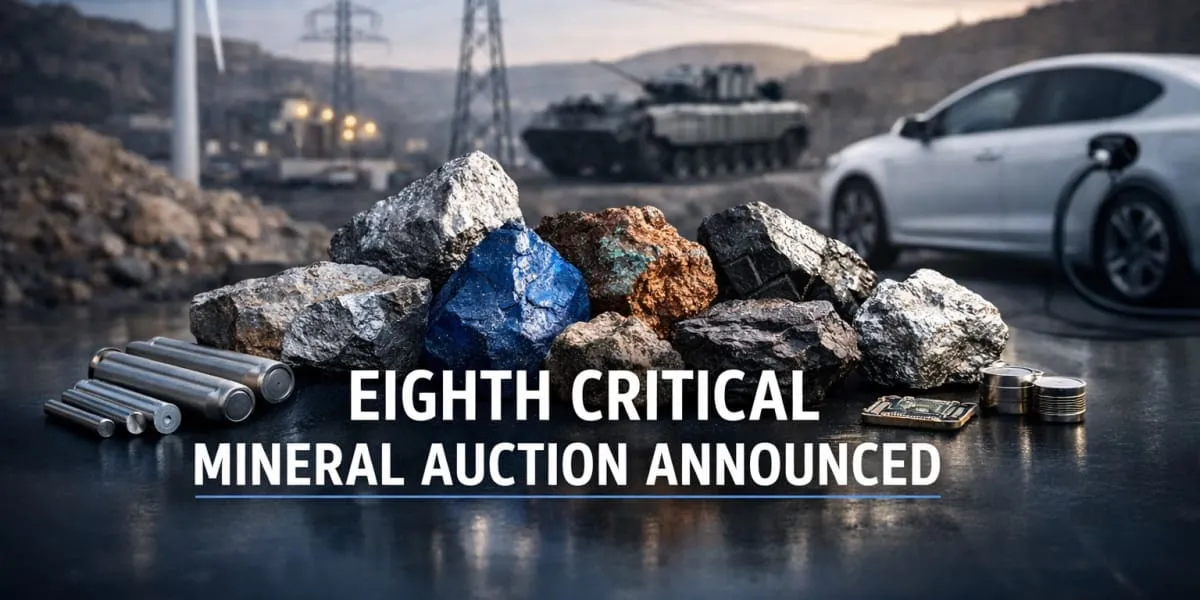
Government Launches Eighth Critical Mineral Auction
COAL & MINING

Government Launches Eighth Critical Mineral Auction

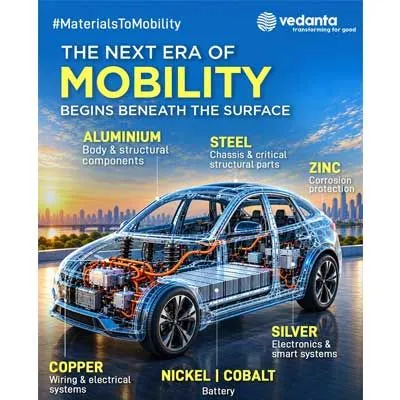
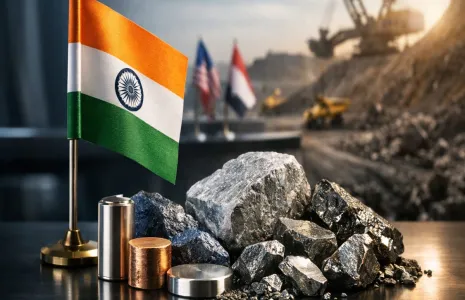
The government has launched the eighth tranche of auctions for 20 critical and strategic mineral blocks to boost domestic availability of inputs for clean energy, electric mobility, defence and advanced manufacturing. The measure aims to strengthen mineral security and reduce import dependence by encouraging exploration and development. The tranche comprises 13 newly identified blocks and seven offered under a second attempt under the Mineral (Auction) Rules.

The blocks are located across nine states and contain rare earth elements, lithium and graphite among other minerals such as tungsten, molybdenum, vanadium and titanium. Chhattisgarh accounts for the highest number at five, followed by Bihar and Odisha with three each, while Andhra Pradesh, Maharashtra and Rajasthan have two each and Punjab, Telangana and West Bengal have one each. Officials said these minerals are critical for clean energy technologies, electric vehicles, electronics, fertilisers, aerospace and defence.

The sale of tender documents began on July 15 and will close on September 14 at five pm, while the deadline for submission of technical bids and initial price offers is September 21 at five pm. The blocks will be auctioned online through a two-stage ascending forward auction and the preferred bidder will be selected on the basis of the highest per cent of the value of mineral dispatched quoted during the auction. The model is intended to promote transparent competition.

Alongside the auction the government set out a roadmap for a coal exchange to facilitate market-based trading of coal and processed coal products, strengthen price discovery and improve efficiency. The announcement coincided with the curtain raiser for India Mining Week, which will present mining-sector reforms and bring together representatives of the centre and states, public sector companies, industry participants and prospective investors. The Union coal and mines minister G. Kishan Reddy said successive rounds of auctions supported by policy reforms and the National Critical Mineral Mission were laying the foundation for a self-reliant mineral ecosystem and supporting India's clean-energy transition and industrial growth.

The government has launched the eighth tranche of auctions for 20 critical and strategic mineral blocks to boost domestic availability of inputs for clean energy, electric mobility, defence and advanced manufacturing. The measure aims to strengthen mineral security and reduce import dependence by encouraging exploration and development. The tranche comprises 13 newly identified blocks and seven offered under a second attempt under the Mineral (Auction) Rules. The blocks are located across nine states and contain rare earth elements, lithium and graphite among other minerals such as tungsten, molybdenum, vanadium and titanium. Chhattisgarh accounts for the highest number at five, followed by Bihar and Odisha with three each, while Andhra Pradesh, Maharashtra and Rajasthan have two each and Punjab, Telangana and West Bengal have one each. Officials said these minerals are critical for clean energy technologies, electric vehicles, electronics, fertilisers, aerospace and defence. The sale of tender documents began on July 15 and will close on September 14 at five pm, while the deadline for submission of technical bids and initial price offers is September 21 at five pm. The blocks will be auctioned online through a two-stage ascending forward auction and the preferred bidder will be selected on the basis of the highest per cent of the value of mineral dispatched quoted during the auction. The model is intended to promote transparent competition. Alongside the auction the government set out a roadmap for a coal exchange to facilitate market-based trading of coal and processed coal products, strengthen price discovery and improve efficiency. The announcement coincided with the curtain raiser for India Mining Week, which will present mining-sector reforms and bring together representatives of the centre and states, public sector companies, industry participants and prospective investors. The Union coal and mines minister G. Kishan Reddy said successive rounds of auctions supported by policy reforms and the National Critical Mineral Mission were laying the foundation for a self-reliant mineral ecosystem and supporting India's clean-energy transition and industrial growth.

Related Stories

Gold Stories
Next Story
Real Estate

BMC OC Amnesty Scheme Requires Key Approvals from Mumbai Societies

The Brihanmumbai Municipal Corporation (BMC) has clarified that housing societies applying under its Occupation Certificate (OC) amnesty scheme must possess key approvals linked to the original construction. The requirements include a valid Intimation of Disapproval (IOD), an approved building plan and a Commencement Certificate (CC), along with a No Objection Certificate (NOC) from the developer or original construction applicant. The Standard Operating Procedure (SOP) makes clear that the absence of an OC alone will not qualify a building for relief. Societies must establish that their build..

Next Story
Real Estate

Gurugram Emerges as Luxury Senior Living Hub

Gurugram is emerging as a potential hub for luxury senior living, supported by available land, healthcare infrastructure, connectivity and a concentration of affluent professionals, high-net-worth individuals and non-resident Indians. These factors could give the city an advantage over land-constrained metros such as Mumbai. A report by the Association of Senior Living India (ASLI) and JLL estimates that India’s organised senior living market could represent a $10.1 bn opportunity by 2030. The sector had about 25,050 organised units as of June 2026, while penetration stood at only 1.5 per ce..

Next Story
Real Estate

Corrosion Costs India’s Infrastructure Rs. 142 bn Annually

Corrosion costs India an estimated Rs. 1.42 tn annually, equivalent to 4.3 per cent of gross domestic product, according to a report by the Confederation of Indian Industry and the National Research Institute. Infrastructure accounts for Rs. 142 bn of the annual burden, making it the sector with the largest absolute cost among those examined. The report, presented at the CII Annual Infrastructure Summit 2026, said the infrastructure-sector cost equals about 2.9 per cent of the sector’s gross domestic product. It estimated that effective measures could generate maximum savings of Rs. 495.8 bn..

Advertisement

Subscribe to Our Newsletter

Get daily newsletters around different themes from Construction world.

STAY CONNECTED

Advertisement

SPECIAL OFFER
QR Code