India Coal-Fired Power Output in June Hits Highest Since November 2023
COAL & MINING

India Coal-Fired Power Output in June Hits Highest Since November 2023

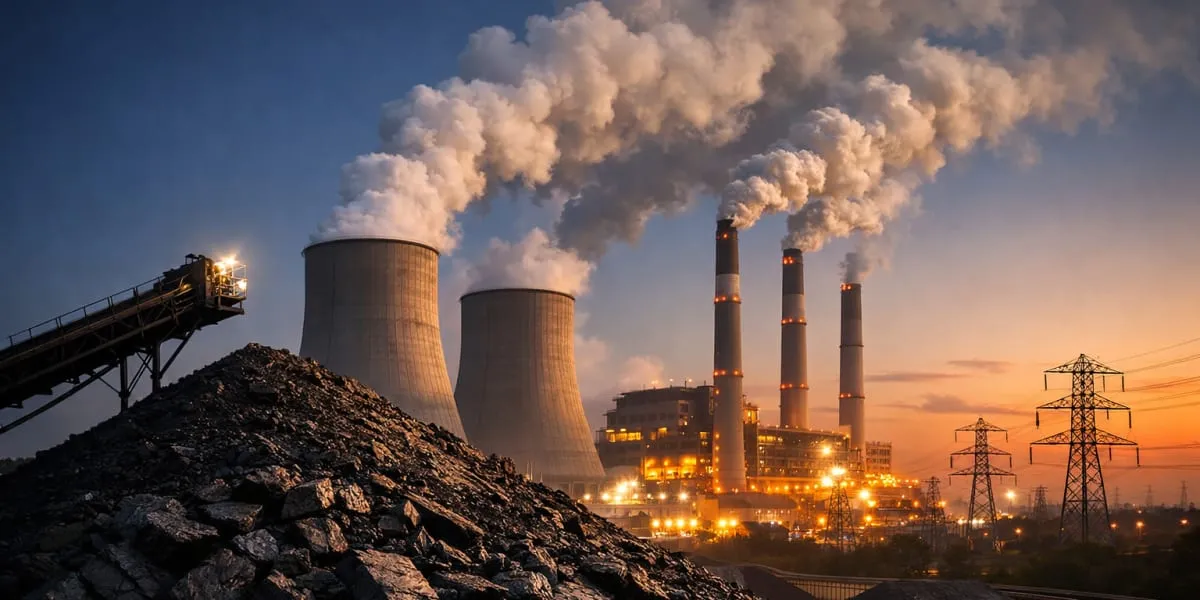
India's total electricity generation in June rose 10.4 per cent year-on-year to 178.31 billion kilowatt-hours (bn kWh), according to Reuters calculations of daily data from the federal grid regulator Grid-India. Coal-fired power generation rose about 14 per cent year-on-year to 120.20 bn kWh, the highest since November 2023. The rise came as cooling demand climbed amid sustained high temperatures and weak rainfall. Grid operators increased coal dispatches to meet peak evening demand when solar output was insufficient.

Last month was the fifth-driest June since 1901 as a strong El Nino pattern contributed to searing heat and below-average monsoon precipitation, the meteorological office reported. El Nino involves warming of Pacific Ocean waters off South America and tends to bring hot, dry conditions to parts of South and Southeast Asia. The extended heatwave increased demand for air conditioning, particularly in the evening, when solar output is limited by the lack of large-scale battery storage. System operators relied more on coal generation to balance the grid as a result.

Renewable power's share of the mix rose to a record 19 per cent in June, with overall renewable generation at 33.81 bn kWh, up 23 per cent from a year earlier. Despite additions to renewable capacity, the lack of storage constrained use of solar generation during evening peak periods. Hydropower output fell 24.4 per cent to 14 bn kWh, the steepest decline since February 2024, reflecting the weaker monsoon. Natural-gas-based generation also declined, down 30.1 per cent from a year earlier.

Industry observers noted that in 2025 India's coal power generation fell annually for the first time since the COVID-19 lockdowns in 2020, underscoring the recent variation in the sector. Market participants said coal demand has surged in recent months to meet evening air-conditioning needs as battery storage for solar remains limited. ICRA vice president Ankit Jain said thermal generation could increase this fiscal year to meet higher electricity demand in peak consumption periods. Policymakers and grid operators face the challenge of integrating rising renewable capacity while maintaining reliable supply during extreme weather.

"Join industry leaders at RAHSTA Expo, India's premier platform for roads, highways and traffic infrastructure. Register now to explore innovations, network with experts and shape the future of mobility."

India's total electricity generation in June rose 10.4 per cent year-on-year to 178.31 billion kilowatt-hours (bn kWh), according to Reuters calculations of daily data from the federal grid regulator Grid-India. Coal-fired power generation rose about 14 per cent year-on-year to 120.20 bn kWh, the highest since November 2023. The rise came as cooling demand climbed amid sustained high temperatures and weak rainfall. Grid operators increased coal dispatches to meet peak evening demand when solar output was insufficient. Last month was the fifth-driest June since 1901 as a strong El Nino pattern contributed to searing heat and below-average monsoon precipitation, the meteorological office reported. El Nino involves warming of Pacific Ocean waters off South America and tends to bring hot, dry conditions to parts of South and Southeast Asia. The extended heatwave increased demand for air conditioning, particularly in the evening, when solar output is limited by the lack of large-scale battery storage. System operators relied more on coal generation to balance the grid as a result. Renewable power's share of the mix rose to a record 19 per cent in June, with overall renewable generation at 33.81 bn kWh, up 23 per cent from a year earlier. Despite additions to renewable capacity, the lack of storage constrained use of solar generation during evening peak periods. Hydropower output fell 24.4 per cent to 14 bn kWh, the steepest decline since February 2024, reflecting the weaker monsoon. Natural-gas-based generation also declined, down 30.1 per cent from a year earlier. Industry observers noted that in 2025 India's coal power generation fell annually for the first time since the COVID-19 lockdowns in 2020, underscoring the recent variation in the sector. Market participants said coal demand has surged in recent months to meet evening air-conditioning needs as battery storage for solar remains limited. ICRA vice president Ankit Jain said thermal generation could increase this fiscal year to meet higher electricity demand in peak consumption periods. Policymakers and grid operators face the challenge of integrating rising renewable capacity while maintaining reliable supply during extreme weather.

Next Story
Real Estate

SNN Estates Expands North Bengaluru Housing Project

SNN Estates has announced an expansion of its SNN Estates Felicity residential project in North Bengaluru following strong buyer demand, with 75 per cent of the first-phase inventory sold within three days of launch.The developer will add 76 apartments in the new phase, taking the project's estimated revenue potential to around Rs 1,000 crore upon completion of Phase 2.Spread across 6.5 acres in Rachenahalli, near Manyata Tech Park, the project comprises 604 apartments in 1.5, 2, 2.5, 3 and 4 BHK configurations. The development includes a 50,000-sq-ft clubhouse with amenities such as sports co..

Next Story
Infrastructure Urban

SCG Drives ASEAN Industrial Transformation Strategy

SCG is strengthening its focus on ASEAN as a key growth region by advancing industrial transformation, enhancing competitiveness and building resilient regional value chains. Thammasak Sethaudom, President and Chief Executive Officer, SCG, highlighted the need for industries to continuously develop capabilities, strengthen resilience and deepen regional cooperation to achieve sustainable long-term growth.SCG views ASEAN as an important growth engine alongside China, supported by favourable demographics, trade connectivity and investment flows. With ASEAN’s GDP projected to grow by around 4.7..

Next Story
Products

EUROBOND Expands NABL Accreditation to 51 Testing Parameters

EUROBOND, the flagship brand of Euro Panel Products, has expanded the National Accreditation Board for Testing and Calibration Laboratories (NABL) accreditation of its in-house laboratory from 16 to 51 mechanical and chemical testing parameters, making it the only Indian aluminium composite panel (ACP) manufacturer with accreditation covering such an extensive testing scope.The expanded accreditation enables the company to independently test coils, coatings, cores, aluminium composite panels (ACP) and metal composite panels (MCP) in accordance with international standards, including IS, ASTM, ..

Advertisement

Subscribe to Our Newsletter

Get daily newsletters around different themes from Construction world.

STAY CONNECTED

Advertisement

Advertisement

Advertisement