+
Anti Dumping Duty Could Raise Transformer Costs
POWER & RENEWABLE ENERGY

Anti Dumping Duty Could Raise Transformer Costs

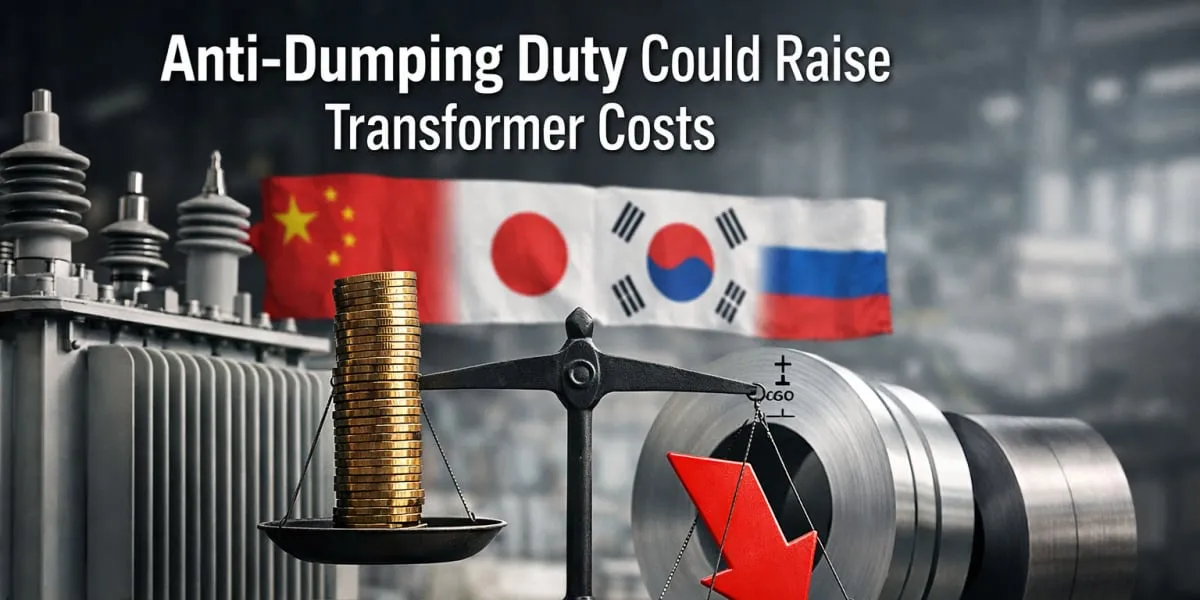
India's commerce ministry arm has opened an anti-dumping probe into imports of cold-rolled grain-oriented electrical steel (CRGO) and amorphous metals from China, Japan, South Korea and Russia following a complaint by JSW JFE Electrical Steel Nashik. The Directorate General of Trade Remedies initiated the investigation on June 22, 2026, covering imports from April one, 2025, to March 31, 2026, and an injury analysis for 2022-23 to 2024-25. Industry observers said any move to impose anti-dumping duties could increase costs for transformer manufacturers and complicate supply chains.

The specialised electrical steel is used in the magnetic core of every power and distribution transformer and it minimises energy losses, making it essential for efficient transmission and distribution. The Global Trade Research Initiative (GTRI) said that annual CRGO consumption is estimated at 400,000-450,000 tonnes (t) and domestic production is only 40,000-50,000 t. GTRI highlighted that nearly 90 per cent of requirements are imported, mainly from China, Japan, South Korea and Russia.

GTRI noted that demand for CRGO is likely to rise as India plans to invest Rs nine point one five trillion (tn) to expand its power grid by 2032, adding 191,000 circuit kilometres of transmission lines and more than doubling transformer capacity to 2,342 Gigavolt-Amperes (GVA). The organisation said that with domestic output meeting less than one-tenth of demand, higher duties could raise prices without materially reducing import dependence. That scenario could slow investments in transmission infrastructure, renewable-energy integration and electricity distribution.

The body said that CRGO imports are already subject to mandatory Bureau of Indian Standards certification, which suggests the investigation centres on pricing rather than product quality. GTRI founder Ajay Srivastava said that higher duties could therefore increase transformer costs and impede the country's ambitious grid expansion plans. JSW JFE Nashik's acquisition of a domestic grain-oriented electrical steel facility in Nashik was noted as a step to build capacity, but the gap between demand and production remains substantial.

India's commerce ministry arm has opened an anti-dumping probe into imports of cold-rolled grain-oriented electrical steel (CRGO) and amorphous metals from China, Japan, South Korea and Russia following a complaint by JSW JFE Electrical Steel Nashik. The Directorate General of Trade Remedies initiated the investigation on June 22, 2026, covering imports from April one, 2025, to March 31, 2026, and an injury analysis for 2022-23 to 2024-25. Industry observers said any move to impose anti-dumping duties could increase costs for transformer manufacturers and complicate supply chains. The specialised electrical steel is used in the magnetic core of every power and distribution transformer and it minimises energy losses, making it essential for efficient transmission and distribution. The Global Trade Research Initiative (GTRI) said that annual CRGO consumption is estimated at 400,000-450,000 tonnes (t) and domestic production is only 40,000-50,000 t. GTRI highlighted that nearly 90 per cent of requirements are imported, mainly from China, Japan, South Korea and Russia. GTRI noted that demand for CRGO is likely to rise as India plans to invest Rs nine point one five trillion (tn) to expand its power grid by 2032, adding 191,000 circuit kilometres of transmission lines and more than doubling transformer capacity to 2,342 Gigavolt-Amperes (GVA). The organisation said that with domestic output meeting less than one-tenth of demand, higher duties could raise prices without materially reducing import dependence. That scenario could slow investments in transmission infrastructure, renewable-energy integration and electricity distribution. The body said that CRGO imports are already subject to mandatory Bureau of Indian Standards certification, which suggests the investigation centres on pricing rather than product quality. GTRI founder Ajay Srivastava said that higher duties could therefore increase transformer costs and impede the country's ambitious grid expansion plans. JSW JFE Nashik's acquisition of a domestic grain-oriented electrical steel facility in Nashik was noted as a step to build capacity, but the gap between demand and production remains substantial.

Related Stories

Gold Stories

Next Story
Infrastructure Urban

KONE Opens India's First Digital Experience Centre in Pune

KONE, a global elevator and escalator manufacturer, has inaugurated its first Digital Experience Centre (DEC) in India, located in Pune. The facility aims to showcase how artificial intelligence (AI), connectivity and data-driven technologies can enhance customer experiences and improve building operations.The centre was inaugurated by Jussi Herlin, Executive Vice Chair, KONE Corporation; Philippe Delorme, President and CEO, KONE; and Nandan Nilekani, Co-founder and Chairman of the Board, Infosys.Designed as an interactive customer environment, the facility demonstrates digital solutions cover..

Next Story
Infrastructure Urban

CII GreenCo Launches Circularity Guidelines for Indian Industry

The Confederation of Indian Industry (CII) GreenCo Council has launched the CII GreenCo Circularity Guidelines – Pilot Version at the 17th CII GreenCo Waste & Resource Management Summit 2026 in Chennai. The initiative aims to strengthen resource efficiency, waste reduction and circular economy practices across Indian manufacturing and process industries.The guidelines introduce a structured framework with circularity indices covering raw materials, consumables, packaging and other resource inputs. These indicators will help industries assess existing practices, identify opportunities to ..

Next Story
Infrastructure Energy

Global Electronics Association Launches IPC-1783-CO2E Standard

The Global Electronics Association has introduced IPC-1783-CO2E, a new international standard aimed at improving consistency, transparency and comparability in product carbon footprint reporting across the electronics manufacturing industry.The standard, titled International Standard for Data Collection and Reporting of CO2 Equivalent (CO2e) Emissions for the Electronics Manufacturing Supply Chain, provides industry-specific guidance for collecting, estimating and reporting carbon emissions data.With increasing regulatory requirements and customer expectations, electronics manufacturers face c..

Advertisement

Subscribe to Our Newsletter

Get daily newsletters around different themes from Construction world.

STAY CONNECTED

Advertisement

SPECIAL OFFER
QR Code