Domestic Power Consumption Rises Nearly 11 Per Cent in July
POWER & RENEWABLE ENERGY

Domestic Power Consumption Rises Nearly 11 Per Cent in July

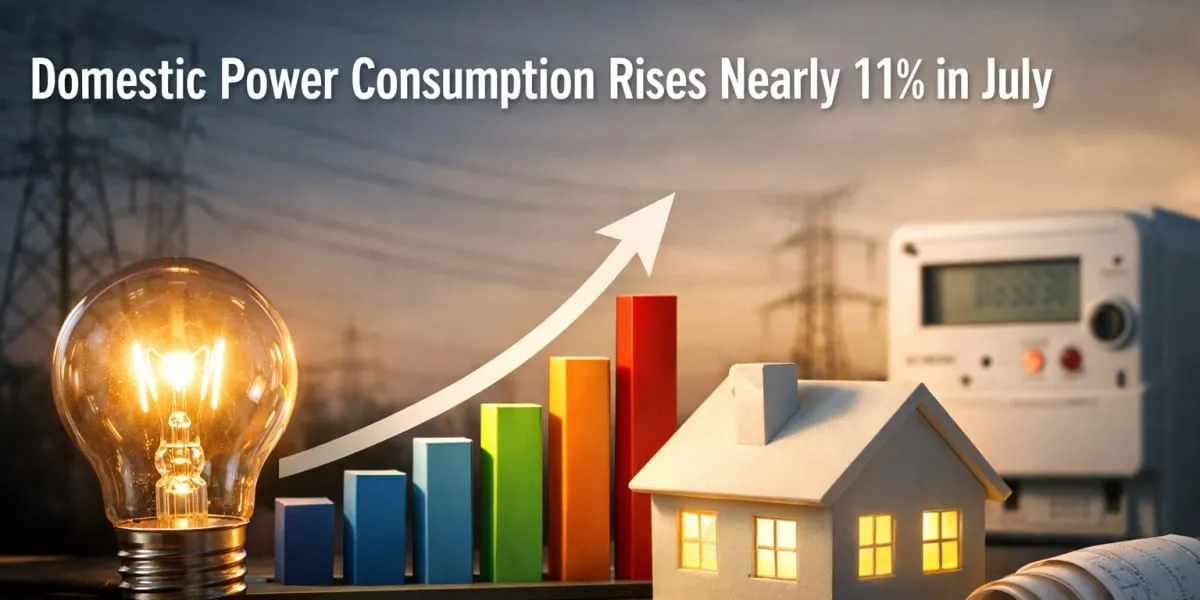
Domestic electricity consumption rose nearly 11 per cent in July compared with the same month last year, official figures showed. The increase reflected a combination of higher cooling load and a pickup in industrial and commercial activity across regions. Analysts noted that prolonged warm weather and greater economic activity pushed household and business demand upwards. The rise marks a clear recovery from the prior year and underscores stronger short term energy needs.

Demand growth was broad based, with urban centres registering larger increases as well as notable gains in semi urban and rural districts where pump usage for agriculture returned to seasonal norms. Utilities reported tighter daytime peaks and sustained evening loads, testing distribution networks in several states. System operators adjusted generation schedules to meet the higher load and to maintain grid stability. The trend added pressure on fuelled thermal stations while drawing on flexible resources.

Renewable energy output assisted supply but variability required conventional plants to provide balancing power, according to system managers. Thermal generation continued to supply the bulk of incremental energy while grid integration of wind and solar remained critical to meeting peak requirements. Transmission corridors experienced higher utilisation and maintenance planning took on added importance to avoid bottlenecks. Policy makers and regulators are monitoring the pattern to ensure adequate reserves and supply security.

The month on month increase is shaping near term planning for utilities and is influencing tariff and fuel procurement decisions, officials and industry observers noted. Distribution companies will need to accelerate investment in network strengthening and demand side measures to manage future peaks. Greater focus on energy efficiency and flexible generation remains central to balancing growth in consumption with system reliability. Stakeholders are watching the coming months for persistence of the trend.

Domestic electricity consumption rose nearly 11 per cent in July compared with the same month last year, official figures showed. The increase reflected a combination of higher cooling load and a pickup in industrial and commercial activity across regions. Analysts noted that prolonged warm weather and greater economic activity pushed household and business demand upwards. The rise marks a clear recovery from the prior year and underscores stronger short term energy needs. Demand growth was broad based, with urban centres registering larger increases as well as notable gains in semi urban and rural districts where pump usage for agriculture returned to seasonal norms. Utilities reported tighter daytime peaks and sustained evening loads, testing distribution networks in several states. System operators adjusted generation schedules to meet the higher load and to maintain grid stability. The trend added pressure on fuelled thermal stations while drawing on flexible resources. Renewable energy output assisted supply but variability required conventional plants to provide balancing power, according to system managers. Thermal generation continued to supply the bulk of incremental energy while grid integration of wind and solar remained critical to meeting peak requirements. Transmission corridors experienced higher utilisation and maintenance planning took on added importance to avoid bottlenecks. Policy makers and regulators are monitoring the pattern to ensure adequate reserves and supply security. The month on month increase is shaping near term planning for utilities and is influencing tariff and fuel procurement decisions, officials and industry observers noted. Distribution companies will need to accelerate investment in network strengthening and demand side measures to manage future peaks. Greater focus on energy efficiency and flexible generation remains central to balancing growth in consumption with system reliability. Stakeholders are watching the coming months for persistence of the trend.

Next Story
Infrastructure Transport

Surya Roshni delivers customised lighting for NCRTC RRTS stations

Surya Roshni has supplied customised indoor lighting solutions for 18 elevated stations on the National Capital Region Transport Corporation's (NCRTC) Rapid Rail Transit System (RRTS), strengthening its presence in India's infrastructure lighting segment.The project involved the design and deployment of lighting systems for platforms, concourses, foot overbridges (FOBs) and back-of-house (BOH) areas. According to the company, the luminaires were developed specifically to meet NCRTC's design, operational and performance requirements rather than using standard products.Surya introduced two custo..

Next Story
Real Estate

Hilton debuts Tapestry Collection brand in Vietnam

Hilton has opened NHAAN Resort & Spa Hoi An, Tapestry Collection by Hilton, marking the debut of the Tapestry Collection brand in Vietnam and expanding its lifestyle hospitality portfolio in Southeast Asia.Located along the Co Co River in Cam Thanh village, the 174-key resort provides access to Hoi An Ancient Town, Cua Dai Beach and the Cam Thanh Nipa Forest. The property has been designed by Vietnamese architect Vo Trong Nghia, incorporating biophilic architecture, locally sourced materials and riverfront landscapes.The resort offers a mix of guest rooms and suites, including family-frien..

Next Story
Building Material

Electrent expands lithium energy storage system portfolio

Electrent Energy has expanded its lithium-based energy storage portfolio with the launch of the ESS 850 and ESS 1050, targeting compact and maintenance-free power backup solutions for Indian homes.The new systems integrate a Home UPS and a LiFePO4 lithium battery into a single unit, extending the company's product range following the launch of its ESS 1350 and ESS 2500 models.Designed for apartments and smaller homes, the ESS 850 provides up to 1 hour 15 minutes of backup, while the ESS 1050 offers up to 1 hour 45 minutes on a typical 400 W household load. The systems can power essential appli..

Advertisement

Subscribe to Our Newsletter

Get daily newsletters around different themes from Construction world.

STAY CONNECTED

Advertisement

Advertisement

Advertisement