+
India Power Consumption Rises Nearly 11 Per Cent in July
POWER & RENEWABLE ENERGY

India Power Consumption Rises Nearly 11 Per Cent in July

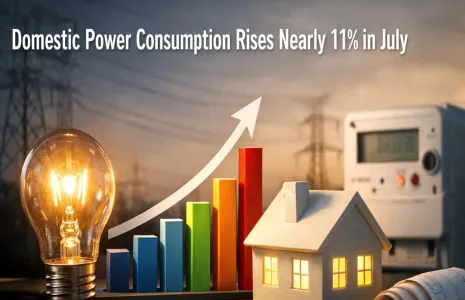
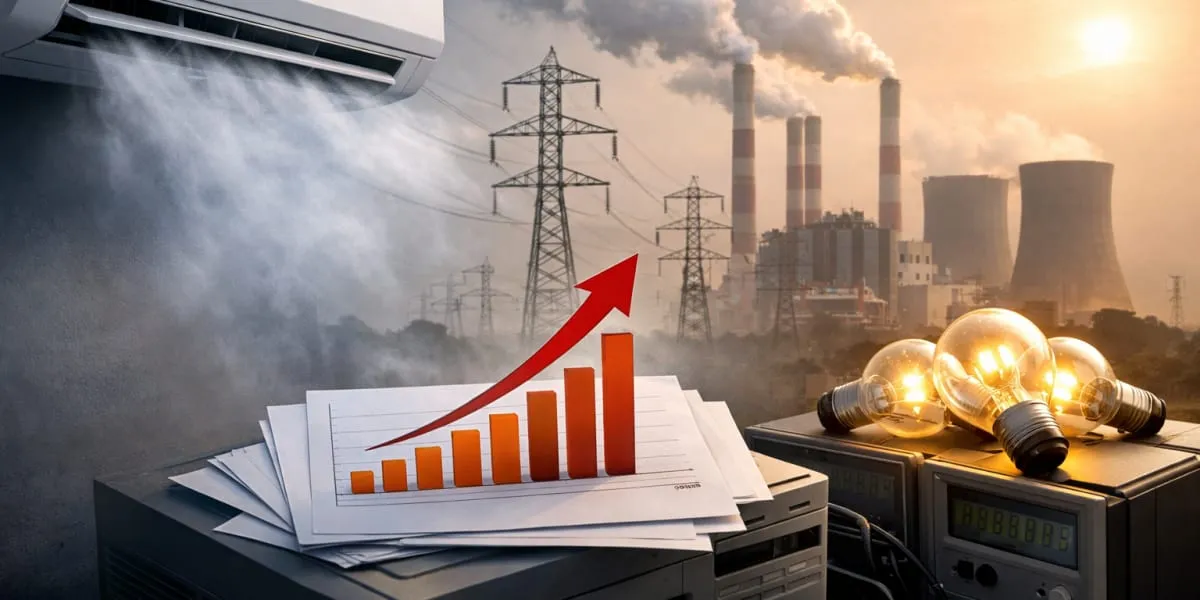
India's power consumption grew 10.93 per cent year-on-year to 170.70 billion units (bn units) in July, official data showed, as high humidity levels increased use of cooling appliances across many regions. The rise came amid continued monsoon conditions that produced a higher feel-like temperature than the actual thermometer reading, prompting greater reliance on air conditioning and other cooling equipment.

The country's total power consumption was 153.88 billion units in July 2025, underscoring the seasonal escalation in demand. Analysts attributed the jump chiefly to elevated humidity that amplified perceived heat, while distribution companies reported stronger residential and commercial load during evening hours.

Peak power demand also rose markedly, reaching 270.20 gigawatts (GW) in July from 220.74 GW in July 2025, moving close to the all-time peak of 270.82 GW recorded in May. By comparison, peak demand in May last year stood at 230.99 GW and the previous summer's high was 242.77 GW in June 2025, figures that reflect both rising baseline consumption and intermittent spikes driven by weather patterns.

Looking ahead, forecasters expect demand to remain steady into August as humid conditions persist through the ongoing monsoon, sustaining reliance on cooling loads across urban and rural centres. The India Meteorological Department has projected deficient rainfall for this season, a factor that market participants said could influence reservoir levels and generation mixes, and consequently shape dispatch and fuel planning for power firms.

India's power consumption grew 10.93 per cent year-on-year to 170.70 billion units (bn units) in July, official data showed, as high humidity levels increased use of cooling appliances across many regions. The rise came amid continued monsoon conditions that produced a higher feel-like temperature than the actual thermometer reading, prompting greater reliance on air conditioning and other cooling equipment. The country's total power consumption was 153.88 billion units in July 2025, underscoring the seasonal escalation in demand. Analysts attributed the jump chiefly to elevated humidity that amplified perceived heat, while distribution companies reported stronger residential and commercial load during evening hours. Peak power demand also rose markedly, reaching 270.20 gigawatts (GW) in July from 220.74 GW in July 2025, moving close to the all-time peak of 270.82 GW recorded in May. By comparison, peak demand in May last year stood at 230.99 GW and the previous summer's high was 242.77 GW in June 2025, figures that reflect both rising baseline consumption and intermittent spikes driven by weather patterns. Looking ahead, forecasters expect demand to remain steady into August as humid conditions persist through the ongoing monsoon, sustaining reliance on cooling loads across urban and rural centres. The India Meteorological Department has projected deficient rainfall for this season, a factor that market participants said could influence reservoir levels and generation mixes, and consequently shape dispatch and fuel planning for power firms.

Related Stories

Gold Stories

Next Story
Real Estate

BMC OC Amnesty Scheme Requires Key Approvals from Mumbai Societies

The Brihanmumbai Municipal Corporation (BMC) has clarified that housing societies applying under its Occupation Certificate (OC) amnesty scheme must possess key approvals linked to the original construction. The requirements include a valid Intimation of Disapproval (IOD), an approved building plan and a Commencement Certificate (CC), along with a No Objection Certificate (NOC) from the developer or original construction applicant. The Standard Operating Procedure (SOP) makes clear that the absence of an OC alone will not qualify a building for relief. Societies must establish that their build..

Next Story
Real Estate

Gurugram Emerges as Luxury Senior Living Hub

Gurugram is emerging as a potential hub for luxury senior living, supported by available land, healthcare infrastructure, connectivity and a concentration of affluent professionals, high-net-worth individuals and non-resident Indians. These factors could give the city an advantage over land-constrained metros such as Mumbai. A report by the Association of Senior Living India (ASLI) and JLL estimates that India’s organised senior living market could represent a $10.1 bn opportunity by 2030. The sector had about 25,050 organised units as of June 2026, while penetration stood at only 1.5 per ce..

Next Story
Real Estate

Corrosion Costs India’s Infrastructure Rs. 142 bn Annually

Corrosion costs India an estimated Rs. 1.42 tn annually, equivalent to 4.3 per cent of gross domestic product, according to a report by the Confederation of Indian Industry and the National Research Institute. Infrastructure accounts for Rs. 142 bn of the annual burden, making it the sector with the largest absolute cost among those examined. The report, presented at the CII Annual Infrastructure Summit 2026, said the infrastructure-sector cost equals about 2.9 per cent of the sector’s gross domestic product. It estimated that effective measures could generate maximum savings of Rs. 495.8 bn..

Advertisement

Subscribe to Our Newsletter

Get daily newsletters around different themes from Construction world.

STAY CONNECTED

Advertisement

SPECIAL OFFER
QR Code