Energy Efficiency Drives Andhra Pradesh Climate Agenda
POWER & RENEWABLE ENERGY

Energy Efficiency Drives Andhra Pradesh Climate Agenda

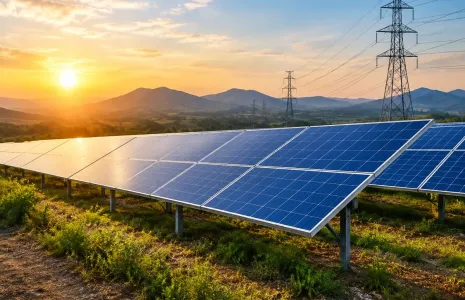
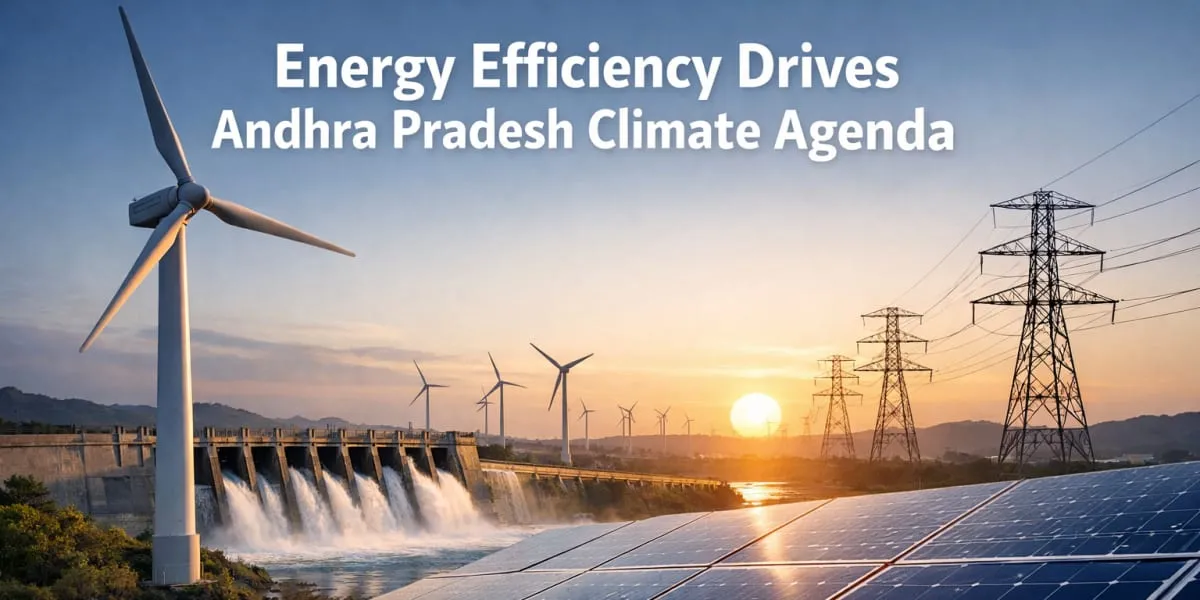
A multi-pronged approach to implement energy efficiency initiatives with a high strike rate is transforming Andhra Pradesh into a national role model. The State has achieved nearly 37 per cent renewable energy capacity out of a total installed power generation capacity of 21,457 megawatt (MW). The Government has set a target of generating 160 gigawatt (GW) of renewable energy through the New and Renewable Energy Development Corporation of Andhra Pradesh (NREDCAP).

The State has set a target of increasing its green cover from the present level of around 30 per cent to 37 per cent by 2030 and to 50 per cent by 2047, reinforcing its commitment to ecological conservation and sustainable development. The administration links these goals to economic growth, energy conservation and environmental stewardship. This integrated approach is intended to balance developmental needs with long term climate resilience.

A special report prepared by Energy Efficiency Services Limited (EESL) in coordination with the Andhra Pradesh State Energy Conservation Mission (APSECM) and the Energy Department assesses the economic and environmental impact of energy efficiency programmes. The Chief Secretary, G Sai Prasad, described the Centre State partnership as a national success story in energy efficiency and climate action and said it contributes to India's climate commitments. He indicated that the State Government has reaffirmed its commitment to making Andhra Pradesh a leader in combating climate change through sustainable development. The administration credited technological advancement and targeted programmes with delivering measurable gains.

The State declared full support for the Union Government's mission of effective fuel management and the National Energy Conservation Movement, and it has adopted a comprehensive multi-pronged strategy that integrates climate action with industrial growth. Agencies such as NREDCAP and EESL are central to implementing demand side interventions and large scale efficiency measures across sectors. Officials view the model as scalable for other jurisdictions seeking to align environmental stewardship with economic objectives.

A multi-pronged approach to implement energy efficiency initiatives with a high strike rate is transforming Andhra Pradesh into a national role model. The State has achieved nearly 37 per cent renewable energy capacity out of a total installed power generation capacity of 21,457 megawatt (MW). The Government has set a target of generating 160 gigawatt (GW) of renewable energy through the New and Renewable Energy Development Corporation of Andhra Pradesh (NREDCAP). The State has set a target of increasing its green cover from the present level of around 30 per cent to 37 per cent by 2030 and to 50 per cent by 2047, reinforcing its commitment to ecological conservation and sustainable development. The administration links these goals to economic growth, energy conservation and environmental stewardship. This integrated approach is intended to balance developmental needs with long term climate resilience. A special report prepared by Energy Efficiency Services Limited (EESL) in coordination with the Andhra Pradesh State Energy Conservation Mission (APSECM) and the Energy Department assesses the economic and environmental impact of energy efficiency programmes. The Chief Secretary, G Sai Prasad, described the Centre State partnership as a national success story in energy efficiency and climate action and said it contributes to India's climate commitments. He indicated that the State Government has reaffirmed its commitment to making Andhra Pradesh a leader in combating climate change through sustainable development. The administration credited technological advancement and targeted programmes with delivering measurable gains. The State declared full support for the Union Government's mission of effective fuel management and the National Energy Conservation Movement, and it has adopted a comprehensive multi-pronged strategy that integrates climate action with industrial growth. Agencies such as NREDCAP and EESL are central to implementing demand side interventions and large scale efficiency measures across sectors. Officials view the model as scalable for other jurisdictions seeking to align environmental stewardship with economic objectives.

Related Stories

Gold Stories

Next Story
Real Estate

A Concrete Statement in Jubilee Hills

The Jubilee Hills residence is an exploration of structure as architecture, where mathematical precision, exposed concrete, and engineering discipline come together to create a bold and enduring built form.Constructed with Blushfarbe, HAACE’s bespoke concrete finish, the project demanded exceptional control, as every visible structural element was also required to perform as the final architectural surface. Deep reinforced concrete roof frames extend into the vertical façade, while precision-cast fluted surfaces, rhythmic vertical fins, circular columns, and a cantilevered staircase create ..

Next Story
Infrastructure Energy

Hindustan Zinc raises renewable power share to 22 per cent

Hindustan Zinc has increased the share of renewable energy in its overall power consumption to 22 per cent, up from around 18 per cent in FY26, as it advances towards sourcing 70 per cent of its power requirements from renewable sources by FY28.During FY26, the company generated 892 million units of green power, up from 632 million units in FY25. It has also expanded its round-the-clock renewable power arrangement with Serentica Renewables from 450 MW to 530 MW to support the transition.Hindustan Zinc is strengthening its renewable energy portfolio through solar, wind and energy storage soluti..

Next Story
Resources

Crompton unveils new brand identity and super-premium platform

Crompton Greaves Consumer Electricals Ltd. has unveiled a new master brand identity as part of its Crompton 2.0 transformation, alongside the launch of its super-premium brand Crompton Rhion and the strengthening of its Energion platform.The refreshed identity introduces Cephyr, a new emblem inspired by sapphire and Zephyrus, the Greek wind, representing Crompton’s evolution towards a design-led, consumer-centric brand. The new brand promise, ‘Amazing, Every Day’, is supported by a new sonic identity that will be rolled out across advertising, digital platforms, products and retail envir..

Advertisement

Subscribe to Our Newsletter

Get daily newsletters around different themes from Construction world.

STAY CONNECTED

Advertisement