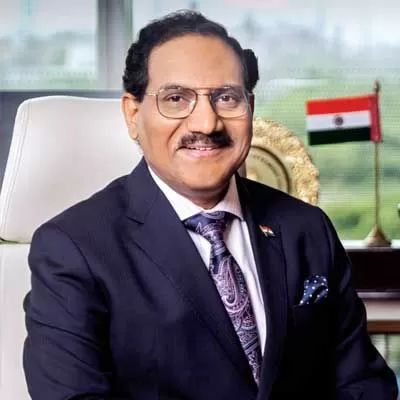
Energy Transition Can Boost Jobs, Industry and Growth: Pralhad Joshi
POWER & RENEWABLE ENERGY

Energy Transition Can Boost Jobs, Industry and Growth: Pralhad Joshi

Union Minister for New and Renewable Energy Pralhad Joshi has said that India’s energy transition has been strategically designed to act as a catalyst for industrialisation, employment generation and global competitiveness, offering a scalable model for emerging economies.

Speaking at a high-level session titled “Energy: The Great Funding Gap” during the World Economic Forum Annual Meeting 2026 in Davos, the Union Minister said that under the leadership of Prime Minister Narendra Modi, India has transformed its clean energy transition into a people-centric development movement. He added that the approach has simultaneously strengthened energy security while lowering power costs for industry and consumers.

The Union Minister noted that India has already achieved 267 GW of installed non-fossil fuel-based capacity, with renewable energy accounting for around 52% of the country’s total installed power capacity, well ahead of initial targets. He stressed that India views the energy transition not just as an environmental obligation but as a key driver of economic growth and affordable electricity.

Highlighting flagship decentralised initiatives, he said that PM Surya Ghar: Muft Bijli Yojana has enabled rooftop solar installations in 2.7 million households over the past two years, with a target of covering 10 million households and generating around 30 GW of power. Under PM-KUSUM, over 2.1 million farmers have solarised their irrigation pumps, reducing dependence on subsidised grid power and creating opportunities to earn additional income by selling surplus electricity. “These initiatives are not only providing affordable energy but are also turning consumers into ‘prosumers’, improving household incomes and rural livelihoods,” the Minister said.

The Union Minister also highlighted India’s expanding clean energy manufacturing ecosystem, noting 144 GW of solar module capacity and rapidly growing solar cell manufacturing, alongside scaling up of wind energy, battery storage and pumped storage solutions. He added that India is pursuing an integrated strategy combining renewables, storage and nuclear power to ensure reliability, demonstrating that energy security, affordability and sustainability can be achieved together.

Union Minister for New and Renewable Energy Pralhad Joshi has said that India’s energy transition has been strategically designed to act as a catalyst for industrialisation, employment generation and global competitiveness, offering a scalable model for emerging economies.Speaking at a high-level session titled “Energy: The Great Funding Gap” during the World Economic Forum Annual Meeting 2026 in Davos, the Union Minister said that under the leadership of Prime Minister Narendra Modi, India has transformed its clean energy transition into a people-centric development movement. He added that the approach has simultaneously strengthened energy security while lowering power costs for industry and consumers.The Union Minister noted that India has already achieved 267 GW of installed non-fossil fuel-based capacity, with renewable energy accounting for around 52% of the country’s total installed power capacity, well ahead of initial targets. He stressed that India views the energy transition not just as an environmental obligation but as a key driver of economic growth and affordable electricity.Highlighting flagship decentralised initiatives, he said that PM Surya Ghar: Muft Bijli Yojana has enabled rooftop solar installations in 2.7 million households over the past two years, with a target of covering 10 million households and generating around 30 GW of power. Under PM-KUSUM, over 2.1 million farmers have solarised their irrigation pumps, reducing dependence on subsidised grid power and creating opportunities to earn additional income by selling surplus electricity. “These initiatives are not only providing affordable energy but are also turning consumers into ‘prosumers’, improving household incomes and rural livelihoods,” the Minister said.The Union Minister also highlighted India’s expanding clean energy manufacturing ecosystem, noting 144 GW of solar module capacity and rapidly growing solar cell manufacturing, alongside scaling up of wind energy, battery storage and pumped storage solutions. He added that India is pursuing an integrated strategy combining renewables, storage and nuclear power to ensure reliability, demonstrating that energy security, affordability and sustainability can be achieved together.

Next Story
Infrastructure Urban

Henkel, Rotary Recycle PoP Ganesha Idols Under Project HARMONY

Henkel India, in partnership with the Rotary Club of Navi Mumbai – Joy of Giving and with support from the Navi Mumbai Municipal Corporation (NMMC), has advanced circular sustainability through Project HARMONY by recycling Plaster of Paris (PoP) Ganesha idols into community learning assets. The initiative highlights an integrated approach to environmental restoration and social impact.As part of the project, materials collected after Ganesh Visarjan 2025 at Nerul were responsibly diverted from land and water bodies and processed at an authorised recycling facility, with on-ground execution s..

Next Story
Real Estate

Houssed.com Expands to 33 Cities, Crosses Rs 1 Bn in Deals

Proptech platform Houssed.com has expanded its presence to 33 cities across India, strengthening its national footprint as it crosses 50,000 verified property listings and facilitates real estate transactions worth over Rs 1 billion. The milestone marks a significant phase in the company’s growth as demand rises for transparent and technology-driven property discovery in India’s estimated $500-billion real estate market.The company said the expansion reflects increasing preference among homebuyers and developers for platforms that prioritise verification, accountability and customer trust...

Next Story
Infrastructure Urban

Hindustan Zinc to Set Up India’s First Zinc Tailings Recycling Unit

Hindustan Zinc, a Vedanta Group company and the world’s largest integrated zinc producer, has awarded contracts to CIMIC Group companies Sedgman and Leighton Asia for the development of India’s first zinc tailings recycling facility at its Rampura Agucha Mines in Rajasthan. The project marks a significant step towards adopting circular economy practices in the country’s mining sector.Tailings are finely ground residues left after mineral extraction and are traditionally treated as waste. However, they often contain residual quantities of valuable metals that were not recoverable using ea..

Advertisement

Subscribe to Our Newsletter

Get daily newsletters around different themes from Construction world.

STAY CONNECTED

Advertisement

Advertisement

Advertisement

Advertisement

Open In App