Gujarat Cuts Carbon Emissions By 49.79 mn Tonnes In FY26
POWER & RENEWABLE ENERGY

Gujarat Cuts Carbon Emissions By 49.79 mn Tonnes In FY26

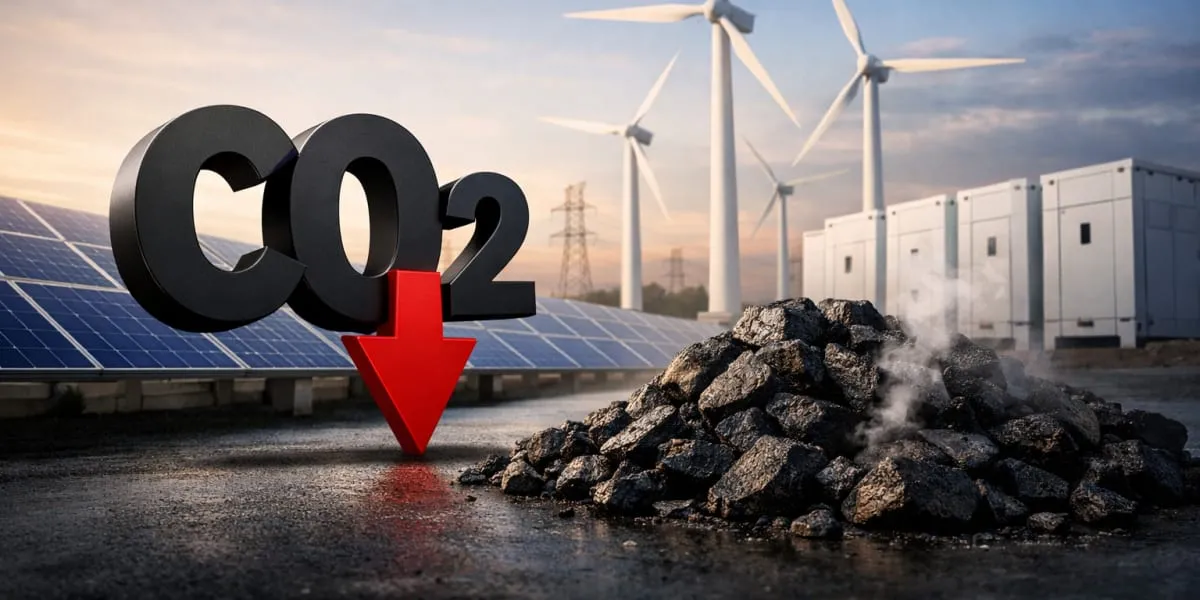
Gujarat reduced carbon emissions by 49.79 million tonnes (49.79 mn t) in the fiscal year 2025–26, the state government said, marking a significant step in its clean energy transition. The reduction followed record renewable electricity generation as the state pursued large scale solar and wind deployment alongside storage projects. Officials attributed the outcome to accelerated capacity additions and policy measures aimed at scaling green energy.

The state generated a record 67,655 million units of electricity from renewable sources during the fiscal year, equivalent to 67,655 mn units, the government report stated. Over the past five years the government estimates it has prevented a cumulative 179 million tonnes (179 mn t) of carbon emissions through renewable projects and related initiatives. Improved grid integration and project commissioning were cited as central to converting capacity into actual delivered clean energy.

Key measures driving the expansion include the Integrated Renewable Energy Policy 2026, the Green Hydrogen Policy and the Gujarat Pumped Storage Policy, which together target deployment, storage and green fuel uptake. Agencies such as Gujarat Urja Vikas Nigam (GUVNL), Gujarat Energy Development Agency (GEDA) and Gujarat Power Corporation (GPCL) have been tasked with implementing auctions, facilitating land and grid connections and coordinating project roll out. The coordinated approach has prioritised faster approvals and investment facilitation to attract developers and financiers.

The state has set a target of developing 100 gigawatts (GW) of renewable energy capacity by 2030 as part of its long term strategy to diversify the power mix. Projects such as the Khavda Renewable Energy Park in Kutch illustrate the scale of planned solar and wind investments and the integration of storage solutions to manage variability. The expansion is expected to reduce dependence on fossil fuels and contribute to India’s national objective of achieving 500 GW of non fossil fuel power capacity by 2030 and the longer term net zero pathway for 2070.

Gujarat reduced carbon emissions by 49.79 million tonnes (49.79 mn t) in the fiscal year 2025–26, the state government said, marking a significant step in its clean energy transition. The reduction followed record renewable electricity generation as the state pursued large scale solar and wind deployment alongside storage projects. Officials attributed the outcome to accelerated capacity additions and policy measures aimed at scaling green energy. The state generated a record 67,655 million units of electricity from renewable sources during the fiscal year, equivalent to 67,655 mn units, the government report stated. Over the past five years the government estimates it has prevented a cumulative 179 million tonnes (179 mn t) of carbon emissions through renewable projects and related initiatives. Improved grid integration and project commissioning were cited as central to converting capacity into actual delivered clean energy. Key measures driving the expansion include the Integrated Renewable Energy Policy 2026, the Green Hydrogen Policy and the Gujarat Pumped Storage Policy, which together target deployment, storage and green fuel uptake. Agencies such as Gujarat Urja Vikas Nigam (GUVNL), Gujarat Energy Development Agency (GEDA) and Gujarat Power Corporation (GPCL) have been tasked with implementing auctions, facilitating land and grid connections and coordinating project roll out. The coordinated approach has prioritised faster approvals and investment facilitation to attract developers and financiers. The state has set a target of developing 100 gigawatts (GW) of renewable energy capacity by 2030 as part of its long term strategy to diversify the power mix. Projects such as the Khavda Renewable Energy Park in Kutch illustrate the scale of planned solar and wind investments and the integration of storage solutions to manage variability. The expansion is expected to reduce dependence on fossil fuels and contribute to India’s national objective of achieving 500 GW of non fossil fuel power capacity by 2030 and the longer term net zero pathway for 2070.

Next Story
Infrastructure Urban

AI Powered Security Robot To Debut At Puri Station

The East Coast Railway (ECoR) has unveiled an artificial intelligence powered robotic surveillance platform that will be deployed at Puri railway station ahead of Lord Jagannath's Bahuda Yatra on 24 July to enhance passenger safety and security. The platform, named DSC ARJUN, was revealed in the presence of ECoR General Manager Parmeshwar Funkwal and senior railway and Railway Protection Force (RPF) officers. ECoR officials said the system has been introduced as a temporary deployment for the festival and may later be shifted to Bhubaneswar railway station. Developed to support Railway Protect..

Next Story
Infrastructure Urban

India Eases RCMC Rule For Low Value Exports

The Directorate General of Foreign Trade (DGFT) has proposed exempting low value export consignments from the requirement to hold a registration-cum-membership certificate (RCMC), in a move intended to simplify compliance for small exporters. The proposal targets shipments with a free-on-board value of up to Rs 10,000 and seeks to reduce paperwork for first time exporters and micro, small and medium enterprises. The announcement forms part of a wider government effort to encourage exports through online platforms and emerging delivery channels. Under the proposed amendment to Paragraph 2.57 of..

Next Story
Infrastructure Urban

Assam Launches Centre Of Excellence For Additive Manufacturing

The Assam government has inaugurated a Digital Design and additive manufacturing centre of excellence in Guwahati, signalling a push towards technology driven manufacturing across the state. Chief Minister Himanta Biswa Sarma opened the facility and outlined its intended role in fostering innovation, product development and entrepreneurship. The centre will provide industries, startups and researchers with access to advanced digital manufacturing tools and additive manufacturing capabilities. Officials said the facility aims to strengthen the state innovation ecosystem and reduce dependence on..

Advertisement

Subscribe to Our Newsletter

Get daily newsletters around different themes from Construction world.

STAY CONNECTED

Advertisement

Advertisement

Advertisement