+
IEW 2026 Panel Stresses Energy Security and Global Cooperation
POWER & RENEWABLE ENERGY

IEW 2026 Panel Stresses Energy Security and Global Cooperation

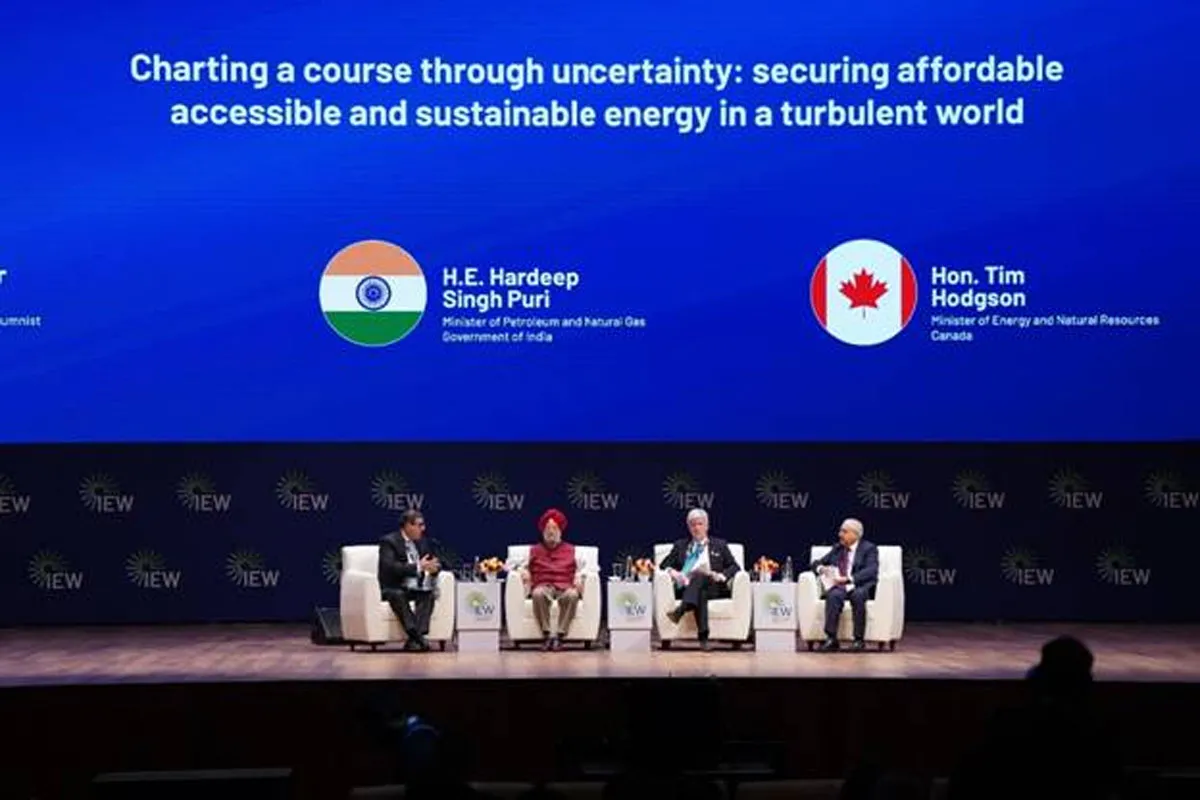
A high-level ministerial panel on the opening day of India Energy Week 2026 recently underscored the need for pragmatic energy policies, sustained investment and stronger international cooperation to manage growing geopolitical and market uncertainty. The session focused on securing affordable, accessible and sustainable energy in a rapidly changing global landscape.

Participating in the discussion were Hardeep Singh Puri, Minister of Petroleum and Natural Gas, Government of India; Tim Hodgson, Minister of Energy and Natural Resources, Canada; and Jassim Al Shirawi, Secretary General of the International Energy Forum.

The panel highlighted that rising demand from emerging economies, combined with geopolitical tensions and shifting trade dynamics, has brought energy security, affordability and sustainability into sharper focus. Speakers agreed that there is no single transition pathway suitable for all countries and that a balanced, inclusive approach is essential.

From India’s perspective, Hardeep Singh Puri emphasised that energy availability is critical for economic growth and national resilience. He noted that India has managed recent global disruptions by diversifying energy sources, expanding supplier geographies and implementing reforms across the energy value chain. He reiterated that the global transition should be based on energy addition rather than abrupt replacement, supported by stable and predictable markets.

Tim Hodgson highlighted the importance of trusted partnerships and diversified supply chains in a more fragmented global trading environment. He expressed Canada’s interest in deepening cooperation with India across LNG, oil supplies and critical minerals, stressing the role of middle powers in supporting free and reliable energy trade.

Providing a global outlook, Jassim Al Shirawi noted that population growth, urbanisation and industrialisation will continue to drive energy demand, with oil and gas remaining important alongside renewables and electrification. He cautioned that underinvestment and supply-chain constraints could pose risks to energy security, calling for sustained dialogue between producers and consumers.

The panel concluded that navigating uncertainty will require realism, adaptability and cooperation, with continued investment across oil, gas, LNG, grids, critical minerals and emerging technologies to ensure a resilient and affordable global energy transition.

A high-level ministerial panel on the opening day of India Energy Week 2026 recently underscored the need for pragmatic energy policies, sustained investment and stronger international cooperation to manage growing geopolitical and market uncertainty. The session focused on securing affordable, accessible and sustainable energy in a rapidly changing global landscape. Participating in the discussion were Hardeep Singh Puri, Minister of Petroleum and Natural Gas, Government of India; Tim Hodgson, Minister of Energy and Natural Resources, Canada; and Jassim Al Shirawi, Secretary General of the International Energy Forum. The panel highlighted that rising demand from emerging economies, combined with geopolitical tensions and shifting trade dynamics, has brought energy security, affordability and sustainability into sharper focus. Speakers agreed that there is no single transition pathway suitable for all countries and that a balanced, inclusive approach is essential. From India’s perspective, Hardeep Singh Puri emphasised that energy availability is critical for economic growth and national resilience. He noted that India has managed recent global disruptions by diversifying energy sources, expanding supplier geographies and implementing reforms across the energy value chain. He reiterated that the global transition should be based on energy addition rather than abrupt replacement, supported by stable and predictable markets. Tim Hodgson highlighted the importance of trusted partnerships and diversified supply chains in a more fragmented global trading environment. He expressed Canada’s interest in deepening cooperation with India across LNG, oil supplies and critical minerals, stressing the role of middle powers in supporting free and reliable energy trade. Providing a global outlook, Jassim Al Shirawi noted that population growth, urbanisation and industrialisation will continue to drive energy demand, with oil and gas remaining important alongside renewables and electrification. He cautioned that underinvestment and supply-chain constraints could pose risks to energy security, calling for sustained dialogue between producers and consumers. The panel concluded that navigating uncertainty will require realism, adaptability and cooperation, with continued investment across oil, gas, LNG, grids, critical minerals and emerging technologies to ensure a resilient and affordable global energy transition.

Next Story
Infrastructure Transport

Second Mountain Tunnel Breakthrough in Palghar Advances High Speed Rail

The Mumbai-Ahmedabad high speed rail (MAHSR) project reached a milestone with the breakthrough of a mountain tunnel in Palghar, Maharashtra. Mountain tunnel MT-six measures 454 metres long and 14.4 metres wide and will accommodate up and down tracks. The breakthrough follows MT-five near Saphale on second January 2026 and the MT-six excavation was completed from both ends using the New Austrian Tunnelling Method. The ministry reported that the tunnelling was completed within 12 months. The New Austrian Tunnelling Method is favoured for its flexibility in complex geology and irregular tunnel s..

Next Story
Infrastructure Transport

Modi Government Pushes Atmanirbhar Container Drive With BCSL MoU

The Union Government advanced a plan to create an integrated, domestically anchored container ecosystem with the signing of a Memorandum of Understanding to establish the Bharat Container Shipping Line (BCSL). The MoU was signed by key agencies including the Shipping Corporation of India and Container Corporation of India alongside major port authorities and Sagarmala Finance Corporation Limited under the Ministry of Ports, Shipping and Waterways, in the presence of senior ministers. The initiative aligns with the Container Manufacturing Assistance Scheme announced in the Union Budget 2026–2..

Next Story
Infrastructure Urban

Ministry Reports Gains In Mobility For Marginalised Communities

The Ministry of Social Justice and Empowerment is implementing skill development, education and rehabilitation schemes to promote socio-economic mobility and sustainable livelihoods for marginalised and disadvantaged communities across the country. Programmes target Scheduled Castes, Other Backward Classes, Economically Weaker Sections, De-notified Tribes and Safai Karamcharis through specialised implementing corporations and empanelled training institutes. Pradhan Mantri Dakshata Aur Kushalta Sampann Hitgrahi Yojana, or PM-DAKSH, provided skill training and placement support through the Nati..

Advertisement

Subscribe to Our Newsletter

Get daily newsletters around different themes from Construction world.

STAY CONNECTED

Advertisement

Advertisement

Advertisement

Open In App