IIT Guwahati Develops Two-Stage Process to Boost CO? Capture
POWER & RENEWABLE ENERGY

IIT Guwahati Develops Two-Stage Process to Boost CO? Capture

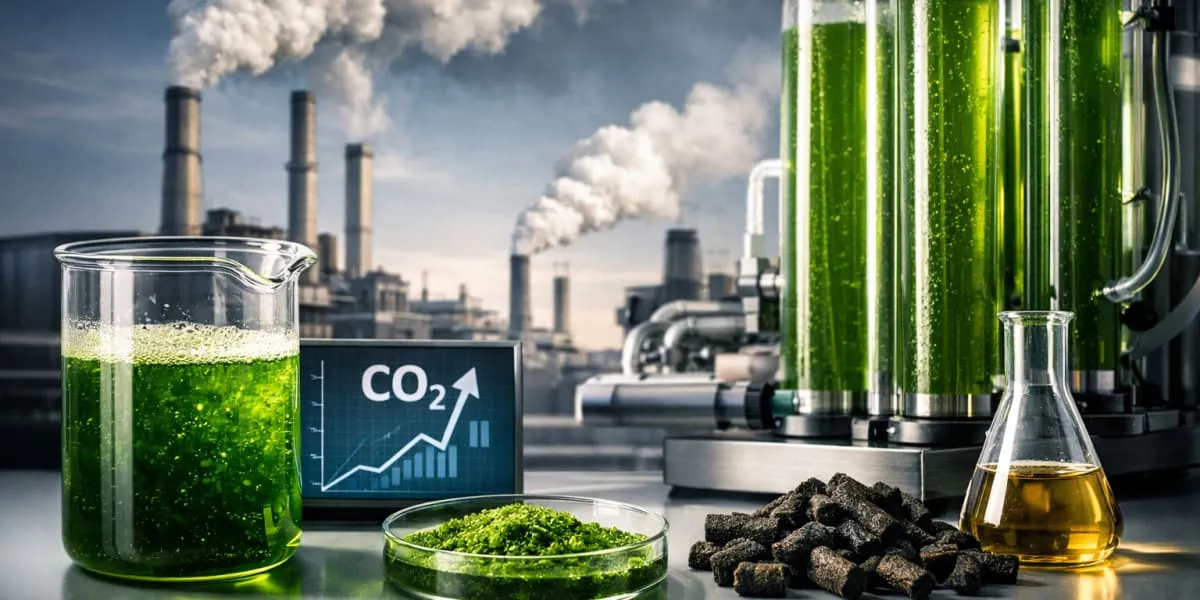
Researchers at the Indian Institute of Technology Guwahati have developed a two-stage cultivation process that improves carbon dioxide (CO?) capture, microalgal biomass production, efficient self-harvesting and bioenergy generation simultaneously. The process is intended to allow industrial facilities to use flue gas as a continuous carbon source while reducing the energy required for downstream biomass recovery. The team reported that microalgae convert CO? into biomass that can be processed into renewable fuels and other bioenergy products.

To balance high carbon availability with sustained photosynthetic performance, the team led by Professor Kaustubha Mohanty implemented an initial high-CO? phase followed by a lower-CO? phase with nutrient amendments. In the first stage cultures were grown under 15 per cent CO? to promote rapid growth, but prolonged exposure led to acidification and reduced growth rate. In the second stage CO? concentration was reduced to five per cent and calcium and phosphorus were added to stabilise pH, promote biomass aggregation and induce self-flocculation.

In a two-litre bubble-column photobioreactor the two-stage strategy produced measurable gains over single-stage cultivation, including 25.7 per cent higher biomass production, 35.4 per cent higher CO? fixation and one point eight six times higher lipid productivity. Total intracellular bioenergy efficiency improved by 37.65 per cent and the energy value of the biomass increased, while biodiesel derived from the algal biomass met standards applicable in India, the United States and Europe. The calcium-assisted aggregation enabled auto-sedimentation, which raised biomass recovery efficiency to 98.46 per cent.

The researchers concluded that the nutrient-assisted CO? modulation approach reduces the energy penalty associated with harvesting and offers a practical pathway to pilot-scale integration with CO?-rich industrial exhaust streams and microalgal biorefineries. The study is presented as a potential means to maintain efficient carbon fixation during prolonged cultivation and lower downstream separation energy, two commercially relevant challenges for algal biorefineries. Further work is indicated to scale the system and validate continuous operation on industrial flue gas.

Researchers at the Indian Institute of Technology Guwahati have developed a two-stage cultivation process that improves carbon dioxide (CO?) capture, microalgal biomass production, efficient self-harvesting and bioenergy generation simultaneously. The process is intended to allow industrial facilities to use flue gas as a continuous carbon source while reducing the energy required for downstream biomass recovery. The team reported that microalgae convert CO? into biomass that can be processed into renewable fuels and other bioenergy products. To balance high carbon availability with sustained photosynthetic performance, the team led by Professor Kaustubha Mohanty implemented an initial high-CO? phase followed by a lower-CO? phase with nutrient amendments. In the first stage cultures were grown under 15 per cent CO? to promote rapid growth, but prolonged exposure led to acidification and reduced growth rate. In the second stage CO? concentration was reduced to five per cent and calcium and phosphorus were added to stabilise pH, promote biomass aggregation and induce self-flocculation. In a two-litre bubble-column photobioreactor the two-stage strategy produced measurable gains over single-stage cultivation, including 25.7 per cent higher biomass production, 35.4 per cent higher CO? fixation and one point eight six times higher lipid productivity. Total intracellular bioenergy efficiency improved by 37.65 per cent and the energy value of the biomass increased, while biodiesel derived from the algal biomass met standards applicable in India, the United States and Europe. The calcium-assisted aggregation enabled auto-sedimentation, which raised biomass recovery efficiency to 98.46 per cent. The researchers concluded that the nutrient-assisted CO? modulation approach reduces the energy penalty associated with harvesting and offers a practical pathway to pilot-scale integration with CO?-rich industrial exhaust streams and microalgal biorefineries. The study is presented as a potential means to maintain efficient carbon fixation during prolonged cultivation and lower downstream separation energy, two commercially relevant challenges for algal biorefineries. Further work is indicated to scale the system and validate continuous operation on industrial flue gas.

Related Stories

Gold Stories

Next Story
Infrastructure Transport

Garuda Aerospace, Goa Partner to Train Women Drone Pilots

Garuda Aerospace has partnered with the Goa Information Technology Development Corporation (GITDC) and the Department of Information Technology, Electronics & Communications (DITE&C) to support the government’s broader ‘Drone Didi’ initiative in Goa.The programme aims to train 100 women every financial year and create 300 certified women drone pilots over three years, subject to statewide approval by DITE&C. The initiative seeks to strengthen rural livelihoods, encourage women-led entrepreneurship and develop a digitally skilled workforce.The first cohort of 12 women, recogni..

Next Story
Infrastructure Urban

Bondada Group Hosts ‘Bharat Unbound’ for Young Entrepreneurs

Bondada Group recently hosted ‘Bharat Unbound – Celebrating the Freedom to Dream, Create & Lead’ in Hyderabad, bringing together students and young entrepreneurs to discuss entrepreneurship, leadership, resilience and emerging opportunities in India.Held at Bondada House as part of the Group’s Independence Day celebrations, the event featured a fireside conversation with Dr Bondada Raghavendra Rao, Chairman and Managing Director, Bondada Group. He shared insights from his entrepreneurial journey and discussed how young people can use their freedom to pursue ideas, create opportunit..

Next Story
Infrastructure Urban

REC Backs Six Mobile Medical Units in Chhattisgarh

REC Limited, under its Corporate Social Responsibility (CSR) initiative, has supported six Mobile Medical Units (MMUs) worth Rs 7.21 crore in Chhattisgarh to strengthen healthcare access in underserved areas.Chhattisgarh Governor Shri Ramen Deka recently flagged off the six MMUs at Lok Bhawan, Chhattisgarh. The ceremony was attended by Shri Satyaban Sahoo, Chief Project Manager, Regional Office Raipur, REC Limited, along with officials from REC Limited and the Indian Red Cross Society (IRCS), Chhattisgarh.The mobile medical units are aimed at bridging healthcare gaps and improving last-mile de..

Advertisement

Subscribe to Our Newsletter

Get daily newsletters around different themes from Construction world.

STAY CONNECTED

Advertisement