+
India Makes Strides In Manufacturing Innovation And Green Energy
POWER & RENEWABLE ENERGY

India Makes Strides In Manufacturing Innovation And Green Energy

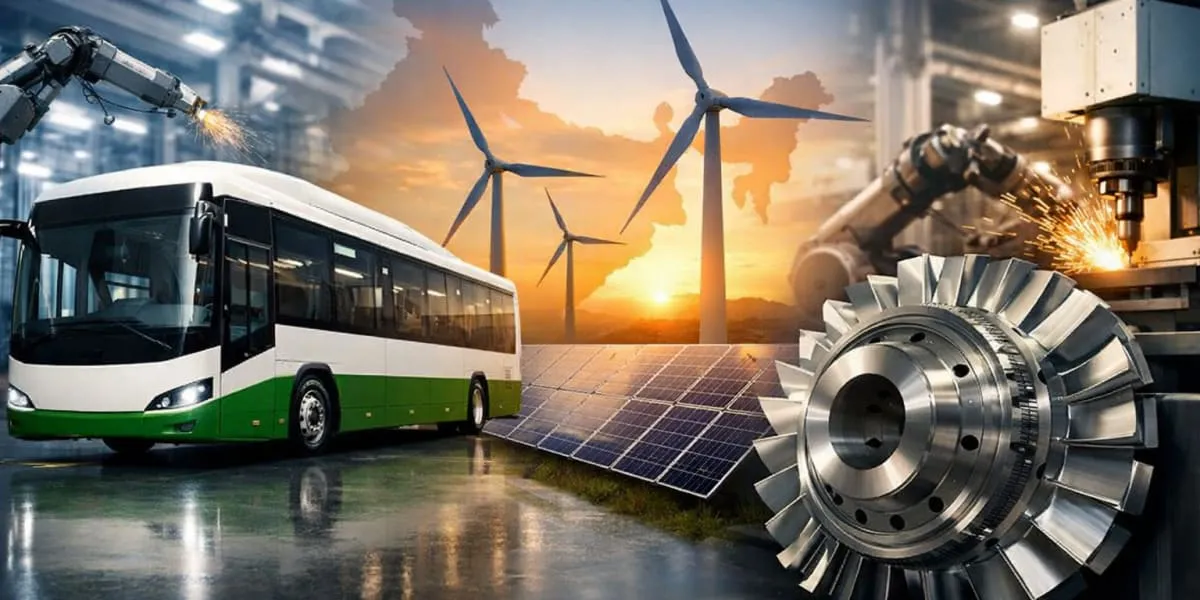
Union Minister for Coal and Mines G Kishan Reddy said in Hyderabad that India was making significant strides in manufacturing, innovation, green energy and sustainable mobility under the leadership of Prime Minister Narendra Modi. He referred to the unveiling of Telangana-based KETO Motors' first commercial electric bus and described the launch as reflecting the growing strength of indigenous manufacturing capabilities and the country's commitment to building an Aatmanirbhar Bharat. The account was provided by PTI. Reddy said electric mobility was not merely an alternative to conventional transport but a strategic element for enhancing India’s energy security, reducing pollution and lowering dependence on fuel imports while promoting technological self-reliance. He outlined that the Central government remained committed to strengthening the entire electric vehicle (EV) ecosystem, encompassing vehicle and battery manufacturing, expansion of charging infrastructure, research and development and skill development. The minister indicated that policy support and industry collaboration were being prioritised to accelerate adoption. He highlighted that Telangana-based enterprises were contributing to the national electric mobility drive by developing indigenous solutions that strengthened public transport, generated employment and supported sustainable economic growth. The minister characterises the launch of KETO Motors' first commercial electric bus as a major milestone for the company and a sign of maturation in the commercial EV ecosystem. The event was presented as evidence of increasing private sector engagement and manufacturing capacity. Officials and industry observers were said to view such developments as reinforcing India’s broader goals on manufacturing, innovation and green energy transition without creating additional dependence on imports. The minister’s remarks were framed around the twin objectives of economic growth and environmental sustainability, with emphasis on job creation and technological self-reliance. Future efforts will focus on scaling manufacturing capabilities and infrastructure to consolidate gains in sustainable mobility.

Union Minister for Coal and Mines G Kishan Reddy said in Hyderabad that India was making significant strides in manufacturing, innovation, green energy and sustainable mobility under the leadership of Prime Minister Narendra Modi. He referred to the unveiling of Telangana-based KETO Motors' first commercial electric bus and described the launch as reflecting the growing strength of indigenous manufacturing capabilities and the country's commitment to building an Aatmanirbhar Bharat. The account was provided by PTI. Reddy said electric mobility was not merely an alternative to conventional transport but a strategic element for enhancing India’s energy security, reducing pollution and lowering dependence on fuel imports while promoting technological self-reliance. He outlined that the Central government remained committed to strengthening the entire electric vehicle (EV) ecosystem, encompassing vehicle and battery manufacturing, expansion of charging infrastructure, research and development and skill development. The minister indicated that policy support and industry collaboration were being prioritised to accelerate adoption. He highlighted that Telangana-based enterprises were contributing to the national electric mobility drive by developing indigenous solutions that strengthened public transport, generated employment and supported sustainable economic growth. The minister characterises the launch of KETO Motors' first commercial electric bus as a major milestone for the company and a sign of maturation in the commercial EV ecosystem. The event was presented as evidence of increasing private sector engagement and manufacturing capacity. Officials and industry observers were said to view such developments as reinforcing India’s broader goals on manufacturing, innovation and green energy transition without creating additional dependence on imports. The minister’s remarks were framed around the twin objectives of economic growth and environmental sustainability, with emphasis on job creation and technological self-reliance. Future efforts will focus on scaling manufacturing capabilities and infrastructure to consolidate gains in sustainable mobility.

Related Stories

Gold Stories

Next Story
Real Estate

BMC OC Amnesty Scheme Requires Key Approvals from Mumbai Societies

The Brihanmumbai Municipal Corporation (BMC) has clarified that housing societies applying under its Occupation Certificate (OC) amnesty scheme must possess key approvals linked to the original construction. The requirements include a valid Intimation of Disapproval (IOD), an approved building plan and a Commencement Certificate (CC), along with a No Objection Certificate (NOC) from the developer or original construction applicant. The Standard Operating Procedure (SOP) makes clear that the absence of an OC alone will not qualify a building for relief. Societies must establish that their build..

Next Story
Real Estate

Gurugram Emerges as Luxury Senior Living Hub

Gurugram is emerging as a potential hub for luxury senior living, supported by available land, healthcare infrastructure, connectivity and a concentration of affluent professionals, high-net-worth individuals and non-resident Indians. These factors could give the city an advantage over land-constrained metros such as Mumbai. A report by the Association of Senior Living India (ASLI) and JLL estimates that India’s organised senior living market could represent a $10.1 bn opportunity by 2030. The sector had about 25,050 organised units as of June 2026, while penetration stood at only 1.5 per ce..

Next Story
Real Estate

Corrosion Costs India’s Infrastructure Rs. 142 bn Annually

Corrosion costs India an estimated Rs. 1.42 tn annually, equivalent to 4.3 per cent of gross domestic product, according to a report by the Confederation of Indian Industry and the National Research Institute. Infrastructure accounts for Rs. 142 bn of the annual burden, making it the sector with the largest absolute cost among those examined. The report, presented at the CII Annual Infrastructure Summit 2026, said the infrastructure-sector cost equals about 2.9 per cent of the sector’s gross domestic product. It estimated that effective measures could generate maximum savings of Rs. 495.8 bn..

Advertisement

Subscribe to Our Newsletter

Get daily newsletters around different themes from Construction world.

STAY CONNECTED

Advertisement

SPECIAL OFFER
QR Code