India's Rooftop Solar Market Has 132 GW Potential
POWER & RENEWABLE ENERGY

India's Rooftop Solar Market Has 132 GW Potential

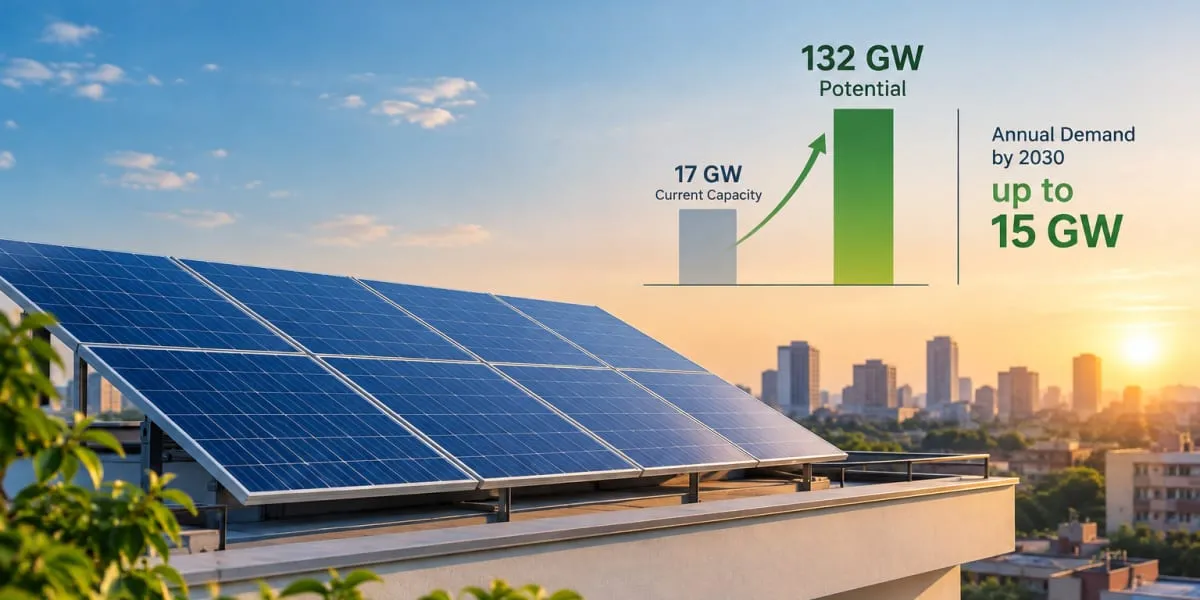
India’s rooftop solar market has the potential to expand to 132 GW from the current installed capacity of 17 GW, with annual demand expected to reach up to 15 GW by 2030, according to the Indian Solar Manufacturers Association (ISMA). The assessment points to a substantial pipeline for domestic manufacturers of solar cells, modules, inverters and balance-of-system components.

ISMA said the sector’s current attractiveness was being driven mainly by subsidies under the PM Surya Ghar: Muft Bijli Yojana (PMSGMBY), combined with state-level capital incentives. The programme has also changed expectations around the future trajectory of electricity tariffs and improved the economics of residential rooftop installations.

A typical 3 kW residential rooftop system takes between 2 and 6.7 years to recover its cost after central and state subsidies in the 10 states with the highest rooftop solar adoption. However, the analysis found that payback periods varied considerably without subsidies, with high-tariff states such as Maharashtra and Kerala offering quicker returns than Uttar Pradesh, Gujarat and Tamil Nadu.

The scheme is supporting installations even in states where rooftop solar would not yet recover its cost without assistance. About 60 per cent of the capacity installed under PMSGMBY is located in such states, indicating that subsidies are closing the payback gap and broadening adoption across residential markets.

ISMA said deployment was increasingly constrained by grid-hosting and metering capacity rather than a lack of consumer interest. It identified policy continuity beyond March 2027, when the current phase of PMSGMBY expires, as a key priority. Early clarity on a possible next phase, including PM Surya Ghar 2.0, would help sustain demand, prevent disruption and give manufacturers greater confidence to plan investments and capacity.

India’s rooftop solar market has the potential to expand to 132 GW from the current installed capacity of 17 GW, with annual demand expected to reach up to 15 GW by 2030, according to the Indian Solar Manufacturers Association (ISMA). The assessment points to a substantial pipeline for domestic manufacturers of solar cells, modules, inverters and balance-of-system components. ISMA said the sector’s current attractiveness was being driven mainly by subsidies under the PM Surya Ghar: Muft Bijli Yojana (PMSGMBY), combined with state-level capital incentives. The programme has also changed expectations around the future trajectory of electricity tariffs and improved the economics of residential rooftop installations. A typical 3 kW residential rooftop system takes between 2 and 6.7 years to recover its cost after central and state subsidies in the 10 states with the highest rooftop solar adoption. However, the analysis found that payback periods varied considerably without subsidies, with high-tariff states such as Maharashtra and Kerala offering quicker returns than Uttar Pradesh, Gujarat and Tamil Nadu. The scheme is supporting installations even in states where rooftop solar would not yet recover its cost without assistance. About 60 per cent of the capacity installed under PMSGMBY is located in such states, indicating that subsidies are closing the payback gap and broadening adoption across residential markets. ISMA said deployment was increasingly constrained by grid-hosting and metering capacity rather than a lack of consumer interest. It identified policy continuity beyond March 2027, when the current phase of PMSGMBY expires, as a key priority. Early clarity on a possible next phase, including PM Surya Ghar 2.0, would help sustain demand, prevent disruption and give manufacturers greater confidence to plan investments and capacity.

Related Stories

Gold Stories

Next Story
Real Estate

Address Maker sells over 200 Apollo Address plots in six weeks

The Address Maker Group has sold more than two-thirds of the inventory at its Apollo Address villa-plot development in Nelamangala, North-West Bengaluru, within six weeks of its launch. With over 200 plots purchased and approximately 100 remaining, the project has recorded the fastest sales pace in the developer's history.Spread across 23 acres within a larger 90-acre township, Apollo Address offers villa plots ranging from 1,200 to 2,400 sq ft. Inspired by classical Greek architecture, the development features planned infrastructure, landscaped open spaces and residential amenities.Nearly 30 ..

Next Story
Equipment

Zoomlion strengthens equipment partnerships in Australia

Zoomlion Heavy Industry Science & Technology has reaffirmed its commitment to expanding operations in Australia, with Chairman and CEO Zhan Chunxin meeting customers and business partners in Sydney to strengthen long-term partnerships and discuss opportunities for closer collaboration.The meeting, held on 4 November 2026, focused on equipment quality, technical support, spare parts availability, local training and customer service improvements. Representatives from the tower crane, concrete machinery, earthmoving, aerial work platform, agricultural machinery and financial sectors participa..

Next Story
Real Estate

Rahul Mehta Architects unveils Mumbai cruise terminal design

Rahul Mehta Architects has unveiled the architectural design of the Mumbai International Cruise Terminal (MICT), described as India's first organised international cruise terminal. Located at Indira Dock, the project aims to transform Mumbai's historic waterfront into a destination combining cruise operations, retail, hospitality and public spaces.Appointed by maritime and logistics group JM Baxi, the architectural practice has designed the terminal to meet international cruise operational standards while creating a year-round public destination. The project has been developed under a public-p..

Advertisement

Subscribe to Our Newsletter

Get daily newsletters around different themes from Construction world.

STAY CONNECTED

Advertisement

SPECIAL OFFER
QR Code