No New Renewable Energy Projects Within One Kilometre Of Borders
POWER & RENEWABLE ENERGY

No New Renewable Energy Projects Within One Kilometre Of Borders

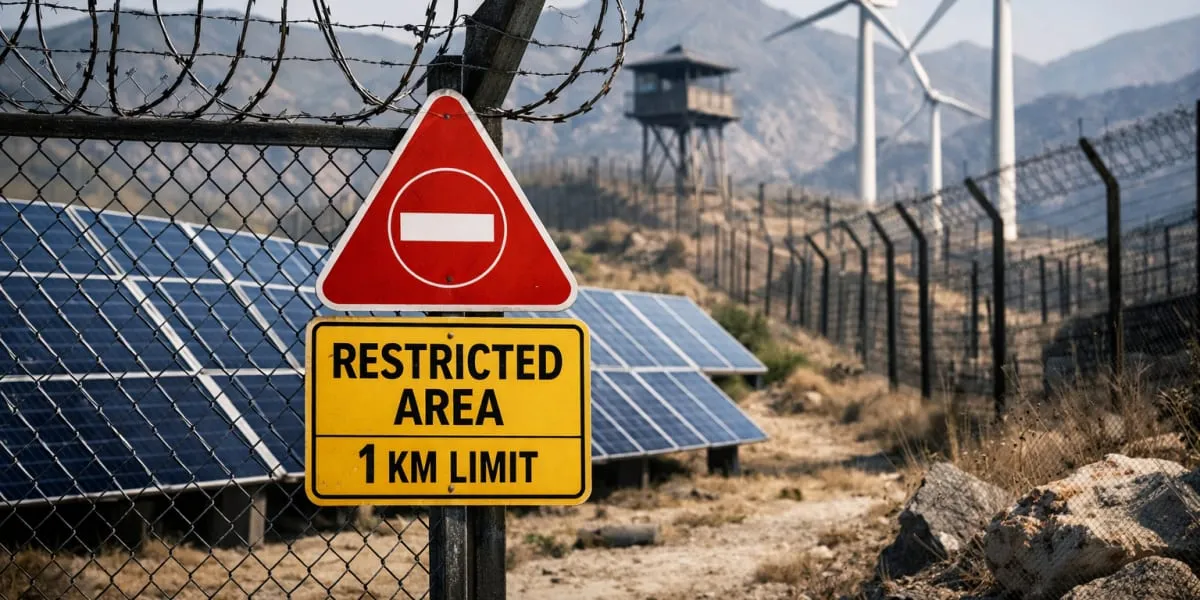
The Ministry of Home Affairs has prohibited the establishment of new solar, wind and hybrid renewable energy projects within one kilometre (km) of the Line of Control, the Line of Actual Control and the International Border, and has prescribed security clearances for installations in a belt. The measures form part of guidelines issued for national security clearance of renewable energy projects in border areas after the Ministry of New and Renewable Energy reported multiple applications for such sites.

Areas within 50 km of the Line of Control, the Line of Actual Control or the International Border have been designated as sensitive, with a separate no-objection certificate (NOC) required for proposals located within 20 km of the International Border to be issued by the Ministry of Defence. Project activity will be strictly barred in the one kilometre exclusion zone and proposals between one km and 50 km will face detailed scrutiny.

The guidelines prohibit the engagement of labour from countries that share a land border with India without central government permission and require separate filings for proposals involving foreign investment to the Department for Promotion of Industry and Internal Trade under the foreign direct investment policy. State governments must provide in-principle land allotment approvals before proposals are advanced.

Applications for projects in the defined belt are to be submitted to the Ministry of New and Renewable Energy, which will forward proposals to the Ministry of Home Affairs for security clearance and to the defence ministry for a no-objection certificate. Security clearance and NOC decisions for projects located between one km and 50 km, and for NOC requests within one km to 20 km, will be assessed on a case-by-case basis.

The guidelines also set limits on the height of civil infrastructure required for maintenance and operation, restricting heights to three metres within one to eight km, five metres within eight to 20 km and 15 metres in the 20 to 50 km band. Authorities said the rules aim to balance security considerations with ease of doing business in consultation with stakeholders.

The Ministry of Home Affairs has prohibited the establishment of new solar, wind and hybrid renewable energy projects within one kilometre (km) of the Line of Control, the Line of Actual Control and the International Border, and has prescribed security clearances for installations in a belt. The measures form part of guidelines issued for national security clearance of renewable energy projects in border areas after the Ministry of New and Renewable Energy reported multiple applications for such sites. Areas within 50 km of the Line of Control, the Line of Actual Control or the International Border have been designated as sensitive, with a separate no-objection certificate (NOC) required for proposals located within 20 km of the International Border to be issued by the Ministry of Defence. Project activity will be strictly barred in the one kilometre exclusion zone and proposals between one km and 50 km will face detailed scrutiny. The guidelines prohibit the engagement of labour from countries that share a land border with India without central government permission and require separate filings for proposals involving foreign investment to the Department for Promotion of Industry and Internal Trade under the foreign direct investment policy. State governments must provide in-principle land allotment approvals before proposals are advanced. Applications for projects in the defined belt are to be submitted to the Ministry of New and Renewable Energy, which will forward proposals to the Ministry of Home Affairs for security clearance and to the defence ministry for a no-objection certificate. Security clearance and NOC decisions for projects located between one km and 50 km, and for NOC requests within one km to 20 km, will be assessed on a case-by-case basis. The guidelines also set limits on the height of civil infrastructure required for maintenance and operation, restricting heights to three metres within one to eight km, five metres within eight to 20 km and 15 metres in the 20 to 50 km band. Authorities said the rules aim to balance security considerations with ease of doing business in consultation with stakeholders.

Related Stories

Gold Stories

Next Story
Infrastructure Urban

Sabarmati Riverfront Two Plots Up for Auction at Rs2.24 bn Base Price

Two commercial plots on the western bank of the Sabarmati Riverfront will be auctioned with a base price of Rs 112 crore each, equivalent to Rs 1.12 bn apiece and Rs 2.24 billion in total. The parcels are located adjacent to the Metro Rail Bridge in Ahmedabad and form the first commercial offering after a prolonged pause. The Riverfront Development Corporation has framed the sale as part of a phased commercial release to revive development along the riverfront. The combined base valuation has been set by the corporation to reflect market rates along the riverfront. The corporation has fixed a ..

Next Story
Infrastructure Urban

Andhra Pradesh to Connect Over One Million Streetlights

Andhra Pradesh will undertake a statewide smart streetlighting programme across all 123 Urban Local Bodies (ULBs), bringing around 1.05 million (mn) streetlights under an AI enabled monitoring and management system. The programme will be implemented by Energy Efficiency Services Limited (EESL) with the Commissioner and Director of Municipal Administration under the state Municipal Administration and Urban Development Department. The project aims to convert conventional streetlighting into a digitally managed municipal service monitored and maintained remotely. The initial phase will cover abou..

Next Story
Infrastructure Urban

AMC To Procure Four Machines For Guard Rail Cleaning

Ahmedabad Municipal Corporation will introduce four specialised machines for cleaning guard railings along major roads and the central verges of BRTS and Metro corridors. The civic body plans to replace manual labour with mechanised cleaning to improve maintenance of road infrastructure and greenery. The purchase is estimated at Rs 82.8 million (mn), excluding GST. The proposal sets the base price of each machine at about Rs 20.7 million (mn) so four units total Rs 82.8 million (mn) before GST. 18 per cent GST will be applicable separately. During the warranty period each machine will operate ..

Advertisement

Subscribe to Our Newsletter

Get daily newsletters around different themes from Construction world.

STAY CONNECTED

Advertisement