+
Swaraj And Mahindra Susten Commission 42 MWp Solar Plant
POWER & RENEWABLE ENERGY

Swaraj And Mahindra Susten Commission 42 MWp Solar Plant

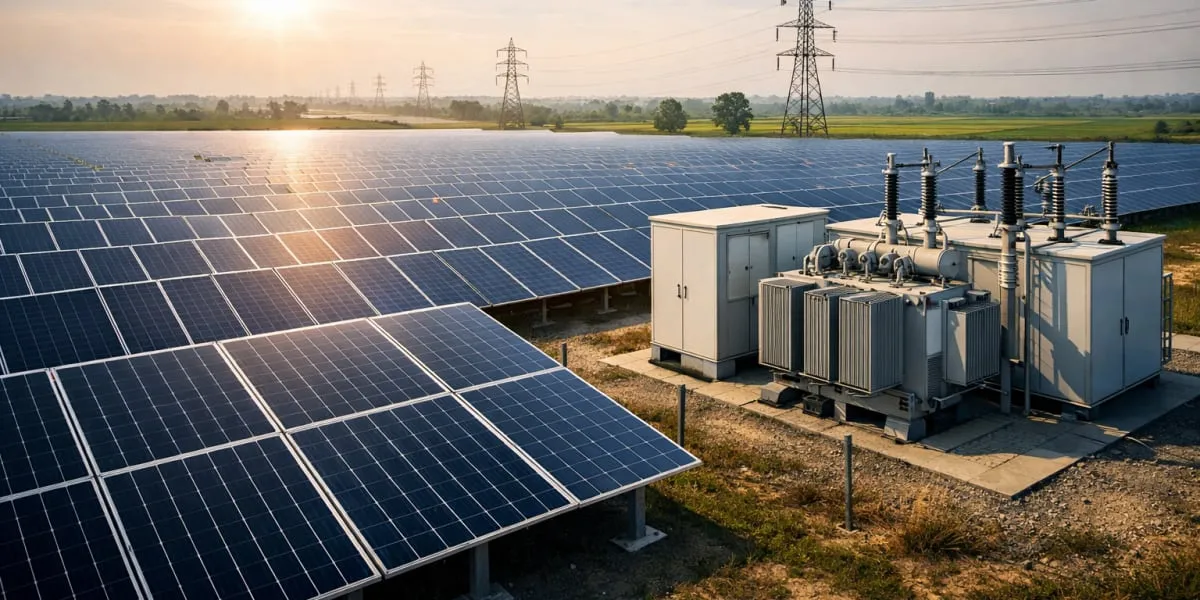
Swaraj Tractors and Mahindra Susten have commissioned a 42 MWp solar project at Talwandi Sabo in Bathinda, Punjab, marking a major step in Swaraj's shift towards cleaner manufacturing. The facility occupies about 141 acres and is expected to generate 61.54 million (mn) units of renewable electricity annually, which will offset roughly 42,000 t of carbon dioxide emissions each year. The installation is described as one of the largest group captive solar projects in the state and is intended to meet around 50 per cent of Swaraj's manufacturing electricity requirements.

Renewable electricity from the Bathinda facility will supply manufacturing, assembly and foundry operations in Mohali, with residual capacity proposed to green electricity consumption across other Mahindra Group entities in Punjab. Mahindra Susten developed and commissioned the project through its independent power producer platform and will manage the facility under the group captive arrangement. The companies envisage closer collaboration to explore expanding renewable supply to the tractor maker.

Swaraj is pursuing a two-pronged energy strategy that focuses on reducing overall consumption while progressively replacing conventional sources with renewables. Company leadership frames sustainability as integral to business growth and highlights innovation, productivity and technology as central to the manufacturing roadmap. The company has earlier secured EP100 certification for doubling energy productivity and received recognition for energy efficiency efforts.

The Bathinda plant uses high-efficiency N-Type TOPCon bifacial solar modules mounted on fixed-tilt structures to capture direct and reflected radiation, and more than 97 per cent of project components have been sourced domestically. Semi-automated robotic cleaning systems have been installed to reduce water use, saving an estimated 1.92 mn litres annually, and environmental and social impact assessments informed measures to manage waste and protect local ecology.

Mahindra Susten views the project as an initial commercial and industrial supply through the group captive model and is assessing options to increase renewable electricity supply and grid capacity in Punjab. The companies are also evaluating the addition of battery energy storage to shift solar generation across the day and move towards round-the-clock renewable power, while Susten continues to expand its executed and pipeline capacities to support hybrid projects and storage integration.

Swaraj Tractors and Mahindra Susten have commissioned a 42 MWp solar project at Talwandi Sabo in Bathinda, Punjab, marking a major step in Swaraj's shift towards cleaner manufacturing. The facility occupies about 141 acres and is expected to generate 61.54 million (mn) units of renewable electricity annually, which will offset roughly 42,000 t of carbon dioxide emissions each year. The installation is described as one of the largest group captive solar projects in the state and is intended to meet around 50 per cent of Swaraj's manufacturing electricity requirements. Renewable electricity from the Bathinda facility will supply manufacturing, assembly and foundry operations in Mohali, with residual capacity proposed to green electricity consumption across other Mahindra Group entities in Punjab. Mahindra Susten developed and commissioned the project through its independent power producer platform and will manage the facility under the group captive arrangement. The companies envisage closer collaboration to explore expanding renewable supply to the tractor maker. Swaraj is pursuing a two-pronged energy strategy that focuses on reducing overall consumption while progressively replacing conventional sources with renewables. Company leadership frames sustainability as integral to business growth and highlights innovation, productivity and technology as central to the manufacturing roadmap. The company has earlier secured EP100 certification for doubling energy productivity and received recognition for energy efficiency efforts. The Bathinda plant uses high-efficiency N-Type TOPCon bifacial solar modules mounted on fixed-tilt structures to capture direct and reflected radiation, and more than 97 per cent of project components have been sourced domestically. Semi-automated robotic cleaning systems have been installed to reduce water use, saving an estimated 1.92 mn litres annually, and environmental and social impact assessments informed measures to manage waste and protect local ecology. Mahindra Susten views the project as an initial commercial and industrial supply through the group captive model and is assessing options to increase renewable electricity supply and grid capacity in Punjab. The companies are also evaluating the addition of battery energy storage to shift solar generation across the day and move towards round-the-clock renewable power, while Susten continues to expand its executed and pipeline capacities to support hybrid projects and storage integration.

Related Stories

Gold Stories

Next Story
Infrastructure Transport

Mumbai-Ahmedabad Bullet Train’s Surat-Vapi Section Set for 2027

The first section of the Mumbai-Ahmedabad Bullet Train corridor, linking Surat and Vapi, is targeted to begin services in 2027. Construction is expected to be completed by December 2026, while Railway Minister Ashwini Vaishnaw has indicated that an inauguration could take place around the middle of 2027. The National High Speed Rail Corporation (NHSRCL) said the train being manufactured in India is expected to reach the tracks around April or May 2027. The train will undergo extensive testing before the section is opened for passenger services. The project began construction in 2021 and includ..

Next Story
Infrastructure Transport

Indian Railways Approves Four Projects Worth Rs. 7.36 bn Across Four States

Indian Railways has approved four projects with a combined value of Rs. 7.36 bn across Uttar Pradesh, Maharashtra, Andhra Pradesh and Gujarat. The programme covers train protection, signalling, electric traction supply and a road overbridge, with each project assigned to a different railway zone. In Uttar Pradesh, Rs. 2.52 bn has been approved to extend the Kavach 4.0 automatic train protection system across 607.7 km in the Lucknow Division of North Eastern Railway. The system monitors train movements and can apply the brakes if a driver fails to observe a signal or exceeds a safe speed. The w..

Next Story
Infrastructure Urban

Chandru Raheja Sells 1.49% Stake in Mindspace REIT for Rs. 5 bn

Billionaire Chandru Lachmandas Raheja has sold a 1.49 per cent holding in Mindspace Business Parks REIT for Rs. 5 bn through a bulk deal on the BSE. The transaction involved 9.9 mn units and was executed at an average price of Rs. 505 per unit, according to exchange data. Following the sale, units of Mindspace Business Parks REIT were trading 0.18 per cent lower at Rs. 504.05 on Tuesday. Exchange data did not identify the buyers involved in the transaction. Raheja is the chairman of real estate company K Raheja Corp. The sale involved 99,00,990 units, representing 1.49 per cent of the Mumbai-b..

Advertisement

Subscribe to Our Newsletter

Get daily newsletters around different themes from Construction world.

STAY CONNECTED

Advertisement

SPECIAL OFFER
QR Code