Uttarakhand Installs 1,132 Solar Plants Under MSSY Reaching 210 MW
POWER & RENEWABLE ENERGY

Uttarakhand Installs 1,132 Solar Plants Under MSSY Reaching 210 MW

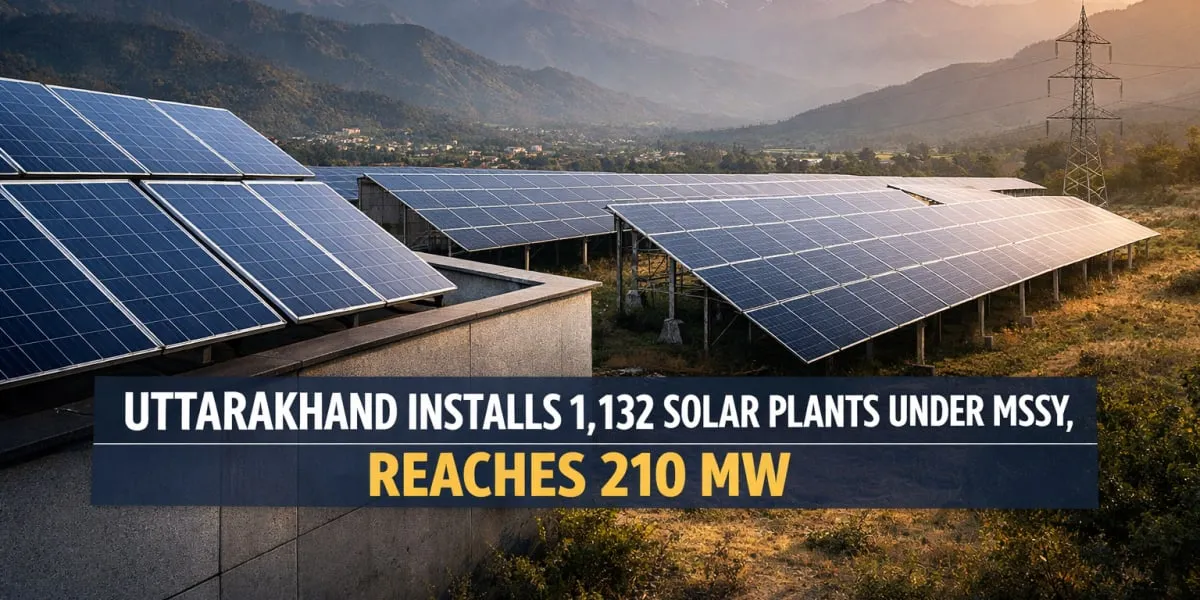
Uttarakhand has installed 1,132 solar plants under the Mukhyamantri Saur Swarojgar Yojana (MSSY), reaching 210 Megawatt (MW) of cumulative capacity. The state government reported that installations were completed across multiple districts, contributing to decentralised renewable energy generation in rural and semi-urban areas. The programme aims to expand rooftop and ground mounted generation while supporting rural livelihoods and reliable local power supply. State officials described the rollout as part of a sustained effort to localise energy production and improve service reliability in remote settlements.

The 1,132 plants include systems mounted on institutional, community and individual rooftops as well as small ground arrays suited to hilly terrain. Implementation involved financial and technical facilitation from state agencies and local partners with priority given to underserved and off-grid communities. The installations are designed to reduce dependence on diesel generation for essential services such as lighting, water pumping and health facilities. Technical audits and standardised installation protocols were reported to have been followed to ensure safety and consistent performance across varied sites.

Under the scheme the government provided subsidies, capacity building for local technicians and assistance with grid interconnection to promote long term operation. The rollout generated both skilled and unskilled employment in installation, maintenance and logistics and stimulated ancillary local economic activity. Officials have instituted monitoring mechanisms and scheduled maintenance plans to sustain performance and output. Local training programmes emphasised system operation and basic troubleshooting to build community capacity for routine upkeep and reduce downtime.

The capacity addition is a practical complement to the state's broader renewable energy objectives and energy security ambitions without creating grid burdens. The distributed generation model reduces transmission losses and improves resilience in mountain communities prone to weather related disruptions. Further scaling of similar programmes could enhance energy access and foster local economic development.

Uttarakhand has installed 1,132 solar plants under the Mukhyamantri Saur Swarojgar Yojana (MSSY), reaching 210 Megawatt (MW) of cumulative capacity. The state government reported that installations were completed across multiple districts, contributing to decentralised renewable energy generation in rural and semi-urban areas. The programme aims to expand rooftop and ground mounted generation while supporting rural livelihoods and reliable local power supply. State officials described the rollout as part of a sustained effort to localise energy production and improve service reliability in remote settlements. The 1,132 plants include systems mounted on institutional, community and individual rooftops as well as small ground arrays suited to hilly terrain. Implementation involved financial and technical facilitation from state agencies and local partners with priority given to underserved and off-grid communities. The installations are designed to reduce dependence on diesel generation for essential services such as lighting, water pumping and health facilities. Technical audits and standardised installation protocols were reported to have been followed to ensure safety and consistent performance across varied sites. Under the scheme the government provided subsidies, capacity building for local technicians and assistance with grid interconnection to promote long term operation. The rollout generated both skilled and unskilled employment in installation, maintenance and logistics and stimulated ancillary local economic activity. Officials have instituted monitoring mechanisms and scheduled maintenance plans to sustain performance and output. Local training programmes emphasised system operation and basic troubleshooting to build community capacity for routine upkeep and reduce downtime. The capacity addition is a practical complement to the state's broader renewable energy objectives and energy security ambitions without creating grid burdens. The distributed generation model reduces transmission losses and improves resilience in mountain communities prone to weather related disruptions. Further scaling of similar programmes could enhance energy access and foster local economic development.

Related Stories

Gold Stories

Next Story
Infrastructure Urban

Panel Urges Zone-Wise Freight Plans and Crew Strengthening

A Parliamentary Standing Committee has urged the Railway Ministry to prepare zone-wise plans to enhance freight traffic in regions with limited mineral movement and industrial activity, according to its ninth report tabled in Parliament on 10 August. The Committee commended efforts to augment network capacity through multitracking, operationalisation of Dedicated Freight Corridors (DFC) and modernisation of yards. It noted that the Ministry has said periodic data-driven assessments are carried out with inputs from Zonal Railways, Divisional Railways and Business Development Units to support po..

Next Story
Infrastructure Urban

Coal India Weighs Buying Wealth Minerals Unit For Chile Lithium

Coal India Limited is evaluating a proposal to acquire the Chilean lithium assets held by the Wealth Minerals unit in Canada as part of a strategic move into battery materials. The company is assessing the asset portfolio, regulatory landscape and integration challenges while retaining coal operations as its core business. The potential interest reflects a shift by a state-owned miner towards minerals critical to the low emission transition. Wealth Minerals, a Canada-based exploration company, holds licences and exploration agreements in Chile that involve hard rock and brine lithium prospects..

Next Story
Infrastructure Energy

Bajel Projects Wins Ultra?Mega Transmission Line Contract

Bajel Projects Limited has secured an Ultra?Mega engineering, procurement and construction order for a transmission line package TL05 from PowerGrid Corporation of India Limited on behalf of its special purpose vehicle. The award forms part of the Western Region–Eastern Region inter?regional network expansion scheme Part A procured under the tariff based competitive bidding route. The contract covers construction of a 765 kV double circuit transmission line. The scope includes bypassing of the Raigarh (Tamnar)–Dharamjaygarh (Sec?B) 765 kV double circuit line and reconfiguration to form the..

Advertisement

Subscribe to Our Newsletter

Get daily newsletters around different themes from Construction world.

STAY CONNECTED

Advertisement