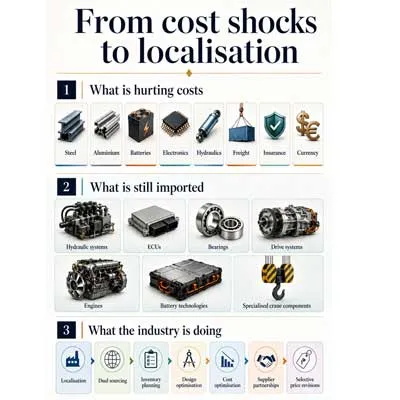
Facing cost headwinds, India’s material handling equipment industry is looking to localise a long list of components.Geopolitical turbulence in the Middle East has created tangible cost headwinds for the material handling equipment industry, compelling players to recalibrate their operations and take a long, hard look at design, with an eye on ushering in manufacturing and supply chain efficiencies, by means of greater localisation, supply chain adjustments or otherwise. Construction World’s analysis of the cost impact and remedial measures throws up ample opportunities for component makers.Impacted componentsWhile multiple input costs have been under consistent upward pressure over the past few quarters, driven by global supply constraints, energy costs and geopolitical disruptions, Rajib Lochan Datta, Head of Manufacturing Operations, TIL, pinpoints steel variations as the most critical, because “steel forms a significant portion of our overall cost structure, especially for load-bearing structures such as booms, frames and chassis.”While steel prices in India during FY26 saw a marginal year-on-year decline, geopolitical tensions towards the latter part of the fiscal year led to a sharp rise in freight and logistics costs, presenting cost challenges for the crane and heavy lifting segment where steel continues to remain the single largest cost component. PN Krishnakumar, CEO, XCMG India, remains concerned over disruptions in DR (direct reduction)-grade pellet flows from the Middle East, which contributes over 38 per cent of global direct reduced iron production, as this could potentially increase iron ore freight rates into Asia, thereby raising the delivered cost of steel inputs.Prices of aluminium, a vital material for lighter components, are also charting an upward trend.“In view of liquid natural gas shortages, structural sections and plates used in crane booms and superstructures have especially seen price increases and tightened availability,” adds Manish Mathur, CEO, Cranes, Action Construction Equipment (ACE). “Battery costs were already volatile due to lithium-ion supply chain dynamics, and continue to remain elevated, pushing up electric forklift manufacturing costs, while disrupted sulphur exports from the Persian Gulf have adversely impacted copper smelting and, hence prices, further adding pressure on electrical components.”“Most noticeably, the cost of key raw materials such as steel, electronic components and batteries, critical for material handling equipment, have increased,” agrees Siddharth Chaturvedi, General Manager Marketing, Tata Hitachi.“Input costs have increased significantly, particularly for steel, hydraulic components, tires, batteries, semiconductors and electronic systems,” according to G Kiran Kumar, National Head (MHE), LiuGong India. “This increase affects forklifts, reach stackers and other material handling solutions differently depending on their component requirements and level of technology integration.” “Other critical inputs such as aluminium, copper, rare earth materials, hydraulic components, and electronic systems continue to face supply chain volatility and pricing pressures,” adds Krishnakumar.Beyond direct cost pressures, indirect cost pressures show through supply chain disruptions, longer lead times and volatility in commodity pricing, explains Datta. “Freight charge and shipment insurance premium fluctuations and currency movements add another layer of uncertainty.”Price adjustmentsAlongside cost, margins are under pressure because customers remain price-sensitive, especially in competitive segments like construction and logistics, according to Datta. Cost and margin pressures jointly make it challenging for manufacturers to maintain cost efficiency while ensuring product quality.Pricing, however, remains a delicate balancing act between staying competitive and ensuring commercial sustainability. Where commodity inflation has been most acute, particularly in larger, more steel-intensive crane formats, ACE has implemented measured price revisions to partially offset input cost escalation, while carefully avoiding adjustments that could undermine its market position. “A cautious approach is inevitable; if the market is not ready to absorb increased costs, demand can also be affected,” explains Mathur. “Our customers, including infrastructure contractors, port operators and logistics firms are themselves under cost pressure, so we aim to be fair, transparent and supportive.” So far, a strong domestic manufacturing base, vertically integrated operations, decades of supply chain experience, a diversified product portfolio and scale have offered ACE resilience and helped absorb a portion of the shock without immediately passing the full burden to customers.“Rather than implementing aggressive price increases, we continue to focus on delivering higher lifecycle value, fuel efficiency, reliability and lower operating costs to customers across our product portfolio,” says Kumar. So while selective price revisions have been necessary to partially offset rising input and logistics costs, LiuGong India is also absorbing part of the impact through internal cost optimisation, localisation and operational efficiency improvements.XCMG India has maintained competitive pricing for product lines where localisation levels have increased and the input cost exposure has been partially insulated. However, for imported equipment and components that have experienced significant increases in landed costs, it has implemented selective and measured price revisions. “Transparent communication with customers, advance visibility wherever possible and easier financing and total cost of ownership offerings are supporting customers in this difficult time,” says Krishnakumar.At TIL, the approach is not to rely solely on price revisions, but to strengthen the cost structure from within to offer competitive pricing by focusing on design optimisation through better load distribution and the use of high-strength materials, improved manufacturing processes and increased localisation across the product portfolio.Towards localisationWith suppliers shortening quote validity periods, adding surcharges and delaying offers, internationally sourced high-technology and precision components add another layer of complexity. The most acutely affected categories, according to Mathur, “include hydraulic systems and components, such as pumps, motors and valves largely sourced from Europe and Japan, as well as electronic control units and telematics modules, high-strength alloy steels, and specialised bearings and slewing rings used in crane turntables, all of which have seen notable price escalations and supply unpredictability.”Critical material handling equipment components that are still imported, and which have seen price volatility in recent months, include hydraulic systems, electronic control units, specialised bearings, drive motors and certain battery technologies for electric equipment, says Datta. For XCMG India, some key imported components include high-performance hydraulic systems, precision undercarriage assemblies, electronic control units, telematics hardware, advanced drive systems for new-energy equipment and specialised crane components such as high-strength alloy booms, which are majorly sourced from China.“Our key imported components that have seen increased moderate to significant price increases include engines, hydraulic systems, transmission assemblies, electronic control units, semiconductors and advanced battery technologies used in electric equipment,” says Kumar. To tide over imported component volatility, all the players CW spoke to attested to focusing on localisation, supply chain diversification and strategisation (focusing on longer procurement planning cycles, strategic safety stocking of critical components and dual-sourcing initiatives), and inventory optimisation. Operational efficienciesOperational and design efficiencies, cost optimisation through value analysis and value engineering, and strengthening supplier partnerships and localisation efforts are helping Tata Hitachi to mitigate cost and margin pressures. “Our emphasis remains on maintaining sustainable margins without compromising on product quality or customer value,” says Chaturvedi.At TIL, the focus is on improving operational efficiencies within plants by optimising production cycles, reducing scrap generation and enhancing preventive maintenance practices to avoid downtime, adds Datta. “Digitalisation is a key enabler in this journey.”Additionally, strengthening vendor partnerships is helping TIL to secure more stable pricing and supply continuity, while better demand forecasting and inventory planning are helping to avoid overstock or shortages, to absorb as much of the external shock as possible internally, without compromising on quality or delivery timelines.“Proactively locking in strategic supplier contracts and optimising procurement cycles have helped tide over the situation,” says Mathur. “We’ve also focused on design efficiency, reducing material wastage, deepening localisation wherever feasible, and building buffer inventory during periods of relative price stability.”Government supportA stable policy framework to ensure long-term planning, incentives for local manufacturing and component localisation, faster execution of infrastructure projects, support for technology adoption and sustainability initiatives, and rationalisation of logistics and input costs are some areas where continued support from the Government would help the industry maintain growth momentum while enhancing global competitiveness, says Chaturvedi.Improved logistics efficiency, stable raw material availability and simplified import-export procedures would further help manufacturers manage costs effectively, adds Kumar. “Additionally, increased investment in skill development, financing support for infrastructure projects and policies encouraging sustainable and energy-efficient equipment would strengthen long-term growth.”Mathur urges the extension and deepening of PLI support for construction and material handling equipment to accelerate domestic manufacturing and reduce import dependence for critical components. “We also request a revisit of import duties on specific high-technology components such as hydraulic assemblies and electronic control systems that are not yet manufactured domestically at adequate quality or scale, providing temporary duty relief to ease our input cost burden,” he adds. “Expediting clearances for infrastructure projects would sustain equipment demand and prevent project deferrals that hurt our entire value chain.”India needs strategic buffer mechanisms or long-term sourcing frameworks for critical raw materials, particularly metallurgical coal and key steelmaking inputs sourced from geopolitically sensitive regions, emphasises Krishnakumar. “Also, policy measures for batteries and electric drive systems, charging infrastructure support at major project sites and preferential procurement policies for cleaner equipment in public infrastructure projects would provide a strong impetus to the adoption of new-energy products at scale, such as electric excavators, mining trucks and hybrid cranes.”Datta advocates appropriate import duties on selected products from the Chinese market, especially in price-sensitive segments. Also, skill development, incentives to support localisation initiatives and a clear preference for Indian-manufactured equipment in public port procurement where equivalent specifications exist would be valuable. With Sagarmala 2.0 targeting investments of `12 lakh crore between 2025 and 2035, the scale of the opportunity and the rationale for a domestic procurement preference becomes more crucial.- Charu Bahri