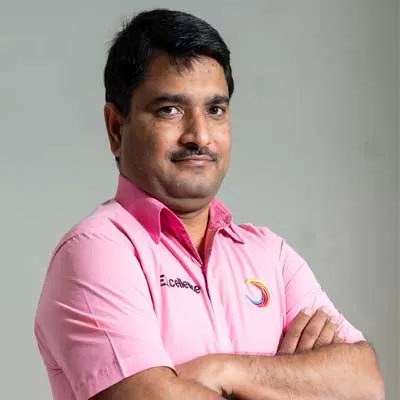
Amara Raja Infra is a leading infrastructure company, with diverse expertise spanning power, industrial, commercial and residential projects. Nageshwar SV, Associate Vice President and Business Head, discusses the company’s venture into commercial infrastructure projects and the strategies behind this diversification.Please tell us about the company and how it has expanded over the years.The company started in 2008, initially focusing on providing solutions for our group’s expansions. In the first few years, we were mainly handling end-to-end projects for our group companies, from design to construction and commissioning. Around 2014-2015, we started branching out into external projects and building our client base. Post-COVID, we realised that with the expertise we had developed over the years and the skilled teams we had built, we could contribute significantly to a growing and challenging market. We uniquely position ourselves with knowledge of process integration, civil execution, and design management—capabilities that are rare to find in firms in India today.Amara Raja Group is known for its energy solutions. What prompted the expansion into diverse commercial infrastructure projects, and what was the strategic vision behind this diversification?Energy solutions have been a key focus for us for decades. However, with India’s rapid growth in the infrastructure and construction segments, we saw an opportunity to contribute to this boom. As part of our strategic vision, we wanted to diversify into the commercial infrastructure sector. We believe this segment could act as another growth engine for the group, alongside energy and mobility. The infrastructure vertical has immense potential and we want to play a pivotal role in this growth story.In a competitive market, what makes the company unique in terms of the services provided?What makes us unique is our ability to integrate complex requirements into projects. We aren’t just a civil construction company; we understand the process requirements of our clients and integrate them seamlessly into our projects. Our engineering capabilities allow us to be more than just contractors – we position ourselves as an EPC company that offers complete and tailored solutions.The company has a diverse portfolio including buildings, factories and various industries. Could you elaborate on the specific growth areas within the commercial building and industrial factory segments that you are targeting?In the building segment, we are focusing on healthcare, education, commercial IT buildings and select residential projects. In the industrial segment, we aim to focus on metal, minerals, and related industries where our engineering expertise can make a significant impact. It’s not just about contracting for us; it’s about providing engineering solutions to meet the growing, complex needs of industries.Regarding industrial projects such as research and manufacturing facilities for companies like Bharat Electronics and Schneider Electric, what are the key challenges you face and the innovations you are implementing?One of the key challenges we face, especially in industrial projects, is the evolving requirements of clients. Projects often undergo changes after the initial planning phase but the delivery timelines remain fixed. To manage this, we use our expertise to conduct brainstorming sessions with clients upfront, identify potential grey areas and come up with solutions early on to avoid cost or time overruns.What are some key trends you are observing in the sector and how is the company adapting to these?The construction boom in India is just beginning and while that presents tremendous growth potential, it also brings challenges – especially in terms of skilled labour. To address this, we’ve established a skill development centre in Chittoor to train our workforce, focusing on mechanical, electrical and plumbing skills. Additionally, we are continuously adopting new technologies to stay ahead of the curve and meet the sector’s evolving demands.Are you looking to expand internationally?At the moment, we are focused on projects within India but we are exploring opportunities in overseas markets. We’re building teams to address potential requirements abroad and we hope to expand into international markets soon.How do technologies like BIM, REVIT and Navisworks integrate into your projects, and how do they improve efficiency and reduce costs?Technologies like BIM, REVIT and Navisworks help us identify design-level clashes early, preventing reworks during construction. These technologies also allow us to manage material orders more efficiently, ensuring on-time delivery and reducing waste, which ultimately helps control project costs and maintain timelines.How do you see technologies like LGSF and cold-form steel shaping the future of commercial construction?LGSF and cold-formed steel technologies are particularly relevant for the future of commercial construction, especially with the growing skill shortage in the industry. These materials help speed up the construction process and result in significant cost savings – sometimes up to 40 per cent in steel usage. We are closely monitoring this space and working on developing our design teams to integrate these technologies into our solutions.Please tell us more about the company’s skill development initiatives.We’ve set up skill development centres in Chittoor, Andhra Pradesh, where we train our workforce in various trades such as MEP, HVAC and civil construction. Additionally, we have mobile training units that visit project sites, offering tailored training based on the specific stage of the project. We also provide certifications for courses completed at our centres.We are offering training initiatives with courses approved under the National Apprenticeship Promotion Scheme (NAPS) in collaboration with the National Skill Development Corporation (NSDC). Our skill development centres in Chittoor also work with industry partners to train workers and ensure we meet the growing demand for skilled labour in the sector.How is Amara Raja Group integrating sustainable practices into its commercial infrastructure projects?Sustainability is a core focus, particularly in the design phase. We ensure that all designs go through our ESG review process to meet sustainability goals. Additionally, when executing projects, we adhere to sustainable practices as specified in the contracts. We also have dedicated resources at the business level to oversee the implementation of sustainability measures across our projects.How does the company ensure quality control and safety standards across its diverse range of projects?Quality control and safety are non-negotiable aspects of our project delivery. We have SOPs in place for both and our central teams conduct regular audits. Additionally, as part of our skill development initiative, we train our teams on safety and quality practices, ensuring that these standards are upheld throughout every project.What are the company’s growth projections for the next five years and what new technologies or market segments is the company planning to explore?We expect our building and factory segment to contribute significantly to our overall business. By 2030, we anticipate a fourfold growth in our overall business. In terms of new market segments, we are looking at areas such as data centres, environmental engineering, and metals and minerals. These areas are ripe for innovation and we plan to provide engineering solutions to address the growing challenges in these fields.We focus on offering cost-effective solutions and building strong partnerships with our suppliers and vendors. By engaging early in the project planning phase, we can develop unique value propositions for our clients. The volatility in material costs and labour are a challenge but we are continuously working on these aspects to ensure we stay relevant and provide the best possible solutions to our clients.