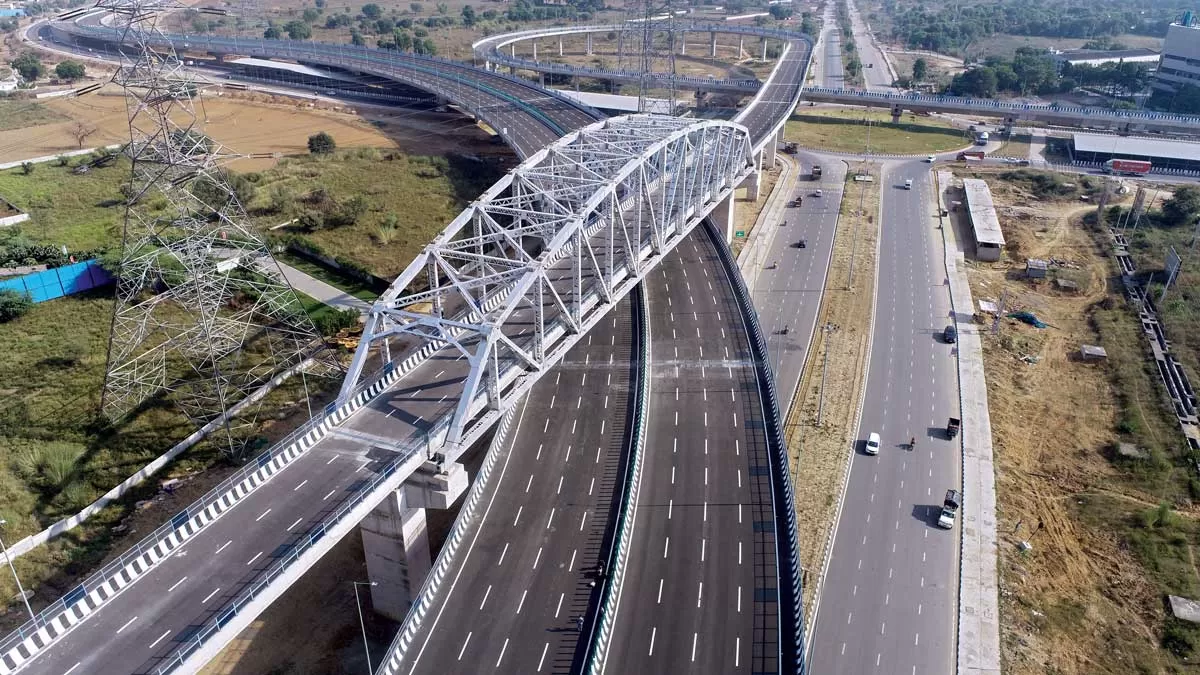
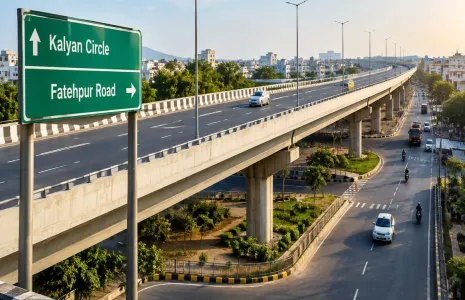
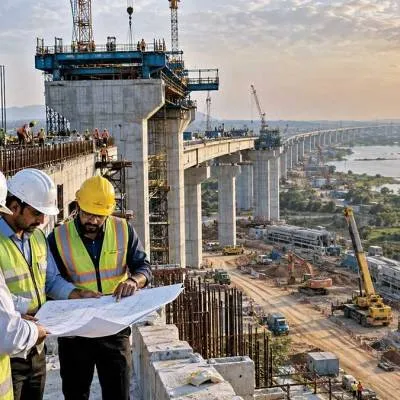
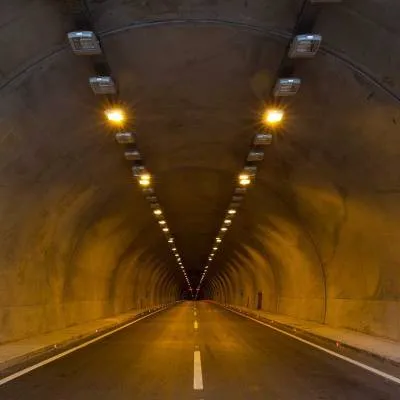
The Dwarka Expressway, the country’s first elevated urban expressway and the first single-pillar flyover with eight lanes, is a significant infrastructure project aimed at alleviating traffic congestion in Delhi. The 9-km-long and 34-m-wide elevated road represents a unique engineering feat – it also includes the country’s longest (3.6 km) and widest (eight-lane) urban road tunnel. This development is expected to enhance connectivity, reduce travel time and improve overall traffic flow in the region. In the expressway project, Package 3 (over 10 km) and Package 4 (over 8 km) were constructed by Larsen & Toubro (L&T). Also to gain an idea of its magnitude, for the total construction, it is estimated to have consumed 200,000 million tonne (mt) of steel (30 times the steel used in the Eiffel Tower) and 2 million cu m of concrete (six times the concrete used in the Burj Khalifa).
The longest bow spring
steel bridge
“The bow string steel bridge was constructed at Level 4 interchange and over an eight-lane wide expressway at a height of about 40 m,” says Manish Kumar Agarwal, Operation Head (North) – Roads, Bridges and Formation BU, Transportation Infrastructure IC, L&T. “The bridge has a high strength-to-weight ratio, making it robust with reduced maintenance needs. The lightweight nature of materials allows for longer spans without the need for extensive support structures, reducing construction cost and time. Its curved design enhances visual appeal and the efficient use of materials lower environmental impact and costs. Also, the design allows for slight movements and adjustments, which helps absorb stresses from traffic loads and environmental factors.”
Construction and design challenges
“Designing an elevated road with 34-metre width on a single pier is unprecedented in India, requiring innovative engineering solutions to ensure stability and load distribution,” he continues. The project required a thorough analysis of structural integrity, dynamic loads and environmental factors. “We collaborated with international experts who provided insights during the design phase.”
“Selecting and installing elastomeric bearings capable of supporting a vertical load of 1,700 mt and a horizontal load of 100 mt, while ensuring both flexibility and durability, posed a significant challenge,” says Agarwal. Thus, a meticulous evaluation of bearing specifications was carried out in consultation with industry experts. “We sourced the bearings from reputed manufacturers, including Hercules Malaysia and Mageba India, to guarantee both quality and adherence to safety standards.” The high-water table profile posed significant challenges for the design of the at-grade service road, vehicular underpasses (VUPs) and subways, particularly in terms of drainage and foundation stability. To address these complexities, tailored engineering solutions were required. “We incorporated effective drainage systems, employed
soil stabilisation techniques and ensured waterproofing of all underground structures.”
With limited space for diversion roads and existing traffic complicating logistics, the team implemented detailed planning, scheduled construction during night hours or off-peak times, and enforced effective traffic management to avoid mishaps. Proper diversion routes were created to regulate traffic flow
and traffic marshals were
deployed at key locations to
ensure smooth regulation.
He outlines other strategies to overcome major challenges:
Working at heights posed a safety risk for workers, necessitating the need for specialised equipment. So, the team ensured proper use of safety harnesses, scaffolding
and cranes, coupled with daily pep talks and frequent
safety workshops.
To maintain a consistent supply of quality materials, contracts were awarded to multiple suppliers after evaluating past performance to ensure a seamless supply chain.
Finding workers with specialised skills in pre-casting was a challenge. This was addressed through comprehensive training during induction and at frequent intervals, along with incentives to retain trained manpower.
The construction of a 120-m span cloverleaf crossing on
NH-8 required careful traffic management. Phased construction and advanced techniques such as pre-casting U-girders and using trestles for erection were implemented to minimise disruption. A comprehensive traffic management plan avoided congestion and ensured safety.
Material procurement issues
Agarwal details the extensive measures adopted to tackle material shortages:?
To meet the demand for 30 lakh metric tonne (lmt) of aggregates in three different fractions, daily coordination with transportation agencies was crucial. Materials were stockpiled well in advance to mitigate potential shortages caused by National Green Tribunal (NGT) bans on crusher operations and winter transportation restrictions.
Procuring 5.20 lmt of cement and 2 lmt of reinforcement steel was particularly difficult. Issues like the farmers’ protest and delays during COVID disrupted supply chains, but price volatility for HYSD steel was managed by maintaining adequate stock levels.
The procurement of bearings was critical as
most of the units were imported from Hercules, Malaysia. The team visited the factory in two batches to inspect the manufactured products, balancing cost and time efficiency.
Batch ordering was implemented based on
project milestones, which helped balance financial management and
resource availability. With restrictions on setting up hot-mix plants in the NCR, asphalt mix had to be sourced from outside. Strong relationships were established with reputable agencies, ensuring sufficient production capacity.
Supplier speak
“Our involvement in the supply and installation of noise barriers for the Dwarka Expressway was a significant achievement,” says Sachin Pratap, Director, Greenvent Acoustic. “In the design phase, ensuring compliance with the project’s stringent technical requirements took considerable effort. The approval process also presented hurdles, requiring multiple revisions and detailed clarifications. However, through collaboration and technical expertise, we overcame these obstacles. We also faced material storage challenges due to limited space and logistical difficulties, including delays in transportation. These issues were further compounded during the Kisan Andolan, which created disruptions in site access and affected timely execution. The installation phase involved managing onsite complexities, but our team was able to complete it efficiently. L&T’s support and coordination helped us
navigate the logistical barriers.”
“Our biggest hurdle was the product approval of bitumen and emulsions by NHAI. With the guidance and help of L&T’s teams, once we secured the approval it was smooth sailing,” says Harkamal Singh, Head - Sales and Marketing, Bitumen Corporation India. “As we have enough capacity to store and make the product, supply was not an issue. We have our own transport so we could supply the material even in the dead of night with a single call. The tough standard for bitumen and emulsions was a challenge but our R&D team made it. Another challenge was the unloading of emulsion tankers. We would send a helper with a special decanting pipe so that the product could be safely transferred to
L&T’s tanks. We delivered material on time, even when they needed 250 mt in one go.”
Green measures
A host of green measures were undertaken; Agarwal details some of them. First, the green steps taken during construction:
Renewable energy: Solar light masts were installed to illuminate the site. For the permanent works, solar blinkers were placed at all locations.
Green materials: 90,000 mt of fly ash was used in concrete production. Additionally, about 8,000 mt
of recycled material replaced
20 mm aggregate in
concrete production.
Reuse of granular subbase (GSB): About 49,000 mt of GSB extracted from existing roads was reused. The reused material was processed to remove contaminants and blended with fresh material to meet design specifications.
Repurposing concrete waste: Approximately 11,000 cu m of concrete
waste from the dismantled precast yard was reused in embankment construction.
Next, mitigating air and noise pollution:
To reduce emissions: The project relied on electrical power (EB) to run plants and fixed equipment, reducing diesel emissions by 820 kl.
Dust control: Water sprinkling tankers and defoggers on trucks were employed to control airborne dust during construction. Compressed natural gas (CNG) fitted
hauling equipment was used
to shift materials, further reducing emissions.
Tree plantation, noise barriers: To improve air quality,
55,000 trees were planted
along the project stretch. Further, 30.6 km of noise barriers were installed on both sides of the elevated road.
Finally, measures for disposal and recycling of construction and demolition (C&D) waste were implemented as follows:
Recycling facilities: Partnerships with local recycling facilities ensured that concrete and metal were recycled instead of ending up in landfills.
Carbon footprint reduction: The use of 30,000 tonne of recycled C&D waste significantly reduced
the carbon footprint. By using recycled materials instead of sourcing new ones, the project avoided the emissions associated with the production of
new concrete.
Emission savings: By replacing 30,000 tonne of new concrete with recycled materials, the project avoided about 27,000 tonne of CO2 emissions.
- R SRINIVASAN