

+
Three WOLFF Cranes Build Riyadh Cable-Stayed Bridges
Equipment

Three WOLFF Cranes Build Riyadh Cable-Stayed Bridges

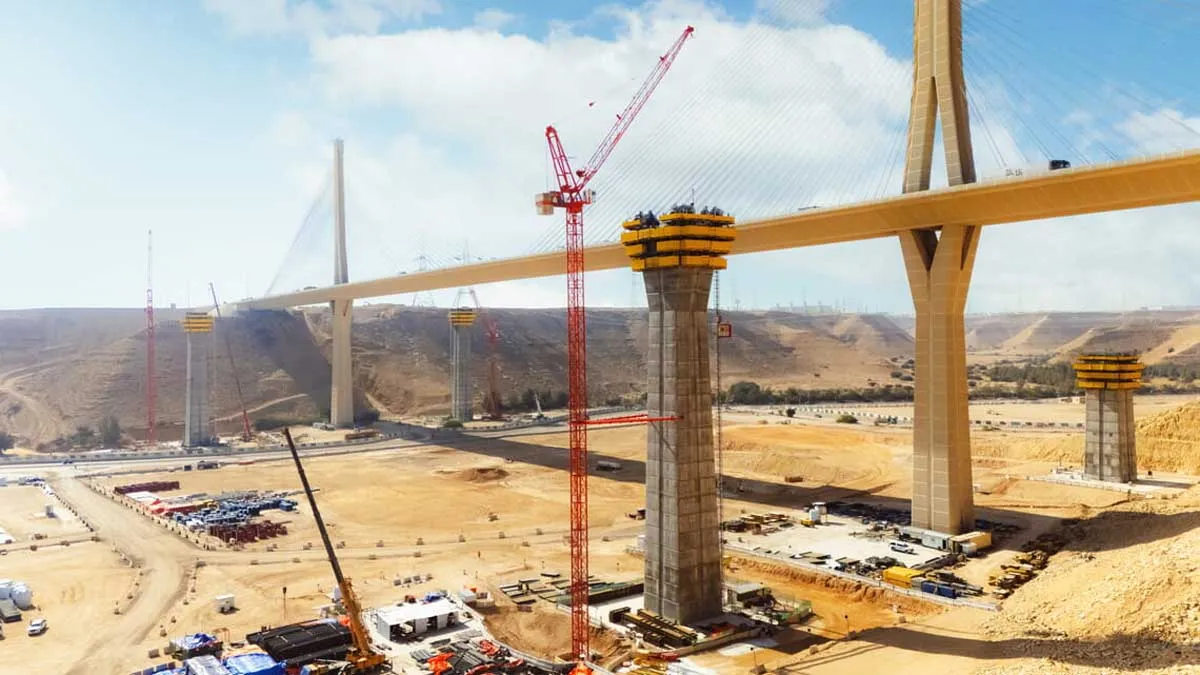
Three WOLFF 180 B luffing jib cranes are supporting the construction of two cable-stayed bridges alongside the existing Wadi Laban Bridge in Riyadh, Saudi Arabia. The project is being developed for the Royal Commission for Riyadh City and executed by the ICRC joint venture comprising IC Ictas and Al Rashid Trading & Contracting Company.

The cranes are handling lifting operations including formwork, reinforcement, concrete placement, work platforms, surveying equipment and other construction materials. Each crane is fitted with a 40 m jib, reaches a hook height of 157 m and offers a maximum lifting capacity of 18 tonnes.

The equipment is being used to construct four bridge pylons reaching approximately 170 m in height. A key challenge involved simultaneously repositioning stacked working platforms while changing formwork between pylon sections, requiring the cranes to operate at their maximum lifting capacity.

As construction progresses, the cranes will also lift support beams weighing up to 12 tonnes for concreting the pylon heads. The three cranes were assembled using mobile cranes in 2025 and are expected to remain operational at the site until 2027.

Once completed, each cable-stayed bridge will measure approximately 763 m in length, feature a 405 m main span and have a width of around 35 m. The bridges will accommodate eight traffic lanes, increasing capacity along an important arterial route in Riyadh.

The development forms part of the Main and Ring Road Axes Development Programme, which aims to expand and improve the Saudi capital’s primary transport corridors.

Three WOLFF 180 B luffing jib cranes are supporting the construction of two cable-stayed bridges alongside the existing Wadi Laban Bridge in Riyadh, Saudi Arabia. The project is being developed for the Royal Commission for Riyadh City and executed by the ICRC joint venture comprising IC Ictas and Al Rashid Trading & Contracting Company.The cranes are handling lifting operations including formwork, reinforcement, concrete placement, work platforms, surveying equipment and other construction materials. Each crane is fitted with a 40 m jib, reaches a hook height of 157 m and offers a maximum lifting capacity of 18 tonnes.The equipment is being used to construct four bridge pylons reaching approximately 170 m in height. A key challenge involved simultaneously repositioning stacked working platforms while changing formwork between pylon sections, requiring the cranes to operate at their maximum lifting capacity.As construction progresses, the cranes will also lift support beams weighing up to 12 tonnes for concreting the pylon heads. The three cranes were assembled using mobile cranes in 2025 and are expected to remain operational at the site until 2027.Once completed, each cable-stayed bridge will measure approximately 763 m in length, feature a 405 m main span and have a width of around 35 m. The bridges will accommodate eight traffic lanes, increasing capacity along an important arterial route in Riyadh.The development forms part of the Main and Ring Road Axes Development Programme, which aims to expand and improve the Saudi capital’s primary transport corridors.

Related Stories

Gold Stories
Next Story
Real Estate

The Energy-Smart Buildings

Passive design is an integral part of energy-efficient architecture. Sophisticated building systems also contribute to this end. But what role do materials play in enhancing a building’s energy-efficiency?“Material selection is one of the earliest opportunities to influence how a building performs,” says Tejbeer Singh, Principal Architect & Founder, Expressionist by Tejbeer Singh. “The objective is not simply to select materials that look appropriate but to understand how they behave within the climate and construction system.”To read the full article Click Here ..

Next Story
Infrastructure Transport

When the Lowest Bid Comes at a Cost

India's infrastructure sector is building at a scale few markets can match. New highways, expressways, metros, bridges and complex engineering projects are transforming the country's landscape. Yet, behind this rapid expansion is a growing concern within the contracting community: Can infrastructure be delivered sustainably when competition pushes prices below commercially viable levels?For Praveen Sethia, Founder & Director, Infra Advisors, who moderated the discussion, the question goes beyond the contractor's commercial interests. Contractors may be one of the two parties to a contract,..

Next Story
Real Estate

Ultra-Luxury Projects Reshape Gurugram’s Housing Market

Gurugram’s luxury housing market has expanded beyond its traditional prime locations, with corridors such as Dwarka Expressway and Golf Course Extension Road emerging as key centres for premium residential development. Larger homes, integrated developments and amenity-led communities are attracting demand from end-users and investors.A 2025 report by Sotheby’s International Realty in collaboration with CRE Matrix identified Gurugram as India’s fastest-growing ultra-luxury housing market. The city overtook Mumbai in total sales value for homes priced above Rs 10 crore, recording nearly Rs..

Advertisement

Subscribe to Our Newsletter

Get daily newsletters around different themes from Construction world.

STAY CONNECTED

Advertisement

SPECIAL OFFER
QR Code