




+
Bitumen Price Hike Raises Ludhiana Road Costs
ECONOMY & POLICY

Bitumen Price Hike Raises Ludhiana Road Costs

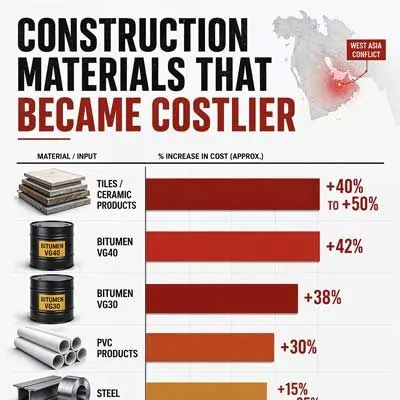
The municipal corporation (MC) in Ludhiana has said that a sharp rise in bitumen prices following supply disruptions linked to the conflict in West Asia has increased road construction and repair costs by nearly 50 per cent, placing additional strain on the cash-strapped civic body. Municipal officials reported that the price of bitumen has risen from about Rs 50 per kilogram (kg) to roughly Rs 75 per kg, substantially escalating costs for ongoing and upcoming projects. The rise follows supply disruptions and has compounded delays already affecting the delivery of works.

The superintendent engineer for buildings and roads, Sham Lal Gupta, said every project involving bitumen would be affected and that the increase will push up project costs across the city. Under existing contract conditions, the municipal corporation must compensate contractors for increases in the prices of essential construction materials if the escalation occurs within six months of the issuance of a work order, adding to expenditure. That clause has heightened the financial exposure of the civic body.

The development coincides with delays in fund releases for development works. Although the finance department sanctioned Rs 560 million (mn) in April, officials said only the first tranche of Rs 130 million (mn) was released in late May after considerable delay, stalling projects such as the reconstruction of Gill Road and blacktopping work on Jagraon Bridge for more than a month. Contractors have since submitted fresh bills totalling around Rs 80 million (mn), but payments remain pending as the civic body awaits further releases.

A shortage of bitumen had earlier delayed blacktopping of roads dug up under the 24x7 surface water supply project; while excavation was completed in several areas in January, resurfacing work could begin only in May because material availability was limited. Municipal officials warned that if the supply situation does not improve, further projects may face additional delays and cost escalations. The combination of material price shocks and constrained fund flows has increased pressure on the municipal corporation's ability to deliver scheduled works.

The municipal corporation (MC) in Ludhiana has said that a sharp rise in bitumen prices following supply disruptions linked to the conflict in West Asia has increased road construction and repair costs by nearly 50 per cent, placing additional strain on the cash-strapped civic body. Municipal officials reported that the price of bitumen has risen from about Rs 50 per kilogram (kg) to roughly Rs 75 per kg, substantially escalating costs for ongoing and upcoming projects. The rise follows supply disruptions and has compounded delays already affecting the delivery of works. The superintendent engineer for buildings and roads, Sham Lal Gupta, said every project involving bitumen would be affected and that the increase will push up project costs across the city. Under existing contract conditions, the municipal corporation must compensate contractors for increases in the prices of essential construction materials if the escalation occurs within six months of the issuance of a work order, adding to expenditure. That clause has heightened the financial exposure of the civic body. The development coincides with delays in fund releases for development works. Although the finance department sanctioned Rs 560 million (mn) in April, officials said only the first tranche of Rs 130 million (mn) was released in late May after considerable delay, stalling projects such as the reconstruction of Gill Road and blacktopping work on Jagraon Bridge for more than a month. Contractors have since submitted fresh bills totalling around Rs 80 million (mn), but payments remain pending as the civic body awaits further releases. A shortage of bitumen had earlier delayed blacktopping of roads dug up under the 24x7 surface water supply project; while excavation was completed in several areas in January, resurfacing work could begin only in May because material availability was limited. Municipal officials warned that if the supply situation does not improve, further projects may face additional delays and cost escalations. The combination of material price shocks and constrained fund flows has increased pressure on the municipal corporation's ability to deliver scheduled works.

Related Stories

Gold Stories
Next Story
Infrastructure Urban

KONE Opens India's First Digital Experience Centre in Pune

KONE, a global elevator and escalator manufacturer, has inaugurated its first Digital Experience Centre (DEC) in India, located in Pune. The facility aims to showcase how artificial intelligence (AI), connectivity and data-driven technologies can enhance customer experiences and improve building operations.The centre was inaugurated by Jussi Herlin, Executive Vice Chair, KONE Corporation; Philippe Delorme, President and CEO, KONE; and Nandan Nilekani, Co-founder and Chairman of the Board, Infosys.Designed as an interactive customer environment, the facility demonstrates digital solutions cover..

Next Story
Infrastructure Urban

CII GreenCo Launches Circularity Guidelines for Indian Industry

The Confederation of Indian Industry (CII) GreenCo Council has launched the CII GreenCo Circularity Guidelines – Pilot Version at the 17th CII GreenCo Waste & Resource Management Summit 2026 in Chennai. The initiative aims to strengthen resource efficiency, waste reduction and circular economy practices across Indian manufacturing and process industries.The guidelines introduce a structured framework with circularity indices covering raw materials, consumables, packaging and other resource inputs. These indicators will help industries assess existing practices, identify opportunities to ..

Next Story
Infrastructure Energy

Global Electronics Association Launches IPC-1783-CO2E Standard

The Global Electronics Association has introduced IPC-1783-CO2E, a new international standard aimed at improving consistency, transparency and comparability in product carbon footprint reporting across the electronics manufacturing industry.The standard, titled International Standard for Data Collection and Reporting of CO2 Equivalent (CO2e) Emissions for the Electronics Manufacturing Supply Chain, provides industry-specific guidance for collecting, estimating and reporting carbon emissions data.With increasing regulatory requirements and customer expectations, electronics manufacturers face c..

Advertisement

Subscribe to Our Newsletter

Get daily newsletters around different themes from Construction world.

STAY CONNECTED

Advertisement

SPECIAL OFFER
QR Code