
Delhi Plans 200-km Ridge Yamuna Green Blue Network
ECONOMY & POLICY

Delhi Plans 200-km Ridge Yamuna Green Blue Network

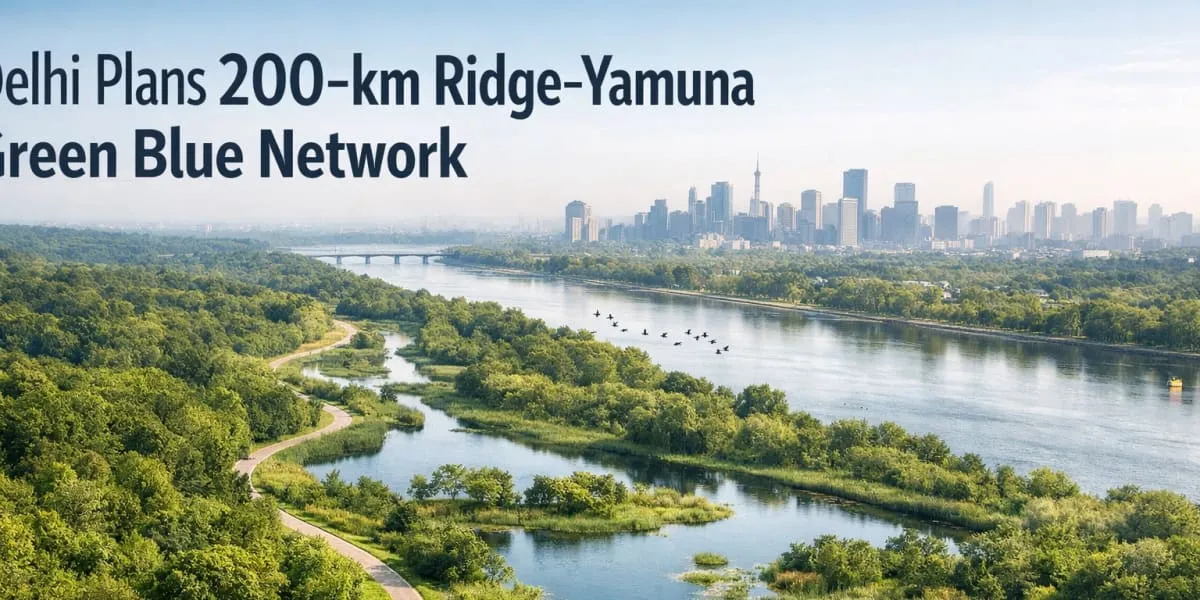
Delhi's Master Plan 2047 sets out a green-blue ecological network linking the Ridge to the Yamuna with an integrated 200-km connector. The plan notes nearly 22 per cent of the National Capital Territory is under green cover and that the Ridge, as reserved forest, covers about 7,784 hectares, or nearly six per cent. The city has 26 protected forests totalling about 1,658 hectares, more than 18,000 parks and gardens, seven biodiversity parks and 746 parks maintained by the Delhi Development Authority covering 6,830 hectares.

The document groups assets into a green-blue framework, with blue elements comprising the Yamuna, wetlands, lakes and a network of natural and constructed drains across key basins. It proposes a three-pronged strategy to preserve and improve existing natural assets, create new green-blue assets and introduce such features into the built environment. The plan says the strategy is aimed at richer biodiversity, lower temperatures, reduced flooding and pollution and improved climate resilience.

Yamuna restoration is central, with the 22-km Wazirabad–Okhla stretch identified as a priority since it contributes about 76 per cent of the river’s pollution load while representing less than two per cent of its length. The plan records no freshwater flow downstream of Wazirabad during the dry season and states the river receives treated and untreated wastewater through drains. It outlines 13 projects across 1,700 hectares of floodplain to restore wetlands, create riverine forests and grasslands and enhance groundwater recharge, designating the active floodplain a no construction zone with limited recreational uses.

To improve water quality the plan proposes intercepting and treating all 22 drains that discharge into the Yamuna through sewage treatment, constructed wetlands and bioremediation and integrating those corridors with green spaces and floodplains to form continuous ecological corridors. A key connectivity proposal is a Ridge–Yamuna Park Connector envisaging a 200-km cycling network including a 52-km floodplain stretch and a 75–100 metre public greenway with trails and activity spaces. The strategy also promotes green buffers, bioswales, urban and micro forests, community gardens and repurposing under-used sites while favouring indigenous species and monitoring.

Delhi's Master Plan 2047 sets out a green-blue ecological network linking the Ridge to the Yamuna with an integrated 200-km connector. The plan notes nearly 22 per cent of the National Capital Territory is under green cover and that the Ridge, as reserved forest, covers about 7,784 hectares, or nearly six per cent. The city has 26 protected forests totalling about 1,658 hectares, more than 18,000 parks and gardens, seven biodiversity parks and 746 parks maintained by the Delhi Development Authority covering 6,830 hectares. The document groups assets into a green-blue framework, with blue elements comprising the Yamuna, wetlands, lakes and a network of natural and constructed drains across key basins. It proposes a three-pronged strategy to preserve and improve existing natural assets, create new green-blue assets and introduce such features into the built environment. The plan says the strategy is aimed at richer biodiversity, lower temperatures, reduced flooding and pollution and improved climate resilience. Yamuna restoration is central, with the 22-km Wazirabad–Okhla stretch identified as a priority since it contributes about 76 per cent of the river’s pollution load while representing less than two per cent of its length. The plan records no freshwater flow downstream of Wazirabad during the dry season and states the river receives treated and untreated wastewater through drains. It outlines 13 projects across 1,700 hectares of floodplain to restore wetlands, create riverine forests and grasslands and enhance groundwater recharge, designating the active floodplain a no construction zone with limited recreational uses. To improve water quality the plan proposes intercepting and treating all 22 drains that discharge into the Yamuna through sewage treatment, constructed wetlands and bioremediation and integrating those corridors with green spaces and floodplains to form continuous ecological corridors. A key connectivity proposal is a Ridge–Yamuna Park Connector envisaging a 200-km cycling network including a 52-km floodplain stretch and a 75–100 metre public greenway with trails and activity spaces. The strategy also promotes green buffers, bioswales, urban and micro forests, community gardens and repurposing under-used sites while favouring indigenous species and monitoring.

Related Stories

Gold Stories
Next Story
Infrastructure Urban

Bengaluru Metro Awards Rs 554.8 mn Travellator Contract

Bengaluru Metro Rail Corporation (BMRCL) has awarded a Rs 55.48 crore (Rs 554.8 million (mn)) contract to Milan Road Buildtech LLP for civil and structural works to install a travellator and a connecting walkway at Central Silk Board. The contract covers design, construction and structural interfaces required to link the two adjacent metro stations. BMRCL authorised the award as part of procurement for infrastructure works on the Phase-2A project. The procurement followed BMRCL's standard tendering and evaluation procedures. The project will connect the Yellow Line Central Silk Board station w..

Next Story
Infrastructure Transport

GMRC Floats Tenders For Ahmedabad Metro RRTS Hybrid Corridors

Gujarat Metro Rail Corporation (GMRC) has floated three tenders for design consultancy services for the Ahmedabad Metro Phase three Metro cum Regional Rapid Transit System (RRTS) hybrid corridor. The procurements cover work on an additional network of 48.38 kilometre (km) to be integrated into the existing metro system. GMRC framed the tenders to secure specialised consultancy for alignment design, systems integration and coordination with RRTS planning. The consultancy scope will support detailed design and interface management for the hybrid corridors. The proposed hybrid routes include Vaki..

Next Story
Infrastructure Transport

Pune Metro Groundwork Starts on Swargate Katraj Underground Line

Construction work has begun on Pune Metro’s underground extension from Swargate to Katraj, with excavation starting at the busy Market Yard station. MLA Madhuri Misal inaugurated the excavation and inspected activities along the corridor. Maha Metro has commenced digging shafts to lower Tunnel Boring Machines (TBMs) into the ground and intends to deploy four TBMs gradually over the next few months. Station building and tunnelling will proceed simultaneously to streamline the schedule. Because the entire line is underground, authorities expect traffic disruption to be minimal and road space w..

Advertisement

Subscribe to Our Newsletter

Get daily newsletters around different themes from Construction world.

STAY CONNECTED

Advertisement