DoT, UNDP Push Circular Economy In Telecom Sector
ECONOMY & POLICY

DoT, UNDP Push Circular Economy In Telecom Sector

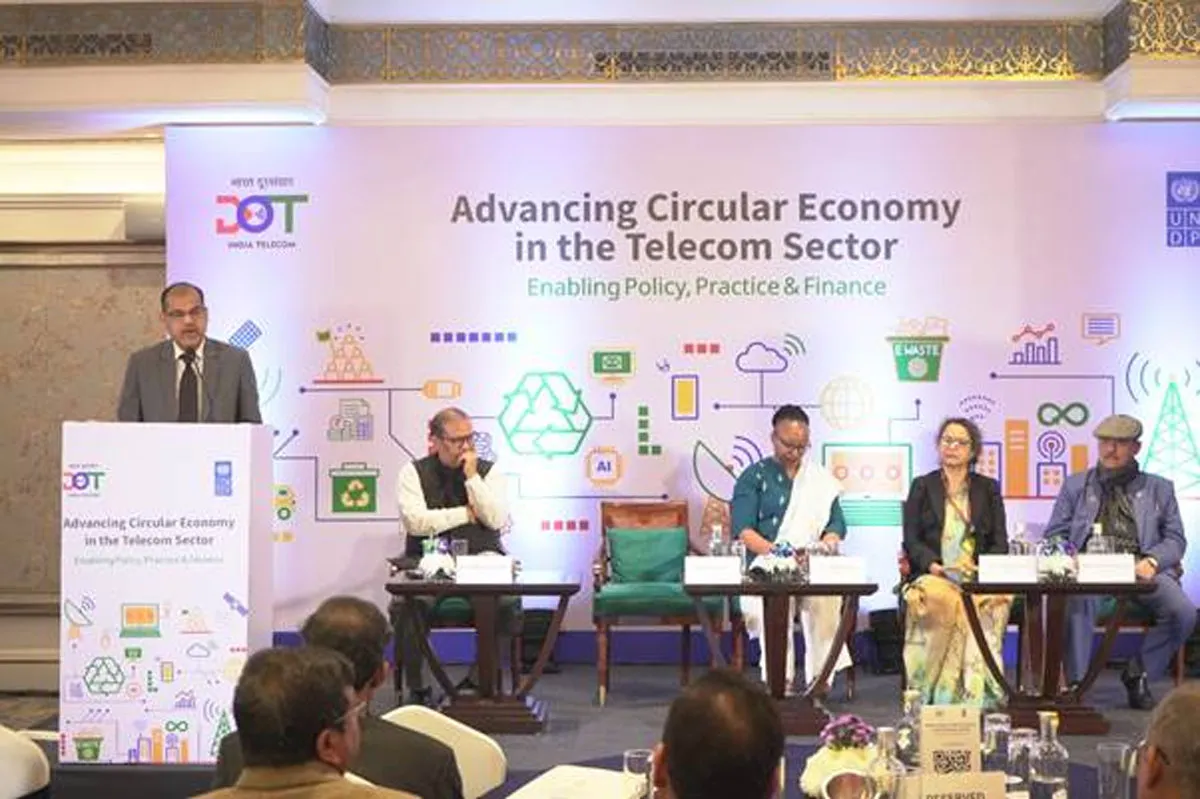
The Department of Telecommunications, Ministry of Communications, in partnership with the United Nations Development Programme, organised a national workshop titled “Advancing Circular Economy in the Telecom Sector: Enabling Policy & Practice” in New Delhi, bringing together policymakers, industry leaders, technology providers, academia, international organisations and value-chain stakeholders to accelerate the adoption of circular economy practices in India’s telecom sector. The workshop focused on identifying actionable pathways to embed circularity across the telecom value chain, including sustainable product design, efficient resource use, lifecycle management, digital tools and financing mechanisms, while aligning policy frameworks, industry practices and technology solutions to enhance long-term sustainability and sectoral resilience.

The inaugural session was moderated by Dr Shilpi Karmakar, Project Manager at UNDP, with welcome remarks and context-setting by Dr Ashish Chaturvedi, Head – ACE, UNDP. Addresses were delivered by Ms Sunita Verma, Scientist ‘G’ at the Ministry of Electronics and Information Technology, Shri Kamendra Kumar, former Director of TCIL and Chairman of Tamil Nadu Telecom Limited, and Dr Angela Lusigi, UNDP Resident Representative, who highlighted the importance of multi-stakeholder collaboration. Delivering the keynote address, Shri R N Palai, Member (Technology), Digital Communications Commission and ex-officio Secretary to the Government of India at DoT, said sustainability and circularity are now strategic imperatives for the telecom sector. He noted that while telecom contributes less than two per cent of India’s greenhouse gas emissions, its reach across nearly 1.2 billion users places a responsibility on the sector to lead in environmentally responsible practices.

Shri Palai described telecom as the invisible infrastructure underpinning the modern economy and a key enabler of climate action by improving efficiency and reducing emissions across sectors. While renewable energy adoption in telecom networks is becoming standard, he stressed that sustainability must extend across the entire lifecycle of telecom products and infrastructure, including e-waste management, right-to-repair and sustainable design, calling for a shift away from the traditional use-and-discard model towards regenerative and resource-efficient systems aligned with national sustainability goals. Dr Angela Lusigi underlined UNDP’s close engagement with the Government of India in advancing circular economy transitions and highlighted its support to DoT in preparing a Circular Economy Plan for the telecom sector, urging stakeholders to develop a time-bound roadmap supported by clear policy frameworks, industry commitment, innovation, investment and strong accountability mechanisms.

A key highlight was a presentation by Shri Arun Agarwal, Deputy Director General (Satellite), DoT, outlining the Circular Economy Action Plan for the Indian telecom sector. The presentation detailed policy directions and practical interventions covering sustainable design and manufacturing, lifecycle management of telecom assets, reduction of e-waste, adoption of digital tracking systems and strengthening transparent and resilient supply chains. Technical deliberations included a panel discussion on rethinking the telecom supply chain for circularity and sustainability, which examined government initiatives, policy challenges, design for circularity, sustainable procurement and existing industry practices. This was followed by a session on digital tools for the transition towards a circular economy, focusing on the use of digital platforms, blockchain-based traceability, data analytics, artificial intelligence and the Internet of Things to improve material recovery, transparency and extended producer responsibility implementation.

In the concluding session, participants stressed the need to move from dialogue to implementation, highlighting that circularity must be driven through coordinated ecosystem-level action supported by scalable and sustainable business models. Emphasis was placed on creating enabling frameworks, strengthening multi-stakeholder collaboration platforms, prioritising pilot-to-scale pathways and shared ownership, with government providing direction, industry driving innovation and partners supporting implementation, capacity building and financing. The workshop concluded with a shared commitment by DoT, UNDP and stakeholders to deepen collaboration and accelerate the transition towards a more circular, sustainable and resilient telecom sector in India.

The Department of Telecommunications, Ministry of Communications, in partnership with the United Nations Development Programme, organised a national workshop titled “Advancing Circular Economy in the Telecom Sector: Enabling Policy & Practice” in New Delhi, bringing together policymakers, industry leaders, technology providers, academia, international organisations and value-chain stakeholders to accelerate the adoption of circular economy practices in India’s telecom sector. The workshop focused on identifying actionable pathways to embed circularity across the telecom value chain, including sustainable product design, efficient resource use, lifecycle management, digital tools and financing mechanisms, while aligning policy frameworks, industry practices and technology solutions to enhance long-term sustainability and sectoral resilience. The inaugural session was moderated by Dr Shilpi Karmakar, Project Manager at UNDP, with welcome remarks and context-setting by Dr Ashish Chaturvedi, Head – ACE, UNDP. Addresses were delivered by Ms Sunita Verma, Scientist ‘G’ at the Ministry of Electronics and Information Technology, Shri Kamendra Kumar, former Director of TCIL and Chairman of Tamil Nadu Telecom Limited, and Dr Angela Lusigi, UNDP Resident Representative, who highlighted the importance of multi-stakeholder collaboration. Delivering the keynote address, Shri R N Palai, Member (Technology), Digital Communications Commission and ex-officio Secretary to the Government of India at DoT, said sustainability and circularity are now strategic imperatives for the telecom sector. He noted that while telecom contributes less than two per cent of India’s greenhouse gas emissions, its reach across nearly 1.2 billion users places a responsibility on the sector to lead in environmentally responsible practices. Shri Palai described telecom as the invisible infrastructure underpinning the modern economy and a key enabler of climate action by improving efficiency and reducing emissions across sectors. While renewable energy adoption in telecom networks is becoming standard, he stressed that sustainability must extend across the entire lifecycle of telecom products and infrastructure, including e-waste management, right-to-repair and sustainable design, calling for a shift away from the traditional use-and-discard model towards regenerative and resource-efficient systems aligned with national sustainability goals. Dr Angela Lusigi underlined UNDP’s close engagement with the Government of India in advancing circular economy transitions and highlighted its support to DoT in preparing a Circular Economy Plan for the telecom sector, urging stakeholders to develop a time-bound roadmap supported by clear policy frameworks, industry commitment, innovation, investment and strong accountability mechanisms. A key highlight was a presentation by Shri Arun Agarwal, Deputy Director General (Satellite), DoT, outlining the Circular Economy Action Plan for the Indian telecom sector. The presentation detailed policy directions and practical interventions covering sustainable design and manufacturing, lifecycle management of telecom assets, reduction of e-waste, adoption of digital tracking systems and strengthening transparent and resilient supply chains. Technical deliberations included a panel discussion on rethinking the telecom supply chain for circularity and sustainability, which examined government initiatives, policy challenges, design for circularity, sustainable procurement and existing industry practices. This was followed by a session on digital tools for the transition towards a circular economy, focusing on the use of digital platforms, blockchain-based traceability, data analytics, artificial intelligence and the Internet of Things to improve material recovery, transparency and extended producer responsibility implementation. In the concluding session, participants stressed the need to move from dialogue to implementation, highlighting that circularity must be driven through coordinated ecosystem-level action supported by scalable and sustainable business models. Emphasis was placed on creating enabling frameworks, strengthening multi-stakeholder collaboration platforms, prioritising pilot-to-scale pathways and shared ownership, with government providing direction, industry driving innovation and partners supporting implementation, capacity building and financing. The workshop concluded with a shared commitment by DoT, UNDP and stakeholders to deepen collaboration and accelerate the transition towards a more circular, sustainable and resilient telecom sector in India.

Next Story
Real Estate

Modon, Related, Panepinto form JV for Harborside 4 in Jersey City

Abu Dhabi-based Modon Holding PSC has formed a joint venture with US real estate major Related Companies and Jersey City-based Panepinto Properties to develop Harborside 4, a 54-storey luxury residential tower on a prime waterfront site in downtown Jersey City, New Jersey.Under the partnership, Modon will hold a majority equity stake alongside Related and Panepinto, marking another step in the group’s strategy to scale and diversify its global real estate portfolio. The project will be developed on one of the last remaining premium waterfront parcels in the city.Designed by Handel Architects..

Next Story
Infrastructure Urban

P+Ex and Post-Tensioning Institute partner to drive sustainability

P+Ex, the Center of Excellence for Concrete Preservation and Service Life Extension, has announced a strategic partnership with the Post-Tensioning Institute (PTI) aimed at advancing sustainability, durability, and resilience in the built environment.The collaboration brings together P+Ex’s expertise in concrete preservation, repair, and service life extension with PTI’s global leadership in post-tensioning technology. Through this alliance, the two organisations will work to advance best practices in durability-focused design for new structures, while also promoting effective repair, reha..

Next Story
Infrastructure Energy

India’s Largest 2,000 MW Subansiri Hydro Project Turns Operational

India’s largest hydropower project, the 2,000 MW Subansiri Lower Hydroelectric Project, has finally become operational with the commissioning of its first unit, marking a major milestone after nearly 20 years of development marked by delays, protests and cost escalation.The 250 MW Unit-2 of the project, located on the Subansiri River at Gerukamukh on the Assam–Arunachal Pradesh border, was virtually inaugurated from New Delhi by Union Minister of Power Manohar Lal Khattar. The event was attended by Pankaj Agarwal, Secretary (Power), and Bhupender Gupta, Chairman and Managing Director, Nati..

Advertisement

Subscribe to Our Newsletter

Get daily newsletters around different themes from Construction world.

STAY CONNECTED

Advertisement

Advertisement

Advertisement

Advertisement

Open In App